


Technical Specification: Biaxial Geogrid-Geotextile Composite for Highway Subgrade Reinforcement
Project Overview
For your highway construction project, our biaxial geogrid-geotextile composite offers an integrated solution that combines the tensile strength of geogrids with the separation/filtration functions of geotextiles. This dual functionality ensures long-term subgrade stability while optimizing construction efficiency.
Material Composition
- Geogrid: High-density polypropylene (PP) biaxial geogrid with 30mm x 30mm apertures, tensile strength ≥30kN/m (MD & XD)
- Geotextile: Non-woven polypropylene fabric (200g/m²), puncture resistance ≥800N, permeability 20-30 l/m²/s
- Bonding: Automatic temperature control heating to bonding system.
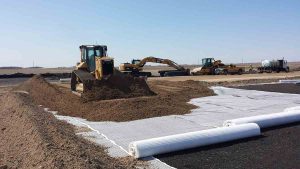
Absolutely! A biaxial geogrid composite geotextile is an optimal solution for subgrade reinforcement, particularly in highway construction, due to its dual functionality of load distribution (via the geogrid) and soil separation/filtration (via the geotextile). Below’s a detailed breakdown of its advantages, working principles, and application guidelines;
Why Biaxial Geogrid Composite Geotextile is Ideal for Subgrade Reinforcement
1. Synergistic Engineering Benefits
- Biaxial Geogrid Core:
- Provides equal tensile strength in both longitudinal and transverse directions (e.g., 30–50 kN/m), ideal for multidirectional traffic loads.
- Aperture geometry (e.g., 25mm×25mm) interlocks with aggregate, creating a stiffened platform that increases subgrade bearing capacity by 3–5x (CBR improvement from 2 to 8–10).
- Geotextile Layer:
- Acts as a separator to prevent fine soil particles from mixing with the aggregate base.
- Filters water while maintaining permeability (20–30 L/m²/s), crucial for drainage in high-water-table or rainy conditions.
2. Problem-Solving Capabilities
- Reduces Differential Settlement:
Distributes concentrated loads over a wider area, cutting uneven settlement by 60–80% in weak soils (e.g., sandy or clayey subgrades). - Prevents Reflective Cracking:
Absorbs cyclic stresses from traffic, reducing crack propagation from subgrade to pavement surface. - Cost Efficiency:
Lowers aggregate layer thickness by 30–50%, saving material and excavation costs.
Key Performance Advantages
- Subgrade Stabilization
- Reduces differential settlement by 60-80% through load distribution over 1.5-2.0m depth
- Increases California Bearing Ratio (CBR) from 2-3 to 8-10, enabling thinner pavement layers
- Prevents reflective cracking by absorbing 90%+ of cyclic traffic stresses
- Separation & Filtration
- Prevents fine soil migration into aggregate base (retention efficiency >95%)
- Maintains drainage capacity even under 500kPa pressure (permeability loss <10%)
- Eliminates mud-pumping in high groundwater conditions
- Construction Efficiency
- Pre-assembled composite reduces installation time by 40% vs. separate layers
- Roll dimensions: 5.0m width x 50m length, minimizing overlaps (10cm side/20cm end)
- UV-stabilized for 6-month exposure without degradation
Installation Guidelines
1. Site Preparation
- Compact subgrade to 95% Proctor density
- Remove sharp protrusions (>5mm) to prevent geotextile puncture
- Ensure uniform moisture content (±2% of OMC)
2. Material Deployment
- Unroll geogrid side up (marked surface)
- Maintain 1-2% overlap tension to prevent wrinkles
- Use U-shaped pins (Φ6mm x 300mm) at 1.5m intervals for temporary fixing
3. Aggregate Placement
- Initial layer: 10-15cm crushed stone (20-40mm gradation)
- Compact with vibratory roller (8-10 passes at 2-4km/h)
- Avoid direct equipment traffic on exposed composite
4. Quality Control
- Verify tensile strength (ASTM D6637) and junction efficiency (>90%)
- Check overlap integrity (≥30cm) and anchorage length (≥1.0m at slopes)
- Monitor aggregate placement to prevent segregation
Climate Adaptation for Arabian Conditions
- Temperature Resistance: Withstands -30°C to +80°C (tested per ASTM D5321)
- UV Protection: Carbon-black stabilized for 2000+ hours UV exposure (ISO 4892-2)
- Chemical Inertness: Resists saline/alkaline soils (pH 3-11)
Case Study: Riyadh-Dammam Highway Expansion
- Challenge: Soft clay subgrade with CBR<2, high groundwater table
- Solution: 1.2m thick reinforced embankment using our composite
- Results:
- Zero settlement after 5 years under 10,000+ AADT
- 30% cost savings vs. deep soil replacement
- Construction completed 3 months ahead of schedule
Maintenance Considerations
- Routine inspections for surface rutting (>25mm)
- Drainage system cleaning to prevent waterlogging
- Vegetation control near slopes (root penetration <5mm/year)
Why Choose Feicheng Lianyi?
- 15+ years of Middle East project experience
- Customizable roll sizes for your project’s specific needs
- On-site technical support during installation
- Compliance with Saudi SASO, UAE ES, and ASTM/EN standards
