





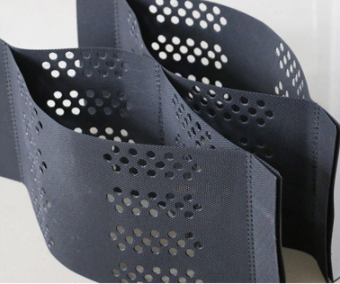


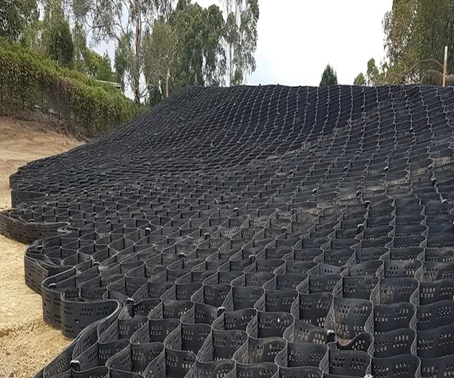

HDPE (High-Density Polyethylene) geocells are three-dimensional honeycomb-like structures used for soil stabilization, erosion control, and load support. They are highly effective in various civil engineering applications due to their durability, flexibility, and load-distribution properties. Here’s an overview of HDPE geocells:
Mechanical Properties
- Tensile Strength: High tensile strength, ensuring durability and long-term performance
- Elasticity: Flexible enough to conform to various ground surfaces while maintaining structural integrity
- Load Distribution: Efficiently distributes loads, reducing pressure on the underlying soil
Durability and Environmental Resistance
- Chemical Resistance: Resistant to a wide range of chemicals, including acids, alkalis, and salts
- UV Resistance: High resistance to UV degradation, ensuring long-term performance even in direct sunlight
- Temperature Stability: Effective in a wide range of temperatures, typically from -60°C to +60°C
- Abrasion Resistance: Resistant to wear and tear from mechanical stresses
Benefits
- Load Support: Enhances load-bearing capacity of weak soils, making it ideal for roads, parking lots, and airport runways
- Erosion Control: Prevents soil erosion on slopes, riverbanks, and coastal areas
- Vegetation Support: Perforations allow for root growth, making it suitable for vegetated retaining walls and green roofs
- Flexibility: Easily conforms to ground contours, providing stability on uneven surfaces
- Installation Efficiency: Lightweight and easy to transport, handle, and install
Applications
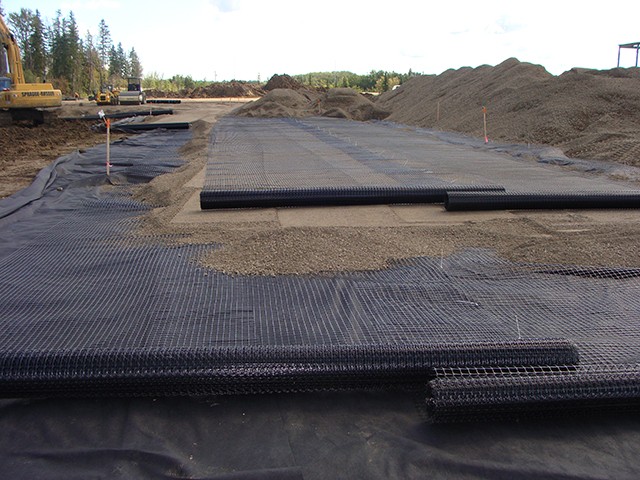
- Road and Pavement Reinforcement: Used to stabilize subgrades and prevent rutting in roads and pavements
- Slope and Channel Protection: Prevents erosion on slopes, riverbanks, and channels
- Retaining Walls: Used to construct gravity and mechanically stabilized earth retaining walls
- Load Support: Enhances load-bearing capacity in areas with poor soil conditions, such as parking lots, airport runways, and railway tracks
- Erosion Control: Effective in preventing soil erosion in various environments, including coastal areas and drainage channels
- Landscaping and Green Roofs: Supports vegetation growth and stabilizes soil in landscaping projects and green roofs
Installation and Handling
- Easy to Deploy: Delivered in collapsed form and expanded on-site to create a stable, interlocking system
- Anchoring: Requires anchoring to the ground using stakes or pins, especially on slopes
- Infill Material: Filled with soil, gravel, sand, or other suitable materials to create a stable structure
- Overlap and Connection: Adjacent panels are overlapped and connected using staples, clips, or other fastening methods to ensure continuity and stability
Producing High-Quality HDPE Geocell
Introduction
High-Density Polyethylene (HDPE) geocells are cellular confinement systems used in civil engineering to stabilize soil and enhance the load-bearing capacity of soft ground. Producing high-quality HDPE geocells involves several critical steps, from material selection to the manufacturing process, quality control, and testing. This guide provides an overview of how to produce high-quality HDPE geocells.
Material Selection
- High-Density Polyethylene (HDPE) Resin:
- Use virgin HDPE resin with a high molecular weight and excellent mechanical properties.
- Ensure the resin has high tensile strength, impact resistance, chemical resistance, and UV stability.
- Additives:
- Incorporate UV stabilizers to protect the geocell from degradation due to exposure to sunlight.
- Use antioxidants and other stabilizers to enhance the long-term performance of the HDPE material.
Manufacturing Process
- Extrusion:
- Extruder Setup: Use a high-quality extruder capable of producing uniform HDPE sheets.
- Temperature Control: Maintain precise control over the temperature throughout the extrusion process to ensure consistent sheet thickness and properties.
- Sheet Formation: Extrude the HDPE resin into flat sheets of uniform thickness. The thickness typically ranges from 1.1 mm to 1.5 mm, depending on the application.
- Perforation:
- Pattern Design: Design the perforation pattern to optimize the geocell’s flexibility and drainage properties while maintaining strength.
- Punching Process: Use precision punching equipment to create uniform perforations in the HDPE sheets. Ensure that the perforations do not compromise the structural integrity of the geocell.
- Welding:
- Ultrasonic Welding: Employ ultrasonic welding to join the perforated HDPE sheets into a cellular structure. Ultrasonic welding provides strong, durable bonds without compromising the material properties.
- Welding Parameters: Control the welding parameters (e.g., time, pressure, and frequency) to ensure consistent and high-quality welds.
- Expansion:
- Expansion Process: Expand the welded sheets into a three-dimensional honeycomb structure. Ensure that the cells are uniform and maintain their shape.
- Quality Checks: Inspect the expanded geocell for uniformity, cell shape, and size consistency.
Quality Control and Testing
- Raw Material Testing:
- Resin Testing: Test the HDPE resin for tensile strength, elongation, melt flow index, and other relevant properties to ensure it meets the required specifications.
- Additives Testing: Verify the quality and compatibility of the additives used.
- In-Process Quality Control:
- Extrusion Monitoring: Continuously monitor the extrusion process for uniform sheet thickness and surface quality.
- Perforation Inspection: Check the perforation pattern for consistency and accuracy.
- Welding Quality: Inspect the welds for strength and uniformity.
- Finished Product Testing:
- Tensile Strength: Perform tensile strength tests on the geocell to ensure it can withstand the required loads.
- Seam Strength: Test the strength of the welded seams to ensure they meet the specified standards.
- Dimensional Stability: Measure the dimensions of the geocell to ensure uniform cell size and shape.
- Environmental Resistance: Test the geocell for UV resistance, chemical resistance, and durability under various environmental conditions.
