


HDPE Geocell Revolution in Modern Construction
For decades, engineers and construction professionals grappled with the inherent challenges of weak soils, steep slopes, and demanding load requirements. Traditional solutions often meant excessive excavation, costly imported materials, complex retaining structures, or ongoing maintenance nightmares. Enter the HDPE Geocell: a game-changing, three-dimensional cellular confinement system that transforms how we build on, stabilize, and protect the earth. Crafted from high-density polyethylene (HDPE), this innovative geosynthetic technology isn’t just another material; it’s a paradigm shift offering unparalleled performance, sustainability, and cost-efficiency across a vast spectrum of applications.
Why HDPE Matters: The Foundation of Superior Performance
The choice of HDPE as the base polymer is critical to the geocell’s success. This isn’t ordinary plastic; it’s engineered for the rigors of civil engineering and environmental projects:
-
Exceptional Strength & Durability: HDPE boasts high tensile strength and impact resistance, enabling the geocell to withstand significant installation stresses and long-term loading without rupture or excessive deformation.
-
Outstanding Environmental Resistance: HDPE is inherently resistant to chemical attack from soils, acids, alkalis, and salts commonly found in the ground. It doesn’t rot, corrode, or support biological growth.
-
Superior UV Stability: Formulated with carbon black and UV stabilizers, HDPE geocells maintain their structural integrity and mechanical properties for decades, even under prolonged sun exposure. Typical design lives exceed 75+ years.
-
Creep Resistance: Crucially, HDPE exhibits low creep – minimal long-term deformation under constant load – ensuring the cellular structure maintains its confining capability over the project’s lifespan.
-
Flexibility: HDPE geocells are flexible enough to conform to uneven subgrades and settle with minor ground movement without cracking, providing a robust yet adaptable solution.
-
Lightweight & Easy Handling: Compared to alternatives like concrete or large riprap, HDPE geocells are incredibly lightweight, drastically reducing transportation costs and simplifying on-site logistics and installation.
The Core Mechanism: Confinement is Key

The power of the HDPE geocell lies in its unique honeycomb-like structure. When expanded on-site and infilled with locally available soil, aggregate, sand, or even concrete, a remarkable transformation occurs:
-
Lateral Confinement: The cell walls physically prevent infill material from moving laterally under load. This confinement dramatically increases the shear strength and stiffness of the infill, effectively turning weak, unbound material into a strong, composite structural layer.
-
Membrane Effect: The interconnected cell walls act like a tensile membrane, distributing imposed loads (vehicles, structures, water flow) over a much wider area of the underlying subgrade. This significantly reduces point pressures and prevents localized failure.
-
All-Around Stress Distribution: The three-dimensional network ensures stresses are transferred efficiently in all directions within the confined zone, enhancing overall stability.
This synergistic effect creates a mechanically stabilized layer (MSE) that outperforms traditional methods, often using less material and enabling construction on sites previously deemed unsuitable.
The Four Pillars: Core Applications of HDPE Geocell
Let’s delve into the four primary areas where HDPE geocells deliver transformative results:
1. Load Support & Soil Stabilization: Building Confidence on Weak Ground

-
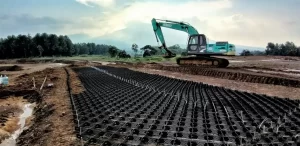
The Challenge: Soft, saturated, or loose soils (clays, silts, sands, organic soils) lack the bearing capacity to support roads, working platforms, foundations, or storage yards without excessive settlement or rutting. Traditional solutions involve deep excavation and replacement with expensive imported granular fill (like crushed rock), which is resource-intensive, costly, and environmentally taxing.
-
The HDPE Geocell Solution: By confining locally available, lower-quality fill (often on-site sand or marginal soils), the geocell creates a stiffened composite mattress. This mattress:
-
Increases Bearing Capacity: Reduces the pressure transmitted to the weak subsoil, preventing shear failure.
-
Reduces Settlement & Rutting: The confined layer distributes loads evenly, minimizing differential settlement and surface deformation under traffic.
-
Enables Construction on Marginal Sites: Allows building directly on soft ground that would otherwise require costly soil removal or deep foundations.
-
Lowers Construction Costs: Significantly reduces or eliminates the need for expensive imported select fill. Uses readily available local materials.
-
Accelerates Construction: Installation is rapid compared to deep excavation and replacement. Projects get back on track faster.
-
-
Key Applications:
-
Access Roads & Haul Roads: Over soft ground for mining, oil/gas, forestry, and construction sites.
-
Temporary & Permanent Working Platforms: For cranes, piling rigs, heavy equipment storage.
-
Parking Lots & Storage Yards: Stabilizing surfaces subject to heavy truck loads.
-
Railway Embankments & Sub-ballast Layers: Improving track foundation support.
-
Foundation Support: Under shallow footings or raft slabs on variable ground.
-
Pipeline Bedding & Haul Roads: Providing stable support in challenging terrain.
-
Table 1: Geocell vs. Traditional Stabilization for Load Support
| Feature | Traditional Method (Excavate & Replace) | HDPE Geocell Solution | Advantage of Geocell |
|---|---|---|---|
| Material Cost | Very High (Imported Select Fill) | Low (Uses Local Marginal Soil) | Significant Savings |
| Transport Cost | Very High (Hauling Fill) | Very Low (Lightweight Panels) | Major Savings & Reduced Emissions |
| Installation Speed | Slow (Excavation, Hauling, Compaction) | Rapid (Unroll, Expand, Infill) | Faster Project Completion |
| Bearing Capacity | Good (Dependent on Fill Quality) | Excellent (Confinement Effect) | Superior Performance on Weak Soils |
| Environmental Impact | High (Quarrying, Hauling Emissions) | Low (Minimal Earthworks) | More Sustainable Solution |
2. Slope Protection & Erosion Control: Securing the Incline


-
The Challenge: Unprotected slopes, whether natural or man-made (embankments, dams, levees, channel banks, hillsides), are vulnerable to surface erosion from rainfall runoff and wind. This can lead to rills, gullies, loss of vegetation, sediment pollution, and ultimately, catastrophic slope failures. Traditional methods like riprap (large rock blankets) or concrete lining are effective but heavy, expensive, difficult to install on steep slopes, and ecologically disruptive.
-
The HDPE Geocell Solution: Geocells provide an elegant, robust, and often greener solution:
-
Anchored Vegetation Support: Filled with topsoil and seeded, the cells protect seedlings from washout, retain moisture, and anchor roots, promoting rapid vegetation establishment for long-term, natural erosion control.
-
Structural Armoring: When infilled with aggregate or concrete, the geocell forms a flexible, permeable, yet high-strength armor layer. It dissipates hydraulic energy from flowing water, prevents surface particle dislodgment, and withstands shear stresses far better than loose rock or unreinforced soil.
-
Flexibility & Conformability: The system conforms to irregular slope surfaces and accommodates minor settlements without cracking, unlike rigid concrete.
-
Permeability: Allows natural drainage, reducing hydrostatic pressure buildup behind the protection layer.
-
Cost-Effectiveness: Uses smaller, less expensive aggregate than riprap for equivalent or better performance. Easier installation on steep slopes.
-
-
Key Applications:
-
Embankment & Dam Face Protection: Preventing erosion from rainfall and wave action.
-
Channel & Riverbank Revetments: Armoring against flowing water scour.
-
Landfill Caps & Closure Systems: Providing stable, erosion-resistant final cover.
-
Coastal & Shoreline Protection: Mitigating wave energy and preventing beach/dune erosion (often combined with other structures).
-
Cut Slope Stabilization: Protecting exposed soil faces during and after construction.
-
Landscaped Retaining Walls: Creating terraced, vegetated walls for aesthetic and functional stability.
-
3. Earth Retention & Gravity Walls: Building Smarter Walls


-
The Challenge: Creating stable vertical or near-vertical faces often requires complex, expensive retaining structures like reinforced concrete walls, gabions, or mechanically stabilized earth (MSE) walls with geogrids. These can be time-consuming to build and require significant backfill material and specialized construction.
-
The HDPE Geocell Solution: Geocells enable the rapid construction of cost-effective, gravity-based retaining structures:
-
Segmental Gravity Walls: Geocells, typically pre-filled or filled in lifts, are stacked horizontally to form the wall face. The weight of the confined infill and the friction/interlock between layers provide stability. Facing options include turf, seeded soil, concrete panels, or shotcrete applied directly to the geocell.
-
Steepened Slopes: Geocells allow construction of stable slopes significantly steeper than the natural angle of repose of the infill soil.
-
Flexibility & Drainage: The inherent flexibility accommodates ground movement without catastrophic failure. The structure remains permeable, preventing water pressure buildup.
-
Speed & Simplicity: Construction is modular and fast, requiring minimal heavy equipment or specialized labor compared to cast-in-place concrete.
-
Aesthetics: Easily vegetated for a natural appearance.
-
-
Key Applications:
-
Landscape Retaining Walls: Terraced gardens, property boundary walls, golf course features.
-
Bridge Abutments & Approach Walls.
-
Noise Barrier Foundations & Walls.
-
Temporary Shoring & Erosion Barriers.
-
Stabilizing Roadway Cut/Fill Transitions.
-
4. Channel & Pond Protection: Containing the Flow

-
The Challenge: Water flowing in channels, ditches, spillways, and around ponds exerts significant hydraulic forces (scour, erosion, uplift). Protecting these surfaces requires durable, erosion-resistant linings. Concrete is expensive, impermeable, and prone to cracking. Loose riprap can be displaced by high flows. Synthetic liners can be punctured.
-
The HDPE Geocell Solution: Provides robust, permeable, and flexible protection:
-
Scour & Erosion Prevention: Confined aggregate dissipates flow energy, prevents particle detachment, and resists scour at high velocities far better than unprotected soil or loose stone.
-
Flexible Armor: Conforms to subgrade irregularities and accommodates minor settlements without loss of integrity.
-
Permeability: Allows for natural groundwater exchange and reduces uplift pressures.
-
Durability: Resists UV, chemical, and biological degradation for long service life.
-
Vegetation Option: Can be filled with topsoil and vegetated for ecological enhancement in lower-flow areas.
-
Cost-Effective: Often more economical than concrete and more stable than loose riprap, especially on steeper gradients.
-
-
Key Applications:
-
Drainage Ditches & Swales.
-
Spillways & Overflow Channels.
-
Pond & Reservoir Banks & Inflow/Outflow Areas.
-
Stormwater Management Infrastructure (Basins, Outfalls).
-
Culvert Inlets & Outlets (Preventing Scour Holes).
-
Erosion Control in Constructed Wetlands.
-
Beyond the Core: Additional Advantages & Sustainability
The benefits of HDPE geocells extend far beyond the four primary applications:
-
Sustainability Champion:
-
Reduced Carbon Footprint: Minimizes excavation, hauling of imported materials, and associated fuel consumption/emissions.
-
Material Efficiency: Utilizes locally available, often marginal soils, reducing demand for quarried aggregates.
-
Long Service Life: Decades of performance reduce the need for reconstruction or replacement.
-
Habitat Enhancement: Vegetated applications promote biodiversity and create green infrastructure.
-
Recyclability: HDPE is highly recyclable at end of life (though landfill disposal is also safe and inert).
-
-
Cost Efficiency Over Lifecycle: While the initial geocell material cost exists, the total project cost is often significantly lower due to savings on expensive fill, reduced excavation, faster construction, lower transportation, and minimal long-term maintenance. The ROI is compelling.
-
Rapid Installation: Geocell panels are lightweight, easy to transport, unroll, expand, anchor, and infill. Projects can be completed in a fraction of the time of traditional methods, minimizing site disruption and weather delays.
-
Versatility: Adaptable to a wide range of soil types, climatic conditions, and project scales. Performs well in challenging environments (arctic, desert, coastal).
-
Proven Performance: Decades of successful projects worldwide, backed by extensive research, laboratory testing, and field performance data, provide confidence in design methodologies.
Table 2: Geocell Performance Across Soil Types
| Soil Type | Typical Challenge | Geocell Effectiveness | Key Benefit Provided |
|---|---|---|---|
| Soft Clays/Silts | Low Bearing Capacity, Rutting | Excellent | Load Distribution, Confinement |
| Loose Sands | Low Shear Strength, Erosion | Excellent | Confinement, Erosion Control |
| Organic Peat | Very Compressible, Unstable | Good to Excellent | Load Distribution, Mattress |
| Gravels | Good Base but Lateral Spread | Very Good | Lateral Confinement |
| Rocky Debris | Compaction Difficult | Good | Unification, Surface Stabilization |
Implementing HDPE Geocell Successfully: Key Considerations
To maximize the benefits, careful planning and execution are vital:
-
Site Assessment: Thorough geotechnical investigation to understand subgrade conditions, soil properties, and groundwater.
-
Design: Engineering design based on project loads, hydraulic forces (if applicable), slope angles, and soil parameters. Critical elements include geocell depth, aperture size, seam strength, infill specification, and anchor requirements.
-
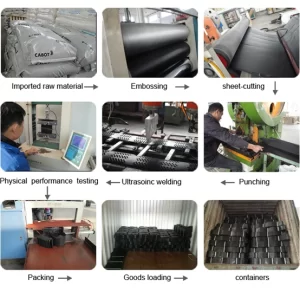
Material Selection: Specify virgin, UV-stabilized HDPE geocells with certified properties (tensile strength, weld strength, carbon black content, creep resistance). Ensure quality control from reputable manufacturers.
-
Subgrade Preparation: Proper compaction and grading are essential. A smooth, stable foundation is critical.
-
Installation: Follow manufacturer guidelines meticulously:
-
Expansion: Fully expand panels according to specification.
-
Anchoring: Secure panels adequately at the top, bottom, and along seams using stakes, pins, or deadman anchors as designed.
-
Infilling: Place infill material in controlled lifts from the cell perimeter inward. Achieve specified compaction within the cells using appropriate equipment (plate compactors, walk-behind rollers). Avoid over-compaction damaging the cells.
-
Seaming: Ensure proper connection of adjacent panels as per design (zipper, J-hook, weld).
-
-
Quality Control: Monitor installation for conformance to design and specifications.
Partnering for Success: Why Choose Our HDPE Geocell?
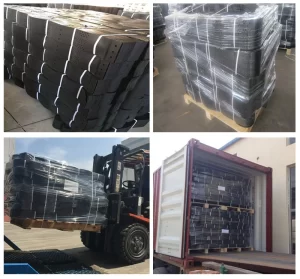
Selecting the right geocell partner is paramount. Our commitment is to provide not just a product, but a complete engineered solution:
-
Premium Virgin HDPE: We use only the highest-grade, UV-stabilized HDPE resins for guaranteed longevity and performance.
-
Rigorous Quality Control: Every batch undergoes stringent testing to meet or exceed international standards (ASTM, ISO) for tensile strength, weld/seam strength, carbon black content, and creep resistance.
-
Engineering Support: Our team of geotechnical specialists offers design assistance, technical guidance, and on-site support to ensure your project’s success from conception to completion.
-
Proven Performance: Our geocells have a documented track record of success in thousands of demanding projects worldwide, across all core application areas.
-
Comprehensive Range: We offer a variety of cell sizes, depths, and strengths to perfectly match your specific project requirements.
-
Sustainable Focus: We are committed to providing solutions that minimize environmental impact throughout the project lifecycle.
Conclusion: Build Stronger, Smarter, and Greener with HDPE Geocell
In an era demanding resilient infrastructure, cost efficiency, and environmental responsibility, HDPE Geocell technology stands out as a fundamental engineering solution. Its ability to transform weak soils into stable platforms, protect vulnerable slopes and channels, create efficient retaining structures, and do so sustainably makes it indispensable for modern construction and environmental projects.
Whether you’re battling unstable ground for a critical access road, securing a dam embankment against erosion, building an aesthetically pleasing retaining wall, or protecting a vital water channel, our HDPE Geocell offers the strength, durability, versatility, and cost-effectiveness you need to succeed. It’s not just about confinement; it’s about unlocking possibilities, reducing risk, accelerating schedules, and building a more sustainable future.
Don’t let challenging ground conditions dictate your project’s limitations or budget. Contact us today to discuss how our advanced HDPE Geocell solutions can provide the stable, cost-effective, and sustainable foundation your next project requires. Let’s build something remarkable, together.
