
Do you want to know the difference between woven geotextile and nonwoven geotextile? Do you want to know when to use woven geotextile and nonwoven geotextile? This article will give you the answer. This article introduces the difference between the two and their different application scenarios in detail and comprehensively. It also shows the market share of the two through clear data charts. There is a lot of data for your reference. You may as well come here to learn more!
What is woven geotextile?
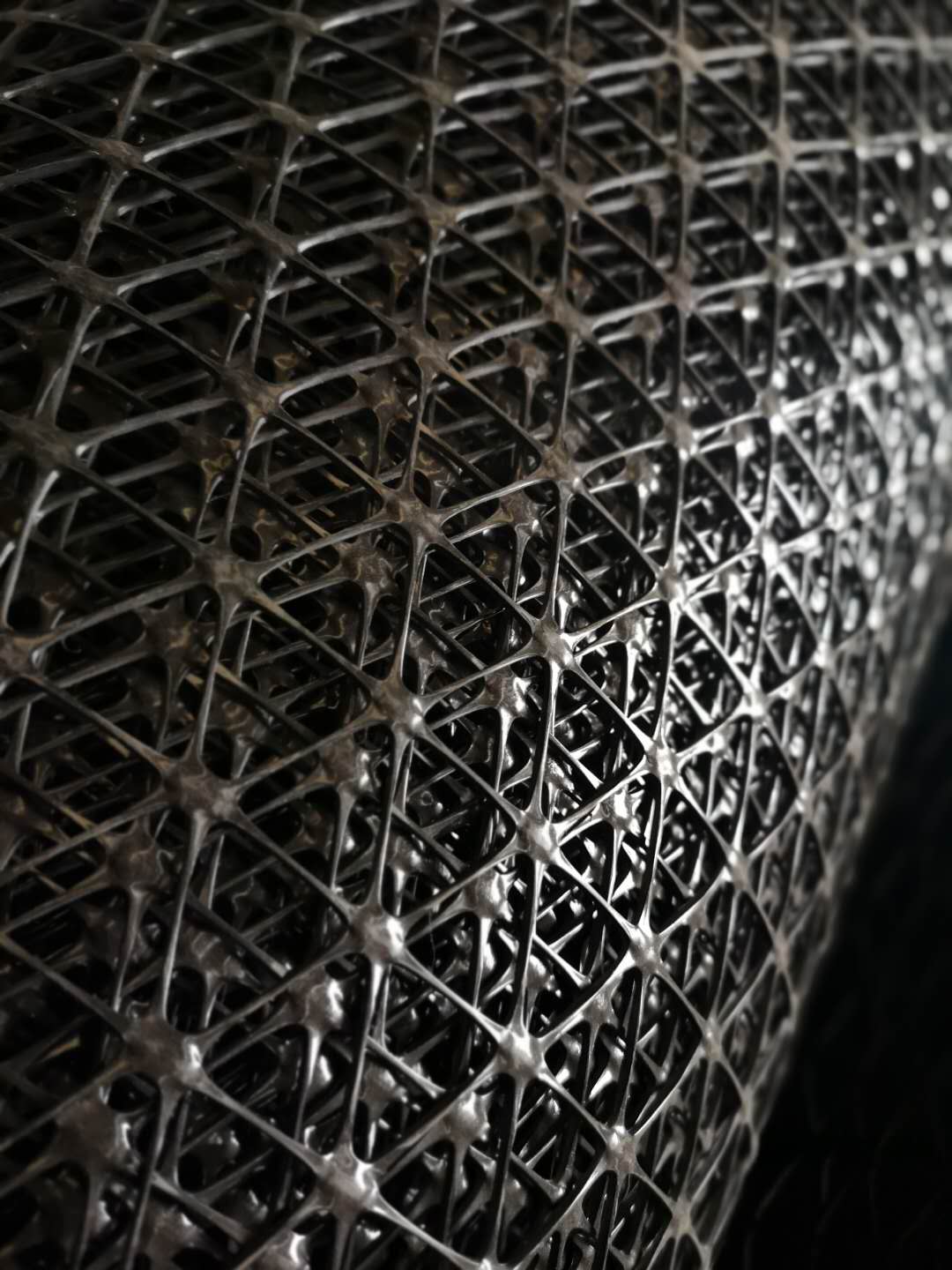
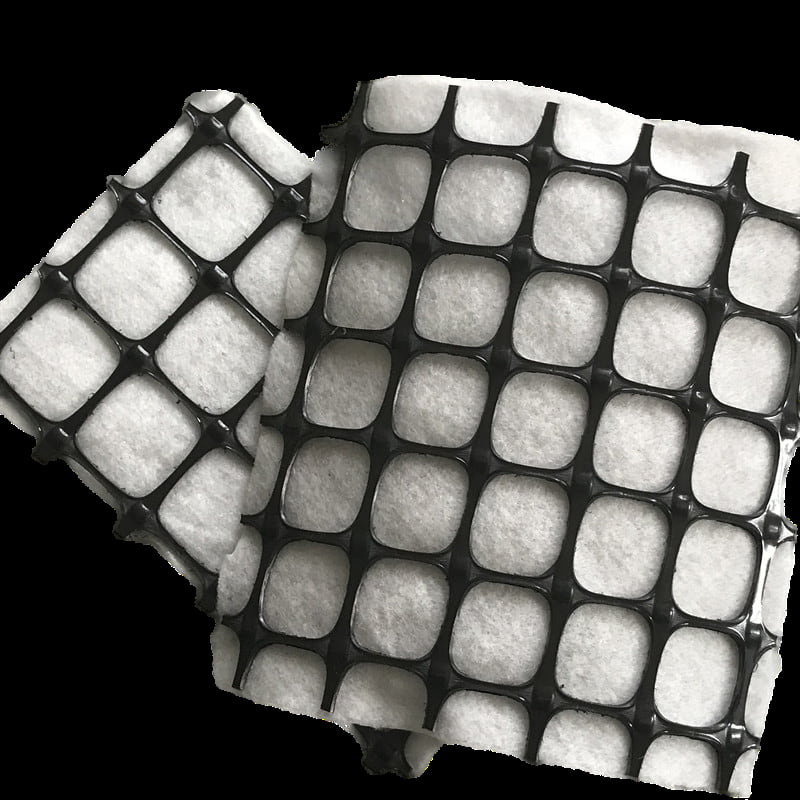
Woven geotextile is a geosynthetic material made of high-strength synthetic fibers (such as polypropylene, polyester, etc.) interwoven in warp and weft. It has excellent tensile strength and tear resistance, usually in a mesh structure with a flat and tight surface. The weaving process gives it strong structural stability, making it suitable for use in soil reinforcement, slope protection, foundation bearing and other projects, especially in situations where high tensile strength is required.
Product Category:
What is nonwoven geotextile?
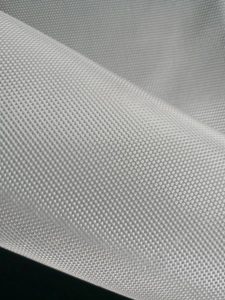
Nonwoven geotextile is a geotechnical material made by mechanical, thermal bonding or chemical methods to entangle and fuse short fibers or continuous filaments, usually a needle-punched product. Its surface presents an irregular fiber distribution structure with good water permeability, filtration and isolation capabilities. nonwoven geotextile is widely used in drainage systems, anti-seepage projects, slope protection, anti-scouring and other occasions, and is a common environmentally friendly engineering material.
Product Category:
Polypropylene Spunbond Nonwoven Fabric
Polyester Spunbond Nonwoven Fabric
Continuous filament Nonwonven Geotextile
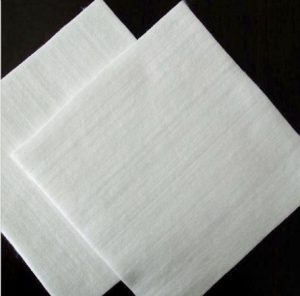
The difference between woven geotextile and nonwoven geotextile
| Comparison Items | Woven Geotextile | Nonwoven geotextiles |
| Technology | Textile (weaving) | Needle punching, hot pressing, bonding |
| Structure | Grid-like, regular | Irregular fiber interlacing |
| Tensile strength | High | Medium to high |
| Water Permeability | Poor | Excellent |
| Filterability | Generally | Very good |
| Applicable occasions | Soil reinforcement, foundation bearing | Drainage filtration, anti-seepage slope protection |
Woven geotextiles are suitable for structural support due to their strength advantages, while nonwoven geotextiles are better at filtering and drainage. They are two products with completely different application directions.
Analysis of market share of woven geotextiles and nonwoven geotextiles
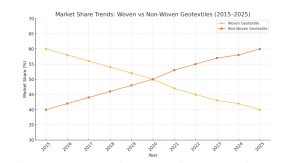
The above figure shows the trend of the share of woven geotextile and nonwoven geotextile in the global market from 2015 to 2025:
Trend description:
- The market share of woven geotextile is declining year by year
From 60% in 2015 to 40% in 2025, it shows that the market’s dependence on traditional woven materials is decreasing. It has advantages in tensile strength, but is limited in drainage and filtration applications.
- The market share of nonwoven geotextile has steadily increased
From 40% in 2015 to 60% in 2025, the growth trend is obvious. The advantages of nonwoven geotextile in drainage, filtration and anti-seepage have led to its widespread use in roads, railways and water conservancy projects.
- The focus of the industry is shifting
With the diversification of infrastructure construction and the increase in environmental protection needs, projects have put forward higher requirements for the permeability and customizability of materials, which has promoted nonwoven geotextiles to occupy a larger market share.
Functions of woven and nonwoven geotextiles
Both can be used for geotextile stabilization, protection, and filtration, but their focus differs:
Main functions of woven geotextiles:
- Reinforce soil structure
- Increase bearing capacity
- Prevent uneven subsidence
Main functions of nonwoven geotextiles:
- Provide good filtration performance
- Assist drainage systems
- Prevent loss of fine soil particles
Application areas of woven and nonwoven geotextiles
| Application Areas | Woven Geotextile | Nonwoven geotextiles |
| Road foundation | ✅ | ✅ |
| Slope protection | ✅ | ✅ |
| drainage system | ❌ | ✅ |
| Anti-seepage engineering | ✅(matching film) | ✅(matching film) |
| Water Conservancy Project | ✅ | ✅ |
| Landfill | ✅ | ✅ |
Nonwoven geotextiles are often used to wrap drainage pipes, river embankments and other projects with high permeability requirements, while woven geotextiles are more suitable for projects with requirements for strength and structural stability.
When to use woven or nonwoven geotextiles?
- Foundation reinforcement: Resists settlement and provides excellent tensile strength.
- Slope protection: Provides structural stability.
- Soft soil bearing: Effectively distributes loads and prevents subsidence.
- Gravel separation: Used to separate materials of varying particle sizes.
Recommendations:
- High tensile strength (>40 kN/m).
- Regular structure and excellent stability.
- Low cost, suitable for large-scale paving.
Precautions:
- Poor permeability, unsuitable for applications requiring high drainage.
- Lack of flexibility, poor bending adaptability during paving.
How to choose woven and nonwoven geotextiles?
- The selection should be based on the project goals, site conditions and budget for comprehensive judgment:
- If the focus is on reinforcement or tensile performance, it is recommended to use woven geotextiles;
- If the project focuses on drainage capacity, filtration or isolation performance, nonwoven geotextiles should be given priority;
- It is recommended to use polyester materials with anti-corrosion functions in highly saline or corrosive environments;
- It is recommended to choose high-weight nonwoven fabrics to enhance structural support in areas with complex construction environments or prone to landslides.
How much tensile strength can woven and nonwoven geotextiles withstand?
The tensile strength of different products varies significantly due to their material, density, and process:
Woven geotextiles: Common strengths range from 20–80 kN/m, with heavy-duty products reaching 100 kN/m.
Nonwoven geotextiles: Typically between 8–40 kN/m, with high-weight filament nonwovens reaching 50 kN/m.
It is important to emphasize that tensile strength is not the only criterion for material selection; ductility, strain resistance, and durability should also be considered.
Woven and nonwoven Geotextile User Guide
Installation Recommendations:
- Subgrade Preparation: Clear away weeds, rocks, and other debris.
- Laying: Lay in the direction of soil flow, avoiding wrinkles.
- Overlap: Leave at least 20–30 cm overlap, securing with sutures if necessary.
- Backfill and Cover: Avoid direct pressure from sharp rocks or heavy objects.
- Protecting against UV exposure: nonwoven fabrics are particularly susceptible to aging and require covering for extended periods of exposure. Storage Requirements:
- Environment:Keep dry and well-ventilated
- Avoidance:Avoid exposure to direct sunlight and rain
- Stacking requirements:Stacking height should not exceed 5 layers
Questions about woven geotextiles and nonwoven geotextiles
- Which is better for drainage, woven geotextiles or nonwoven geotextiles?
nonwoven geotextiles have better water permeability and are suitable for drainage and filtration systems.
- Can woven geotextiles be used under asphalt roads?
Yes. Its high strength and stability are very suitable for structural reinforcement under asphalt roads.
- Does nonwoven geotextiles have good drainage?
Very good. Especially the staple needle-punched type, which is often used for drainage pipe wrapping, percolation water protection, etc.
- What is the service life of woven geotextiles and nonwoven geotextiles?
Woven geotextiles: usually up to 10-20 years, some up to 50 years;
nonwoven geotextiles: can also be used for more than 15 years under good coverage and protection.
The service life depends on factors such as material, use environment, ultraviolet radiation, and burial method.
Conclusion
Woven and nonwoven geotextiles are indispensable geosynthetics in modern engineering, with a wide range of applications and unique advantages and properties. If you need either, when choosing a geotextile, consider not only construction efficiency but also longevity and project quality.
Woven geotextiles excel in high-strength applications, while nonwoven geotextiles excel in permeability, drainage, or filtration. Understand the differences between the two and make an informed choice.
