



Identifying the tensile strength and reinforcement performance of triaxial geogrids compared to biaxial geogrids requires understanding their fundamental structural differences and how these impact testing and performance:
Key Structural Difference:
-
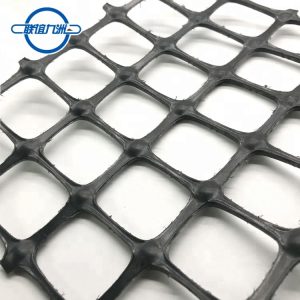
Biaxial: Rectangular grid pattern. Strength primarily in two perpendicular directions (machine & cross-machine). Apertures are typically rectangular.

PP Biaxial Geogrid -
Triaxial: Triangular grid pattern. Strength distributed in three principal directions (usually at 60° or 120° angles). Apertures are typically triangular or hexagonal.

PP triaxial geogrid

Identifying Tensile Strength:
-
Standard Tensile Testing (ASTM D6637 / ISO 10319):
-
The Challenge: Standard tests pull rectangular specimens in one direction. This works well for biaxial geogrids, which have defined strong directions.
-
For Triaxial:
-
Isotropic Nature: Triaxial geogrids are designed to have near-equal strength in all in-plane directions. Testing in any single direction should theoretically yield similar results.
-
Testing Protocol: Reputable manufacturers test specimens cut in multiple directions (e.g., 0°, 60°, 120°) to confirm isotropic properties and report an average tensile strength and modulus.
-
Look For: Manufacturer data sheets should clearly state the tensile strength (e.g., Tult) and stiffness (J) values, specifying they are averages from multi-directional testing per the relevant standard. Be wary of data showing only one direction if it claims isotropy.
-
-
-
Rib & Junction Efficiency:
-
While the overall tensile strength is the primary metric, the efficiency of force transfer between ribs at junctions is critical. This is tested similarly for both types (e.g., ASTM D7864 – Tensile Test on a Single Rib/Junction). Triaxial junctions often have specific geometries due to the triangular pattern.
-
Identifying Reinforcement Performance:
Performance goes beyond simple tensile strength. It’s about how the geogrid interacts with the soil/aggregate:
-
Aperture Stability & Interlock (Key Differentiator):
-
Biaxial: Rectangular apertures provide good interlock mainly in the two strong directions. Stability relies heavily on junction strength.
-
Triaxial: The triangular mesh structure provides inherent radial stiffness and greater aperture stability. Loads applied in any direction are distributed more efficiently through the triangular ribs, minimizing aperture distortion. This often leads to:
-
Improved Particle Confinement: Triangular apertures can offer better confinement of angular aggregate particles, reducing movement.
-
Reduced Localized Stresses: Loads are spread radially, reducing point stresses on aggregate.
-
-
How to Identify: Look for performance data from large-scale model tests (e.g., cyclic loading on paved/unpaved roads, pullout tests, bearing capacity tests) that directly compare biaxial and triaxial geogrids under identical conditions. Performance metrics include:
-
Reduction in Rut Depth (for pavements)
-
Increase in Bearing Capacity or Modulus Improvement Factor (MIF)
-
Reduction in Required Aggregate Thickness
-
Pullout Resistance (peak force and interaction coefficient – Ci)
-
-
Manufacturer Data: Reputable triaxial geogrid manufacturers invest heavily in this type of testing and provide comparative data demonstrating performance advantages over biaxial grids at equivalent tensile strengths.
-
-
Structural Contribution – Tensioned Membrane Effect:
-
Both geogrid types develop tension to span over soft spots. The radial stiffness and stability of triaxial geogrids can lead to a more efficient mobilization of this effect, potentially activating reinforcement at lower deformation levels. This is inferred from performance testing (like rut depth reduction).
-
-
Creep Resistance:
-
Long-term performance under constant load is crucial. Both types are tested for creep (ASTM D5262). Performance is material-dependent (HDPE, PP, PET, coated polyester) rather than solely structure-dependent. Ensure the manufacturer provides certified creep reduction factors for design.
-
Summary & Key Points for Identification:
| Parameter | Biaxial Geogrid | Triaxial Geogrid | Identification Method |
|---|---|---|---|
| Structure | Rectangular grid, 2 primary directions | Triangular mesh, 3 principal directions | Visual inspection of product |
| Tensile Strength | Direction-specific values | Average isotropic strength | Manufacturer data with multi-directional testing |
| Performance Indicators | Particle confinement in 2 directions | Radial stiffness, aperture stability | Large-scale comparative testing results |
| Key Testing | Standard tensile (ASTM D6637) | Multi-directional tensile tests | Review test certificates and protocols |
| Performance Evidence | Traditional reinforcement data | Rut depth reduction, bearing capacity | Manufacturer application performance data |
Critical Considerations:
-
“Equivalent” Strength ≠ Equivalent Performance: A triaxial geogrid with the same tensile strength rating as a biaxial geogrid will often demonstrate superior reinforcement performance in comparative tests due to its structural efficiency and aperture stability. Don’t assume parity based on tensile strength alone.
-
Manufacturer Data is Paramount: Scrutinize technical data sheets. Look for:
-
Clearly stated tensile strength and modulus (average, isotropic).
-
Results from standardized performance tests (pullout, cyclic loading) comparing against biaxial benchmarks or controls.
-
Third-party certification of test data.
-
-
Application Context: The performance advantage of triaxial geogrids is often most pronounced in applications involving multi-directional loads and aggregate confinement (e.g., unpaved & paved roads, working platforms, rail beds). In some wall or slope applications with clearly defined primary failure planes, a high-strength biaxial might be equally suitable.
-
Total System Performance: Performance depends on the interaction with the specific soil/aggregate and installation quality. Triaxial grids may be more forgiving during installation due to their stability.
In essence, identify triaxial geogrid performance by demanding multi-directional tensile test results and critically evaluating comparative large-scale performance test data provided by the manufacturer, focusing on metrics like rutting reduction, bearing capacity increase, or pullout resistance. Recognize that its triangular structure provides fundamental mechanical advantages in load distribution and confinement that often translate to superior field performance compared to biaxial geogrids of equivalent tensile strength.
