


Quick Answer
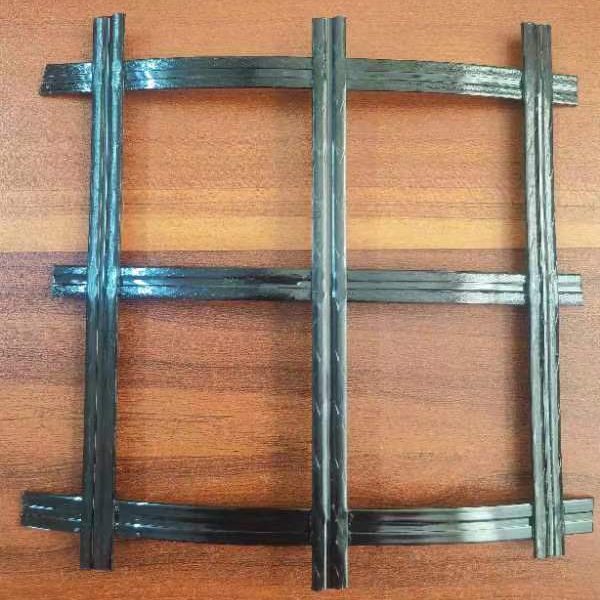
The main difference between biaxial and triaxial geogrids lies in the way they distribute tensile resistance and confine aggregate. Biaxial geogrids provide reinforcement primarily in two principal directions, whereas triaxial geogrids use a triangular or multidirectional rib structure to distribute stiffness and load transfer more uniformly across the plane. Laboratory research has found that triaxial geogrids can provide more uniform tensile behaviour across different loading directions, making them particularly well-suited to pavement stabilisation and applications involving multidirectional or changing traffic loads.
Why Does the Difference Between Biaxial and Triaxial Geogrids Matter?
Geogrids are widely used in geotechnical and pavement engineering to enhance the performance of soil and aggregate layers. They primarily work by interacting with the surrounding aggregate and soil to help control lateral movement, distribute applied loads, and improve the mechanical stability of reinforced layers.
At first glance, biaxial and triaxial geogrids may appear similar as they both consist of interconnected polymer ribs with open apertures. However, the engineering difference becomes clearer when the direction of the applied load is considered. A conventional biaxial geogrid is optimised for two principal directions, whereas a triaxial geogrid is designed to provide a more uniform response across multiple loading directions.
This distinction is particularly relevant in roads, car parks, industrial yards, work platforms and other structures subjected to repeated wheel loads. Traffic does not always produce perfectly aligned tensile forces along the machine or cross-machine directions of a geogrid. Therefore, a pavement reinforcement system needs to interact with aggregate under a more complex stress field than a simple laboratory tensile test might suggest.
Research comparing the performance of biaxial and triaxial geogrids has specifically identified this directional behaviour as an important difference. Zhang et al. found that triaxial geogrids exhibited nearly uniform tensile strength across loading directions compared with biaxial geogrids. Similarly, a review of the literature identifies more distributed load-carrying behaviour as a characteristic of multi-directional geogrid structures.
What Is a Biaxial Geogrid?
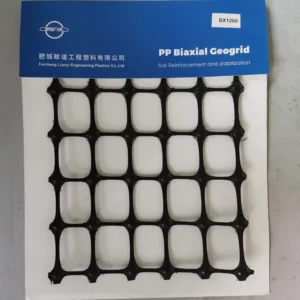
A biaxial geogrid is a polymer grid designed to provide tensile resistance in two perpendicular directions. It has a regular aperture structure that is usually square or rectangular, with ribs extending along the machine and cross-machine directions.
The term ‘biaxial’ does not indicate that the material has identical strength in every direction. Instead, it indicates that the geogrid has engineered tensile properties in two principal directions. Consequently, the strength and stiffness measured in these directions can differ substantially from the response obtained when the material is loaded at an intermediate angle.
Biaxial geogrids are well-established reinforcement products used in applications such as aggregate base stabilisation, road construction, car parks, and other structures where loads need to be distributed across a weak subgrade. Their performance stems not only from the tensile strength of the polymer ribs, but also from the mechanical interlock between the apertures and the surrounding aggregate.
Literature on polymer geogrids identifies biaxial geogrids as a distinct structural class whose tensile properties are strongest in the principal machine and cross-machine directions, with lower resistance possible at intermediate orientations.
What Is a Triaxial Geogrid?
A triaxial geogrid is a multidirectional geogrid whose geometry is designed to provide a more uniform distribution of stiffness and tensile resistance across the reinforcement plane. Rather than relying primarily on two perpendicular rib directions, its structure incorporates triangular or hexagonal apertures and a network of ribs arranged to transfer forces in multiple directions.
The term ‘triaxial’ can sometimes confuse. This does not mean that the product behaves like a conventional three-dimensional material with a separate vertical reinforcement axis. In geogrid engineering, the important distinction lies in its multi-directional in-plane mechanical response.
The geometry changes how forces travel through the grid. When aggregate is placed over the geogrid and compacted, the particles are mechanically confined by the apertures and ribs. Under traffic loading, the grid can resist lateral aggregate movement and redistribute stresses through its interconnected structure.
For example, Tensar’s technical classification distinguishes its TriAx products from traditional biaxial reinforcement by emphasising radial stiffness, radial stiffness ratio, junction efficiency and hexagonal pitch, rather than relying solely on conventional tensile strength values. This distinction is important because a triaxial geogrid should not simply be selected based on its headline tensile strength. Its value lies in the combination of geometry, stiffness distribution, aggregate interaction, and load stabilisation.

Biaxial vs Triaxial Geogrid: Structural Difference
The easiest way to understand the difference is to consider how the grid would react if a load were to approach from different directions.
A biaxial grid has two dominant rib orientations. If the applied force is aligned with these directions, the reinforcement can perform very effectively. However, when a load is applied at an intermediate angle, the load path through the rib network changes and the measured tensile response can be lower than in the principal directions.
A triaxial geogrid distributes its ribs around the plane to create more consistent load paths. The triangular or hexagonal aperture geometry enables interaction between the aggregate and the grid around multiple orientations, which is useful when loads are not consistently aligned.
However, this does not mean that every triaxial product automatically outperforms every biaxial product. The performance of a product in the field is influenced by factors such as the polymer used, rib dimensions, junction characteristics, aperture size, stiffness, tensile strength, installation conditions, and aggregate properties.
| Characteristic | Biaxial Geogrid | Triaxial Geogrid |
| Basic geometry | Usually square or rectangular apertures | Commonly triangular or hexagonal apertures |
| Principal reinforcement | Two primary directions | More uniformly distributed in multiple directions |
| Directional behavior | More pronounced | More uniform around the plane |
| Typical mechanism | Tensile reinforcement and aggregate interlock | Aggregate confinement, stabilization, and multidirectional load transfer |
| Common applications | Roads, base reinforcement, parking areas | Road stabilization, heavy-duty bases, variable traffic loading |
| Intermediate-angle loading | Response can differ from principal directions | Generally more consistent |
| Design parameters | Tensile strength, strain, stiffness, junction properties | Radial stiffness, stiffness ratio, junction efficiency and geometry |
| Main selection consideration | Directional reinforcement requirements | Multidirectional stabilization requirements |
The peer-reviewed literature supports the distinction but also cautions against reducing geogrid performance to a single strength number. A review of polymer geogrids notes that different structural designs produce different stiffness and tensile characteristics, while experimental research has demonstrated more uniform directional behavior for triaxial structures.
The Importance of Aggregate Interlock
The effectiveness of a geogrid in stabilising pavements is closely related to what happens at the interface between the grid and the aggregate.
When aggregate particles are compacted over a geogrid, they can enter or partially engage with the apertures. When under load, the grid restricts the aggregate’s lateral movement, while the aggregate transfers forces into the grid through mechanical interlock. This creates a reinforced composite layer, rather than treating the geogrid as an isolated tensile membrane.
A well-designed triaxial geogrid is particularly effective in this environment because its aperture geometry provides multiple interaction points between the aggregate and ribs. The resulting confinement can help to reduce the lateral spreading and deformation of the base material under repeated loading.
This is why aperture geometry should be considered alongside tensile strength. A geogrid with a very high ultimate tensile strength may not necessarily be the most appropriate choice if its stiffness, aperture dimensions, or interaction with the specified aggregate are not suitable for the project.
Literature on polymer geogrids describes the relationship between grid structure and mechanical behaviour, and experimental triaxial geogrid research has examined tensile response and pull-out behaviour in compacted sand.
Which Has Better Tensile Strength?
This is one of the most common questions, but it requires a more detailed answer than simply saying ‘triaxial’.
The tensile strength of a product depends on its specific properties. For example, a high-strength biaxial geogrid may have a greater tensile capacity in one direction than a lower-strength triaxial product. Conversely, a triaxial geogrid can provide a more uniform tensile response in different directions, even when comparing products with a similar nominal strength.
ASTM D6637/D6637M provides standardised methods for determining geogrid tensile properties using single-rib, multiple-rib or multiple-layer tensile testing. This is important because tensile strength values are only meaningful when the test method, specimen configuration, direction, and reporting basis are understood. For pavement stabilisation, engineers should therefore examine the directional distribution of tensile stiffness and strength rather than simply considering the maximum kN/m value printed on a product datasheet.
Stiffness Can Matter More Than Ultimate Strength
In many stabilisation applications, the behaviour of the geogrid at relatively low strain is particularly relevant. The objective is not to stretch the geogrid until it reaches ultimate tensile failure, but rather to mobilise stiffness and constrain aggregate movement under service loads.
This is one reason why triaxial geogrids are often discussed in terms of parameters such as radial stiffness and the radial stiffness ratio. The engineering objective is to characterise how effectively the grid responds when forces are applied from different directions.
A geogrid that develops useful stiffness at low strain can contribute to the early confinement of the aggregate layer, helping to maintain structural stability before large-scale deformation occurs. This distinction also explains why comparing two products using only ultimate tensile strength can be misleading.
For project design, the relevant question is therefore: Which mechanical property controls the failure or deformation mechanism in this application? If multidirectional aggregate movement under traffic governs the project, directional stiffness and stabilisation behaviour may deserve more attention than ultimate tensile capacity.
Where Is a Biaxial Geogrid Usually Used?
Biaxial geogrids have become widely established in pavement and soil reinforcement applications because their two-directional structure meets many conventional stabilisation requirements.
They are typically used to reinforce road bases, car parks, access roads, working platforms, unpaved roads and foundations over weaker subgrades. They can also be incorporated into aggregate layers to reduce lateral spreading and improve load distribution.
Their well-established design history is an advantage. Engineers and contractors are familiar with the installation methods, testing procedures, material specifications, and performance data of these products. This makes them an efficient choice when project conditions do not require a multidirectional stabilisation mechanism.
‘Biaxial’ does not mean ‘outdated’ or ‘inadequate’. In many projects, it remains the most technically and economically appropriate solution.
Where Is a Triaxial Geogrid Usually Used?
A triaxial geogrid is ideal for applications where traffic and stress conditions create load paths in multiple directions.
Examples of such applications include highways, busy roads, industrial yards, airport pavement areas, container yards, car parks, temporary work platforms and stabilising weak or variable subgrades.
It is not simply because these projects experience ‘heavy loads’. Traffic loads are dynamic and move across the pavement surface, producing changing stress orientations within the aggregate layer. Therefore, a multidirectional reinforcement structure can offer a more consistent mechanical response.
Research from Georgia Tech and other academic institutions has specifically examined the tensile properties of geogrids over a full 360-degree range, reporting more uniformly distributed tensile strength and stiffness for triaxial geogrids compared with biaxial products.
Does Triaxial Always Mean Better?
No, this is an important point for both engineers and buyers.
While a triaxial geogrid may offer advantages under multidirectional loading, the most appropriate product ultimately depends on the entire pavement or soil system. Factors such as subgrade strength, aggregate gradation, base thickness, traffic loading, drainage, installation quality, geogrid stiffness, aperture geometry, and project design methodology all influence the final result.
There can also be a cost difference. A U.S. International Trade Commission investigation found that, while they share many characteristics and applications, biaxial and triaxial integral geogrid products also differ in terms of tensile strength, radial stiffness, thickness, pricing, and specification practices.
Therefore, selecting triaxial simply because it is the newer technology is not sound engineering. The correct product is the one whose performance characteristics solve the actual design problem at an acceptable lifecycle cost.
How to Choose Between Biaxial and Triaxial Geogrids?
The selection process should start with the loading environment rather than the product category.
First, establish whether the dominant reinforcement requirement is directional or multidirectional. If the project involves relatively predictable loading and the design is well suited to a conventional biaxial product, then reinforcement with a biaxial geogrid may be sufficient. However, if traffic produces changing load orientations and the project relies heavily on aggregate stabilisation, a triaxial geogrid would be a better fit.
Secondly, examine the soil and aggregate system. A geogrid does not function independently of the surrounding material. The aperture size should be compatible with the aggregate gradation, and the rib geometry and stiffness should enable effective interaction with the compacted layer.
Thirdly, evaluate the design parameters required by the project specification. Do not substitute an ultimate tensile strength comparison for the actual engineering requirement. While ASTM D6637 can provide standardised tensile data, the designer may require further information on stiffness, junction performance, creep, installation damage, chemical resistance, and long-term design strength, depending on the application.
What Should Engineers Compare on a Geogrid Datasheet?
A proper comparison should go beyond “biaxial” versus “triaxial.” Engineers should review the complete set of properties relevant to the intended application.
For biaxial products, tensile strength and tensile stiffness in the machine and cross-machine directions are commonly important. For triaxial products, radial stiffness and the uniformity of response across different directions can become more relevant.
Other considerations include aperture dimensions, rib dimensions, junction efficiency, polymer type, manufacturing process, resistance to installation damage, long-term performance, and the design methodology used by the project.
| Selection Parameter | Why It Matters | Biaxial vs Triaxial Consideration |
| Tensile strength | Indicates resistance to tensile loading | Compare in the actual required directions |
| Tensile stiffness | Controls reinforcement at working strain | Important for service-load behavior |
| Radial stiffness | Indicates response around multiple directions | Particularly relevant to triaxial stabilization |
| Aperture size | Controls aggregate interaction | Match to aggregate gradation |
| Junction efficiency | Influences force transfer through the grid | Important for both structures |
| Rib geometry | Affects stiffness and interlock | Strongly dependent on product design |
| Creep resistance | Important for long-term reinforcement | Evaluate according to design life |
| Installation damage resistance | Protects design properties during construction | Essential for aggregate placement and compaction |
| Chemical/environmental resistance | Affects long-term durability | Match polymer and environment |
| Cost per reinforced area | Determines economic efficiency | Compare on lifecycle performance, not purchase price alone |
The best comparison is therefore application-specific. Two geogrids with similar nominal tensile strength can have significantly different reinforcement behavior because their geometry and stiffness profiles are different.
Installation Also Influences Geogrid Performance
Even a technically excellent geogrid cannot compensate for poor installation. The final reinforced system is influenced by the prepared subgrade, aggregate quality, placement method, overlap, compaction, and construction traffic.
Geogrids should generally be installed in accordance with the project design and the manufacturer’s requirements. Attention should be paid to wrinkles, folds, damage, anchoring, overlaps, and proper aggregate placement. Construction equipment should also be managed to avoid causing unnecessary damage before the aggregate layer has developed adequate confinement.
This is particularly important when comparing products based on laboratory data. While a tensile test measures a controlled material property, a pavement is a complex composite system that is subjected to moisture, repeated loading, construction variability, and environmental conditions.
Consequently, a good specification should link laboratory properties with installation requirements and the intended design method, rather than treating the geogrid as a commodity product.
Biaxial vs Triaxial Geogrid: The Practical Decision
For conventional road or aggregate-base stabilisation projects where the reinforcement requirements are well understood, and loads can be effectively addressed in two principal directions, a biaxial geogrid can be a practical and cost-effective choice.
However, for projects where load orientation changes substantially, aggregate confinement is a primary design objective, or a more uniform in-plane response is desired, a triaxial geogrid should be given closer consideration. Its geometry is specifically designed to distribute mechanical responses more evenly across multiple directions, which can be advantageous for traffic-induced loading.
It is important to note that these are not simply two grades of the same product. They represent different structural approaches to reinforcement. A biaxial geogrid emphasises two main reinforcement directions, whereas a triaxial structure modifies the way forces are distributed through the grid and the surrounding aggregate.
Final Verdict: Which Geogrid Should You Choose?
If the question is “Which is stronger, biaxial or triaxial?”, the technically correct answer is: it depends on the product and the direction in which strength is measured. If the question is “Which provides a more uniform multidirectional mechanical response?”, research generally supports the triaxial configuration.
A biaxial geogrid remains an effective solution for many road-base and aggregate-reinforcement applications because it has established performance characteristics and strong two-directional reinforcement. A triaxial geogrid becomes particularly compelling where stabilization depends on multidirectional load transfer and aggregate confinement.
For engineers, contractors, and geosynthetic buyers, the safest approach is to select the product according to the design mechanism, not the product name. Compare tensile strength, stiffness, radial response, aperture geometry, junction efficiency, durability, installation resistance, and lifecycle cost against the actual project requirements.
FAQ: Triaxial Geogrid
- What is a triaxial geogrid used for?
A triaxial geogrid is mainly used for aggregate stabilization and reinforcement in roads, pavements, working platforms, and other civil-engineering applications. Its multi-directional structure is particularly useful when loads act from changing or multiple directions.
- Is triaxial geogrid better than biaxial geogrid?
Neither type is automatically better for every project because performance depends on loading, soil, aggregate, design method, and product specifications. Triaxial geogrids generally provide a more uniform tensile response across multiple directions, while biaxial geogrids remain effective for many conventional reinforcement applications.
- What is the main advantage of triaxial geogrid?
Its main advantage is a more uniform multidirectional distribution of stiffness and tensile resistance. This can improve aggregate confinement and load distribution under complex traffic loading.
- What is the difference between biaxial and triaxial geogrid?
Biaxial geogrids have two principal reinforcement directions, whereas triaxial geogrids use a multi-directional network commonly associated with triangular or hexagonal apertures. The structural difference produces different directional stiffness and load-transfer behavior.
- Can triaxial geogrid be used for road construction?
Yes, triaxial geogrids are widely considered for road-base and pavement stabilization applications. They can be particularly useful where repeated traffic loads create multidirectional stresses within the aggregate layer.
- How is triaxial geogrid tested?
Geogrid tensile properties can be evaluated using ASTM D6637/D6637M, which provides single-rib and multiple-rib tensile testing procedures. For project selection, tensile testing should be complemented by relevant information on stiffness, geometry, junction performance, durability, and installation resistance.
Conclusion
The fundamental difference between a biaxial and a triaxial geogrid is not just the shape of the apertures, but also the way the entire grid structure carries and distributes forces.
Biaxial geogrids are designed with two main reinforcement directions and are highly effective in many conventional paving and soil stabilisation applications. Triaxial geogrids use a more multidirectional geometry to provide a more uniform mechanical response, making them particularly relevant where traffic loads and aggregate movement cannot be adequately represented by two fixed directions.
In real-world design, the most reliable method of selection is to look beyond the labels ‘biaxial’ and ‘triaxial’ and compare the properties that actually govern performance, such as tensile strength, stiffness, radial behaviour, aperture geometry, aggregate interaction, junction efficiency, durability, installation resistance, and lifecycle cost. This approach yields a more defensible engineering decision than selecting a geogrid based solely on one category appearing technically superior.
