


Quick Answer
A geogrid is a type of geosynthetic reinforcement, whereas a geocomposite is a composite material made from two or more geosynthetic components that work together to perform one or more engineered functions. The Federal Highway Administration (FHWA) describes geogrids as open networks of tensile elements designed primarily for reinforcement and stabilisation. The International Geosynthetics Society (IGS), meanwhile, defines geocomposites as combinations of geosynthetic products, including geotextiles, geonets, geomembranes and geogrids. Current ISO 10318-1:2026 terminology also defines a geogrid as a planar, polymeric, open network of interconnected tensile elements. This distinction is therefore primarily one of product structure, engineering function, and system design.
Geocomposite vs. geogrid: the key difference
The simplest way to understand the difference between the two products is to consider what they are designed to do. A geogrid is a type of geosynthetic material that has a grid-like structure with relatively large apertures. Its main engineering function is reinforcement: the grid interacts with the aggregate or soil through interlocking and friction to help restrict lateral movement, distribute loads, and improve the stability of a soil-aggregate system. The FHWA specifically identifies geogrids as reinforcement products for use in base and subbase stabilisation, soft subgrade improvement, embankments and related applications.
By contrast, a geocomposite is not defined by one particular shape or one primary function. Rather, it is a manufactured combination of two or more geosynthetic components, such as a geotextile-geonet drainage composite, a geotextile-geogrid reinforcement composite, or a geomembrane-geotextile protection composite. The components are selected and bonded or assembled so that the finished product performs its functions more effectively and conveniently than the individual layers would if used independently.
This distinction matters because the two terms do not really represent competing product categories. ‘Geogrid’ describes a particular geosynthetic structure and reinforcement function, whereas ‘geocomposite’ describes a composite construction that can incorporate different geosynthetic products — including a geogrid. In other words, a geogrid can be one component of a geocomposite; therefore, saying that one is always ‘better’ than the other is technically misleading.
What is a geogrid?
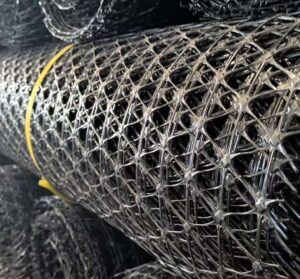
A geogrid is an open, grid-like polymer structure made up of interconnected tensile elements. According to the current ISO terminology, the openings are larger than the elements that form the grid itself, enabling the surrounding soil or aggregate to interact mechanically with the grid.
A geogrid’s engineering value largely comes from soil-geosynthetic interaction rather than simply from the tensile strength stated on a product datasheet. When aggregate is placed over an appropriately selected geogrid, its particles can penetrate or engage with the apertures, creating interlock and lateral restraint. Under traffic or foundation loading, this interaction can reduce aggregate movement and help distribute stresses over a broader area.
Geogrids can be manufactured by extrusion, weaving, or welding, depending on the product design and polymer system. The FHWA states that important characteristics include the type of polymer used, aperture geometry, wide-width tensile strength, junction strength, durability, and the compatibility of the aperture size with the aggregate being reinforced.
Therefore, a geogrid should not simply be selected for having the highest tensile strength. Poorly matching the aperture size to the aggregate can reduce mechanical interlock, and inadequate junctions for the installation stresses may mean that the nominal tensile capacity does not translate into effective field performance.
Typical geogrid applications
Geogrids are particularly useful when the engineering problem involves reinforcement, stabilization, load distribution, or lateral restraint. Typical applications include:
- Unpaved and paved road base stabilization
- Soft-subgrade stabilization
- Working platforms over weak soils
- Reinforced soil slopes
- Mechanically stabilized earth walls
- Embankment reinforcement
- Asphalt or pavement reinforcement in selected designs
- Foundation and load-distribution applications
The FHWA notes that geogrids can be used between weak subgrade and aggregate to distribute loads over a wider area and reduce vertical stress and deformation. Geosynthetics Magazine similarly identifies base reinforcement and subgrade stabilization as two major roadway applications.
What is a geocomposite?
A geocomposite can be understood as an engineered combination of geosynthetic components. According to the IGS classification, examples include geotextile-geonet, geotextile-geogrid, and geonet-geomembrane combinations. Another important form of geocomposite is the geosynthetic clay liner.
The purpose of combining materials is usually functional. For instance, one component may provide filtration, another drainage, another reinforcement, and another barrier or protection. By manufacturing them together, designers can create a product that addresses multiple requirements while reducing the number of separate installation steps.
For instance, a drainage geocomposite may contain a geotextile filter layer and a polymeric drainage core. The geotextile prevents soil particles from entering the drainage structure while allowing water to pass through, and the core provides a preferential in-plane flow path. The FHWA describes geocomposite strip drains in retaining-wall applications as drainage cores combined with filtration geotextiles.
A different geocomposite may combine a geotextile with a geogrid. In this configuration, the geogrid provides tensile reinforcement and interaction with the soil, while the geotextile can provide separation or filtration. The FHWA specifically identifies woven/non-woven geotextile composites and geotextile/geogrid composites as types of geocomposite used for stabilisation.

Geocomposite vs. geogrid comparison
| Feature | Geogrid | Geocomposite |
| Basic definition | Open polymeric grid of tensile elements | Combination of two or more geosynthetic components |
| Main purpose | Reinforcement and stabilization | Multiple functions depending on components |
| Typical structure | Regular open grid | Layered or bonded combination |
| Reinforcement | Usually the primary function | Possible if a geogrid or reinforcing element is incorporated |
| Filtration | Not normally its primary function | Common when a geotextile is included |
| Drainage | Not normally the primary function | Common in drainage geocomposites |
| Separation | Limited as a standalone function | Can be provided by a geotextile layer |
| Barrier function | Not the primary function | Possible when a geomembrane or barrier layer is included |
| Common applications | Roads, slopes, MSE walls, subgrade stabilization | Drainage, filtration, reinforcement, landfill, lining and erosion-control systems |
| Selection focus | Strength, aperture, junction, interlock, durability | Component compatibility, hydraulic/mechanical properties and system performance |
The table illustrates why the terms should not be treated as synonyms. A geogrid is a defined product type with reinforcement as its dominant engineering role, while a geocomposite is a broader engineered assembly whose function depends on the materials incorporated into it.
When should you use a geogrid?
A geogrid is usually the best option when the main design issue is soil or aggregate reinforcement. For example, if a road base deforms under repeated traffic, the designer may use a geogrid to improve aggregate confinement and reduce lateral movement, rather than introducing a composite product simply because it contains more components.
The same logic applies to soft subgrades. A properly designed geogrid can help to create a more stable construction platform by interacting with the aggregate layer and distributing applied loads. However, a geogrid does not automatically fulfil all the requirements of a pavement system. The Federal Highway Administration (FHWA) points out that geogrids do not replace the need for a properly designed separator where fine subgrade material could migrate into the base. In some situations, a geotextile is used separately or in combination with the geogrid.
This is one reason why geogrid-geotextile composites have become useful in practical construction. Rather than installing two separate rolls and managing their positioning relative to each other, an engineered composite can combine the reinforcement and separation functions of the two materials into one product.
When should you use a geocomposite?
Geocomposites are attractive options when projects require more than one geosynthetic function, or when integrating separate materials can simplify installation and improve system control. Drainage is one of the clearest examples of this: a drainage geocomposite can combine filtration and water conveyance in a structure that is assembled in a factory.
Landfill engineering provides another example. The IGS notes that geocomposites can be used for separation, filtration and drainage, whereas different geosynthetic components, such as geomembranes, geonets and geotextiles, perform barrier, drainage or protection functions.
Geocomposites are also useful when the engineering requirement is more complicated than simply adding tensile strength. For instance, a lining system may require a barrier layer, puncture protection, interface friction and reinforcement simultaneously. In such cases, a composite product can be designed to meet the complete system requirements rather than optimising one material property in isolation. Research published through the IGS Digital Library describes geocomposite systems that are selected according to functional criteria such as tensile strength, puncture resistance, tear resistance, interface friction and environmental compatibility.
How do you choose between a geocomposite and a geogrid?
The correct selection process should start with the failure mechanism or design function rather than the product name. Engineers should first establish whether the project primarily requires reinforcement, stabilisation, separation, filtration, drainage, barrier protection, or erosion control, or a combination of these functions.
For a problem requiring only reinforcement, a geogrid may be the most direct and economical solution. For projects requiring reinforcement as well as separation or filtration, a geogrid-geotextile geocomposite can simplify installation. A drainage geocomposite may be more appropriate for subsurface water management because its core and filter are designed to work together.
The most important parameters should then be evaluated against the actual site conditions. For geogrids, these can include tensile strength at relevant strain, aperture size and geometry, junction strength, installation survivability, creep behaviour, chemical and biological durability, UV exposure and soil-aggregate interaction. The FHWA emphasises that aperture compatibility and long-term polymer durability are important factors in geogrid selection.
For geocomposites, the assessment needs to go one step further because the interfaces between components become important. Bonding strength, compressibility, transmissivity, filtration performance, puncture resistance, interface friction, and the ability of the composite to retain its structural integrity during installation and service can all influence performance. FHWA specifically identifies component bonding and hydraulic considerations as important for geocomposites used in stabilization and drainage.
| Project requirement | More likely starting point | Key properties to evaluate |
| Aggregate reinforcement | Geogrid | Tensile strength, aperture, junction strength, interlock |
| Soft-subgrade stabilization | Geogrid or reinforcement composite | Load distribution, confinement, installation survivability |
| Reinforcement + separation | Geogrid-geotextile geocomposite | Tensile performance, filtration, bonding, durability |
| Subsurface drainage | Drainage geocomposite | Transmissivity, compressive behavior, filtration |
| Landfill drainage | Drainage geocomposite | Long-term flow capacity, filter compatibility, chemical durability |
| Barrier + protection | Geomembrane-based geocomposite | Impermeability, puncture resistance, interface friction |
| Erosion-control reinforcement | Reinforced geocomposite | Tensile capacity, surface protection, anchorage and durability |
The important point is that these are starting points rather than universal prescriptions. Final selection should follow the project’s design method, soil conditions, loading, groundwater, installation process, required design life, and applicable specifications.
Can a geocomposite contain a geogrid?
Yes. A geogrid can be one of the components used to manufacture a geocomposite, which is why the distinction can initially seem confusing. The IGS classification explicitly lists geotextile-geogrid composites as an example of a geocomposite.
In such a product, the geogrid does not stop being a geogrid simply because it is incorporated into another product. Instead, the finished material is classified as a geocomposite because its overall structure combines multiple geosynthetic components.
This relationship is useful when reading technical specifications. If a supplier says a product is a “geogrid,” look for reinforcement-related properties; if it is sold as a “geocomposite,” determine exactly which components are included and what function each component is expected to provide.
Common mistakes when comparing geocomposites and geogrids
A common mistake is to compare them as though they were two versions of the same material. They are not. Geogrid is a product category, whereas geocomposite is a composite construction category. While a geocomposite may contain a geogrid, it may also incorporate geotextiles, geonets, geomembranes, bentonite, or other functional layers.
Another mistake is selecting the material based only on tensile strength. A high tensile value does not automatically equate to better field reinforcement because factors such as aperture compatibility, junction behaviour, strain level, soil interaction, construction damage, and long-term durability all affect actual performance.
A third mistake is assuming that a geocomposite is always technically superior just because it combines several materials. While more functions can be valuable, additional components can also introduce interface, hydraulic, installation, or cost considerations. The best solution is one that reliably satisfies the required design functions rather than one with the longest specification sheet.
Why the distinction matters for modern geosynthetic design
The design of modern geosynthetics increasingly focuses on system performance rather than the properties of individual products. The IGS recognises the following as major geosynthetic functions: separation, filtration, drainage, barrier, erosion control, reinforcement, stabilisation, protection and stress relief, while noting that few geosynthetics perform only one function.
This functional approach also highlights the importance of terminology in specifications, procurement, and technical communication. The recently published ISO 10318-1:2026 provides updated international terminology for geosynthetic products, functions, and properties, and ASTM D4439 remains the relevant ASTM standard for terminology relating to geosynthetics. Using standardised terminology helps designers, manufacturers, contractors and purchasers to describe the intended material consistently.
The practical lesson for buyers is straightforward: do not only ask, “Is this a geocomposite or a geogrid?” Instead, ask what engineering function the material must perform, what soil and loading conditions it will encounter, and which measurable properties demonstrate that it can perform that function for the required design life. This approach provides a much more reliable basis for product selection.
FAQ: Geocomposite vs. Geogrid
- Is a geocomposite the same as a geogrid?
No, they are different terms. A geogrid is a specific reinforcement geosynthetic, while a geocomposite combines two or more geosynthetic components.
- Is geogrid better than geocomposite?
Neither is universally better because they are designed for different functions. Geogrid is often preferred for direct soil reinforcement, while geocomposites are useful when multiple functions are required.
- What is a geocomposite used for?
Geocomposites can provide drainage, filtration, separation, reinforcement, protection, or barrier-related functions depending on their components. Drainage geocomposites commonly combine a drainage core with a geotextile filter.
- What is geogrid mainly used for?
Geogrid is mainly used to reinforce soil and aggregate systems. Common applications include road bases, soft-subgrade stabilization, reinforced slopes, and retaining structures.
- Can geogrid and geocomposite be used together?
Yes, and a geotextile-geogrid combination can itself be manufactured as a geocomposite. This approach can provide reinforcement together with separation or filtration.
- How do I choose between geogrid and geocomposite?
Start by identifying the primary engineering problem and required functions. Then compare tensile, hydraulic, filtration, durability, bonding, installation, and soil-interaction properties against the project’s design requirements.
Conclusion
Fundamentally, the difference between a geocomposite and a geogrid lies in how the products are defined and engineered. A geogrid is an open polymeric reinforcement structure that is designed to interact primarily with soil or aggregate in order to improve reinforcement or stabilisation. In contrast, a geocomposite combines multiple geosynthetic components to provide one or more coordinated functions.
For road stabilisation and applications where aggregate confinement is the main requirement, a properly designed geogrid is often the best place to start. Where drainage, filtration, separation, barrier protection, or several functions must work together, a geocomposite can offer a more integrated solution. Ultimately, the right choice should be based on engineering function, site conditions, material interaction, installation stresses, durability, and lifecycle performance, rather than simply whether the product is marketed as a geogrid or a geocomposite.
