


Fiberglass Geogrid for Asphalt Reinforcement: Functions, Performance, and Composite Variations
Fiberglass geogrid is a high-performance geosynthetic material widely used in asphalt pavement reinforcement to mitigate reflective cracking, reduce stress concentrations, and enhance the structural integrity of roadways. When combined with nonwoven fabric (via glue bonding or knitting), it forms composite materials that add barrier functionality. Below is a detailed breakdown of its functions, performance characteristics, and the unique advantages of its three primary types:
1. Functions of Fiberglass Geogrid in Asphalt Reinforcement
- Stress Relief:
- Distributes localized stresses caused by traffic loads and thermal expansion/contraction, reducing strain on the asphalt layer.
- Crack Control:
- Inhibits reflective cracking by bridging existing cracks or joints in the substrate (e.g., old concrete pavements).
- Reinforcement:
- Enhances tensile strength of the asphalt layer, improving resistance to rutting and fatigue failure.
- Dimensional Stability:
- Maintains structural integrity under temperature fluctuations (-40°C to 180°C).
- Barrier Function (Composites Only):
- Nonwoven fabric layers in composites act as waterproofing membranes or filtration barriers, preventing water ingress and subgrade contamination.
2. Performance Characteristics
Base Material: Fiberglass Geogrid
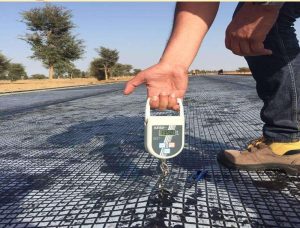
- High Tensile Strength: 50–100 kN/m tensile capacity with minimal elongation (<3%), ensuring load distribution without deformation.
- Thermal Resistance: Retains mechanical properties in extreme temperatures, ideal for asphalt paving (typically applied at 150–170°C).
- Chemical Stability: Resists corrosion from asphalt binders, salts, and moisture.
- Adhesion to Asphalt: Coated with polymer (e.g., bitumen, PVC) to enhance bonding with asphalt mixes.
Composite Variations
- Fiberglass Geogrid Composite with Nonwoven Fabric (Glue-Bonded):
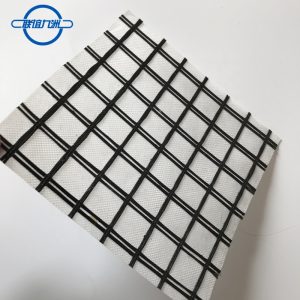
- Structure: Fiberglass geogrid laminated to a nonwoven polypropylene/polyester fabric using high-strength adhesives.
- Functions:
- Reinforcement + Waterproofing: The geogrid provides structural support, while the nonwoven layer blocks water infiltration and prevents subgrade erosion.
- Filtration: Allows vapor transmission to reduce hydrostatic pressure.
- Performance:
- Delamination resistance ≥95% (ASTM D4884).
- Puncture resistance enhanced by 30–50% compared to standalone geogrids.
- Fiberglass Geogrid Knitted with Nonwoven Fabric:
- Structure: Nonwoven fabric mechanically knitted (stitch-bonded) to the geogrid for integrated flexibility.
- Functions:
- Reinforcement + Separation: Prevents intermixing of asphalt and base layers while maintaining drainage.
- Impact Resistance: Knitted design absorbs dynamic loads (e.g., heavy traffic).
- Performance:
- Higher conformability to uneven surfaces vs. glue-bonded composites.
- UV-resistant fabric variants extend service life in exposed applications.
3. Advantages of Fiberglass Geogrids
- Reflective Crack Reduction: Up to 70% reduction in crack propagation compared to unreinforced asphalt.
- Extended Pavement Life: Increases asphalt layer lifespan by 3–5 years in high-traffic areas.
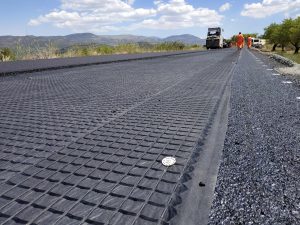
- Lightweight and Thin Profile: Adds minimal thickness (1–3 mm), preserving road design geometry.
- Rapid Installation: Pre-cut rolls simplify deployment; compatible with standard paving equipment.
- Cost Efficiency: Lowers long-term maintenance costs by delaying pavement deterioration.
4. Composite-Specific Benefits
| Type | Key Advantages |
|---|---|
| Standalone Geogrid | Pure reinforcement for projects requiring minimal thickness and maximum strength. |
| Glue-Bonded Composite | Ideal for waterproofing critical areas (e.g., bridge decks, tunnels). |
| Knitted Composite | Superior flexibility for curved surfaces (e.g., roundabouts, airport runways). |
5. Applications
- Highways & Airports: Reinforcement of asphalt overlays on concrete pavements.
- Urban Roads: Crack control in intersections and bus lanes.
- Parking Lots: Mitigates rutting from heavy vehicles.
- Bridge Decks (Composites): Waterproofing and stress relief in expansion joints.
6. Quality Control and Standards
- Material Testing:
- Tensile Strength: ASTM D6637 (≥50 kN/m).
- Junction Efficiency: ISO 10319 (≥90% for knitting/glue bonds).
- Asphalt Compatibility: Roller compaction tests to ensure binder penetration.
- Certifications: CE, ISO 9001, and AASHTO M288 specifications.
7. Feicheng Lianyi’s Expertise
Feicheng Lianyi Engineering Plastics Co., Ltd. produces all three fiberglass geogrid types using:
- Advanced Coating Technology: Bitumen/polymer coatings for optimal asphalt adhesion.
- Custom Solutions: Adjustable grid apertures (20–40 mm), fabric weights (100–400 g/m²), and roll sizes.
- Sustainability: Low-carbon manufacturing processes and recyclable materials.
Conclusion
Fiberglass geogrids and their composite variants are indispensable for modern asphalt reinforcement, offering tailored solutions for stress relief, crack control, and waterproofing. By integrating nonwoven fabrics, these composites add critical barrier functionality, making them ideal for demanding environments. Feicheng Lianyi’s innovative designs and rigorous quality assurance ensure reliable performance in global infrastructure projects
