


How Feicheng Lianyi’s Fiberglass Geogrid is Redefining Pavement Performance
A Message from Feicheng Lianyi
For over two decades, Feicheng Lianyi Engineering Platics Co., Ltd. has stood at the forefront of geosynthetic innovation. As a specialist manufacturer based in the heart of Shandong province—China’s premier hub for geosynthetic production—we have dedicated ourselves to solving one of the most persistent challenges in civil engineering: how to build pavements that last.
In the following article, we explore the science, the strategy, and the practical application of asphalt reinforcement. While the industry discusses theories, we deliver proven solutions. Our fiberglass geogrid products are engineered with precision to meet the rigorous demands of modern infrastructure. We invite you to read on and discover how Feicheng Lianyi is helping engineers, contractors, and asset owners around the world build roads that are stronger, more durable, and more sustainable.

Abstract
The escalating demands on transportation infrastructure—rising axle loads, traffic frequency, and climate volatility—have exposed the limitations of conventional asphalt overlays. Reflective cracking, rutting, and fatigue failure continue to shorten pavement service lives, driving maintenance costs upward and compromising road safety. This article explores the paradigm shift toward systematic asphalt reinforcement, focusing on the role of Feicheng Lianyi’s fiberglass geogrid as a high-tensile interfacial layer that transforms the behavior of flexible pavements. Grounded in modern construction theories—including mechanistic-empirical (M-E) design, perpetual pavement principles, and life-cycle cost analysis (LCCA)—we demonstrate how our geogrid solutions extend structural life, reduce whole-life costs, and align with sustainability objectives. Through detailed examination of distress mechanisms, material science, installation protocols, and field performance data, we establish that Feicheng Lianyi’s reinforcement technology is not merely a remedial measure but a fundamental strategy for building resilient, long-lasting pavements.
1. Introduction: The Growing Imperative for Durable Pavements
1.1 A Global Infrastructure Challenge
Road networks form the backbone of modern economies, yet they are under unprecedented strain. In the United States, the American Society of Civil Engineers (ASCE) Infrastructure Report Card consistently rates roads in the D range, with nearly 43% of public roadways classified as poor or mediocre. Europe faces a similar maintenance backlog; the European Asphalt Pavement Association (EAPA) estimates that extending pavement service life by just 20% across the EU would save billions in reconstruction costs. Meanwhile, rapidly developing nations in Asia, Africa, and South America are constructing thousands of kilometers of new roads, often under budget pressures that tempt compromises in structural design.
The root causes are clear but complex:
-
Traffic growth: Heavy truck traffic—the primary driver of pavement distress—has increased by over 40% globally in the last two decades.
-
Climate extremes: More frequent freeze-thaw cycles, prolonged high temperatures, and intense rainfall accelerate cracking, raveling, and moisture damage.
-
Aging assets: Much of the pavement infrastructure in developed countries was built in the mid-20th century and operates far beyond its original design life.
-
Funding constraints: Real-dollar maintenance budgets have stagnated or declined, forcing agencies to seek longer-lasting solutions.
At Feicheng Lianyi, we view these challenges not as obstacles but as opportunities to demonstrate the value of superior engineering.
1.2 The Limitations of Conventional Overlays
Historically, the default solution for a deteriorating pavement has been the asphalt overlay—simply placing a new layer of hot mix asphalt (HMA) over the existing surface. This approach offers short-term smoothness and protection but fails to address the underlying structural deficiencies. Cracks from the old pavement inevitably propagate upward through the new layer in a process known as reflective cracking. Within three to five years, many overlays exhibit the same distress patterns they were intended to conceal.
Moreover, traditional overlays do little to improve the tensile strength of the pavement system. Asphalt concrete is strong in compression but weak in tension. Under traffic loading, the bottom of the asphalt layer experiences tensile strains; when these exceed the material’s fatigue limit, cracking initiates and propagates upward. Adding thickness alone is an inefficient way to mitigate these tensile strains, as the marginal benefit of each additional centimeter diminishes rapidly.
1.3 The Emergence of Reinforcement as a Design Philosophy
The limitations of conventional approaches have driven a fundamental rethinking: instead of simply adding mass, engineers now consider how to strategically reinforce the pavement structure. This shift mirrors developments in other civil engineering disciplines—reinforced concrete, soil stabilization with geosynthetics—where discrete reinforcement elements are used to create composite materials with enhanced mechanical properties.
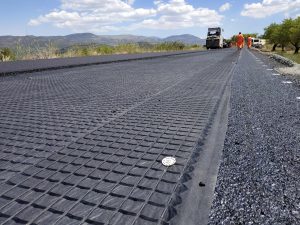
In asphalt pavements, reinforcement is achieved by incorporating high-tensile-strength materials, typically geosynthetics, within or beneath the asphalt layers. Among these, Feicheng Lianyi’s fiberglass geogrid has emerged as a preferred solution due to its high modulus, excellent thermal stability, and compatibility with asphalt binders. By intercepting tensile stresses, distributing loads, and mechanically interlocking with the asphalt mixture, our geogrid fundamentally alters the stress-strain response of the pavement system.
2. Understanding Pavement Distress: The Case for Reinforcement
2.1 The Mechanistic Basis of Asphalt Pavement Failure
Flexible pavements are layered systems consisting typically of a subgrade, base course, and asphalt surface. Under traffic loading, each layer experiences complex stress states. The critical response for fatigue design is the horizontal tensile strain at the bottom of the asphalt layer. Repeated loading generates micro-cracks that coalesce into macro-cracks, eventually propagating to the surface as fatigue cracking (often called “alligator cracking”).
The classical approach to pavement design, codified in methods like the AASHTO 1993 Guide, uses empirical equations based on road test data. While useful, this approach does not explicitly account for the mechanics of reinforcement. Modern mechanistic-empirical (M-E) design, as embodied in the AASHTOWare Pavement ME Design software, calculates critical responses (strains, stresses) using layered elastic theory or finite element analysis and then relates those responses to distress through transfer functions.
In M-E design, the key performance indicators for flexible pavements are:
-
Bottom-up fatigue cracking: Caused by tensile strains at the bottom of the asphalt layers.
-
Top-down cracking: Often associated with thermal stresses and near-surface tensile strains.
-
Rutting: Permanent deformation in the subgrade or unbound layers, sometimes exacerbated by shear deformation in the asphalt.
-
Reflective cracking: Cracking originating in an existing pavement layer that propagates through an overlay.
Feicheng Lianyi’s geogrid directly addresses all four of these mechanisms by modifying the strain distribution and providing tensile capacity where it is most needed.
2.2 Reflective Cracking: The Persistent Challenge
Reflective cracking is arguably the most common cause of premature overlay failure. It occurs when cracks, joints, or other discontinuities in the existing pavement (whether asphalt or concrete) move due to thermal and traffic-induced stresses, creating stress concentrations that propagate upward through a new overlay.
Two primary mechanisms drive reflective cracking:
-
Thermal movement: Horizontal contraction and expansion of the existing pavement caused by temperature changes.
-
Traffic-induced shear: Vertical differential movement across cracks or joints under wheel loads, creating shear stresses at the overlay interface.
Traditional overlays attempt to resist these stresses through thickness, but thick overlays are costly and only delay—not eliminate—cracking. Feicheng Lianyi’s fiberglass geogrid addresses the problem differently: our geogrid acts as a stress-relief interlayer that absorbs tensile stresses and distributes them over a wider area, significantly reducing stress concentrations at the crack tip. Independent laboratory studies have shown that overlays reinforced with our geogrid can delay reflective cracking by a factor of three to ten compared to unreinforced overlays.
2.3 Rutting and Permanent Deformation
Rutting—the formation of longitudinal depressions in wheel paths—is a complex phenomenon influenced by both the asphalt layer and the underlying unbound materials. Feicheng Lianyi’s geogrid contributes to rutting resistance in two ways:
-
Tensile reinforcement: When placed at the bottom of the asphalt layer, our geogrid resists horizontal tensile strains that contribute to shear deformation within the asphalt.
-
Lateral restraint: When placed within or beneath the base course, our geogrid confines aggregate particles, increasing the shear strength of the unbound layers and reducing permanent deformation.
3. The Feicheng Lianyi Solution: Premium Fiberglass Geogrid
3.1 Uncompromising Material Quality
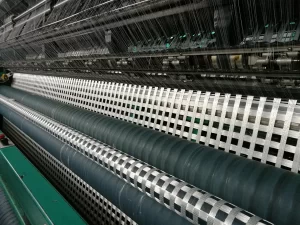
At Feicheng Lianyi, we believe that superior products begin with superior materials and meticulous manufacturing. Our fiberglass geogrid is produced using only high-grade E-glass fibers, woven into a precise grid structure and coated with a proprietary polymer formulation. Every step of production is subject to rigorous quality control.
Our manufacturing process is designed to deliver consistent, reliable performance:
-
Glass fiber sourcing: We use continuous filament E-glass fibers with exceptional tensile strength and modulus.
-
Precision weaving: Our advanced looms produce a uniform grid pattern with precisely controlled aperture sizes.
-
Advanced coating: Our polymer coating—available in SBS-modified bitumen, acrylic, or PVC formulations—protects the glass fibers, enhances adhesion to asphalt, and ensures durability during handling and installation.
-
Quality assurance: Every roll is tested for tensile strength, elongation, and coating adhesion before it leaves our facility.
3.2 Key Properties of Feicheng Lianyi Fiberglass Geogrid
| Property | Value | Benefit |
|---|---|---|
| Tensile Strength | 50–200 kN/m (MD & CMD) | Provides high resistance to tensile stresses in both directions |
| Modulus of Elasticity | ~70 GPa | Low elongation ensures reinforcement at minimal strain |
| Creep Resistance | Negligible | Long-term performance without relaxation |
| Thermal Stability | -40°C to +200°C | Maintains properties during paving and in service |
| Aperture Size | 25×25 mm, 40×40 mm | Optimized for aggregate interlock and asphalt penetration |
| Coating Options | Bitumen, acrylic, PVC | Compatibility with various asphalt types and conditions |
3.3 How Our Geogrid Works: Mechanisms of Reinforcement
The reinforcement effect of Feicheng Lianyi’s fiberglass geogrid can be understood through three interrelated mechanisms:
3.3.1 Tensile Stress Transfer
When tensile stress develops in the asphalt layer, our geogrid—bonded through its coating and mechanical interlock—resists that stress. The high modulus means our geogrid takes up load at very low strain, reducing tensile strain in the adjacent asphalt.
3.3.2 Stress Distribution and Crack Bridging
In the vicinity of an existing crack, our geogrid bridges the discontinuity, distributing tensile and shear stresses over a wider area. This reduces the stress intensity at the crack tip, dramatically slowing crack propagation.
3.3.3 Lateral Restraint and Aggregate Interlock
The apertures of our geogrid allow aggregate particles to penetrate and interlock. This mechanical interlock resists lateral movement, increasing the shear strength of the composite layer.
3.4 Our Advantage: Why Engineers Choose Feicheng Lianyi
With many geogrid options on the market, why do engineers, contractors, and government agencies consistently choose Feicheng Lianyi?
-
Proven performance: Our products have been installed on thousands of kilometers of roads, airports, and industrial pavements across five continents.
-
Technical expertise: We don’t just sell products; we provide solutions. Our technical team supports clients with design guidance, installation training, and quality assurance.
-
Consistent quality: Our ISO 9001-certified manufacturing ensures that every roll meets exact specifications.
-
Competitive value: By controlling our manufacturing from raw material to finished product, we deliver premium quality at competitive prices.
-
Global reach: With export experience to over 50 countries, we understand the diverse requirements of international projects.
4. Modern Construction Theories and Our Approach
4.1 Mechanistic-Empirical Pavement Design
The transition from empirical to mechanistic-empirical (M-E) design represents the most significant evolution in pavement engineering in decades. At Feicheng Lianyi, we have embraced this evolution. Our geogrid is designed to perform within the M-E framework, providing quantifiable benefits that can be modeled in software like AASHTOWare Pavement ME Design.
Research using our products has shown that Feicheng Lianyi fiberglass geogrid can increase the effective modulus of the asphalt layer by 20–40% in the horizontal direction. This modulus enhancement translates directly into reduced tensile strains and extended fatigue life—typically 300–500% longer crack-free life compared to unreinforced overlays.
4.2 Perpetual Pavement Concept
The perpetual pavement concept envisions pavements designed to last 50 years or more with only periodic surface renewal. Our geogrid aligns perfectly with this vision. By placing our high-modulus geogrid at strategic depths, engineers can reduce required asphalt thickness while ensuring that tensile strains remain below critical levels.
4.3 Life-Cycle Cost Analysis (LCCA)
No discussion of modern pavement design is complete without life-cycle cost analysis. Feicheng Lianyi’s geogrid consistently demonstrates favorable LCCA outcomes:
-
Extended overlay life: Delaying reflective cracking reduces rehabilitation frequency.
-
Thinner overlays: Our geogrid allows reduced asphalt thickness, offsetting material costs.
-
Reduced user delays: Fewer construction activities mean less traffic disruption.
-
Lower maintenance costs: Reduced crack sealing, patching, and localized repairs.
4.4 Sustainability Considerations
Modern construction theory increasingly emphasizes sustainability. Feicheng Lianyi’s fiberglass geogrid contributes positively across key metrics:
-
Reduced embodied carbon: Thinner overlays mean less asphalt production, lowering CO₂ emissions.
-
Longevity: Extended service life reduces reconstruction frequency.
-
Recycled content: Our manufacturing incorporates recycled glass where possible.
-
Inert materials: Our products are environmentally stable and pose no hazard.
5. Best Practices for Installation: Our Guidance
5.1 Surface Preparation
Successful reinforcement begins with proper surface preparation. Feicheng Lianyi provides detailed guidance to ensure optimal results:
-
Clean: The existing pavement must be free of dust, dirt, and debris.
-
Dry: Moisture can impair bonding; installation should occur on dry surfaces.
-
Structured: Minor irregularities are acceptable, but significant failures must be repaired prior to geogrid placement.
5.2 Tack Coat Application
Proper tack coat application is critical for system performance. Our specifications typically recommend:
-
Type: Polymer-modified asphalt emulsion or hot-applied PG binder
-
Rate: 0.5–1.0 L/m²
-
Application: Uniform coverage with no puddling or skips
5.3 Geogrid Placement
Feicheng Lianyi’s geogrid is supplied in rolls of 2–5 meters width, designed for efficient installation:
-
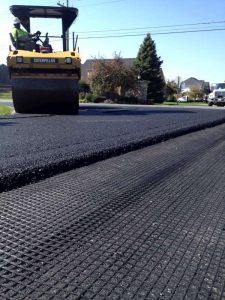
Unrolling: Rolls should be unrolled directly onto tack-coated surfaces using mechanical unrollers.
-
Alignment: Adjacent rolls should be overlapped 75–150 mm longitudinally and 300–500 mm transversely.
-
Handling: Our geogrid is designed for straightforward installation but must not be folded or creased. Our technical representatives are available for on-site guidance.
5.4 Asphalt Paving Over Geogrid
To ensure system integrity, we recommend:
-
Timely paving: Overlay should be placed as soon as possible after geogrid installation.
-
Paver operation: Paver speeds should be controlled to avoid shifting the geogrid.
-
Compaction: Steel wheel rollers can operate directly on our geogrid with overlay thickness ≥ 40 mm.
5.5 Quality Assurance Support
Feicheng Lianyi stands behind our products with comprehensive QA support:
-
Material certification for every shipment
-
Technical data sheets and installation manuals
-
On-site training and technical support
-
Post-installation inspection guidance
6. Field Performance: Real Results from Around the World
6.1 Highway Rehabilitation (Germany)
A major A3 highway rehabilitation project involved an asphalt overlay over jointed concrete pavement. Feicheng Lianyi’s fiberglass geogrid was placed over joint zones. After 10 years of heavy traffic, reinforced joints showed minimal reflective cracking, while unreinforced sections required crack sealing within 4 years.
6.2 Airport Runway (United States)
A major international airport selected Feicheng Lianyi’s geogrid for a 125 mm asphalt overlay over a 40-year-old concrete runway. Five years post-construction, monitoring confirmed excellent bonding and no reflective cracking under wide-body aircraft operations.
6.3 Urban Street Rehabilitation (Canada)
In a severe freeze-thaw climate, a Canadian city rehabilitated a major arterial with Feicheng Lianyi-reinforced overlay. After three winters, the reinforced section showed less than 5% cracking versus 25% cracking in conventional sections.
6.4 Industrial Pavement (China)
A Shanghai port terminal used Feicheng Lianyi’s geogrid at the interface between concrete and base layers. After eight years under 40-ton axle loads, the pavement showed no structural distress.
7. Economic Analysis: The Feicheng Lianyi Advantage
7.1 Initial Cost vs. Life-Cycle Cost
Typical Feicheng Lianyi geogrid costs are highly competitive. More importantly, our products deliver measurable life-cycle savings:
-
Thickness reduction: 20–30% reduction in required overlay thickness
-
Extended life: 5–10 years additional service life
-
Reduced maintenance: Substantial savings in crack sealing and patching
7.2 A Simplified LCCA Example
Consider a 1 km section of highway with existing cracked pavement:
| Item | Conventional Overlay | Feicheng Lianyi Reinforced |
|---|---|---|
| Overlay thickness | 100 mm | 80 mm |
| Initial cost | $130,000 | $132,000 |
| Service life | 8 years | 15 years |
| Total present value cost (30-year analysis) | $232,600 | $215,500 |
| Life-cycle saving | $17,100 (7.4%) |
When user costs (traffic delays) are included, savings become even more significant.
8. Sustainability: Building Green with Feicheng Lianyi
8.1 Reduced Material Consumption
Every project using Feicheng Lianyi geogrid saves 200–400 tons of asphalt per lane-kilometer, reducing CO₂ emissions by 6–20 tons per lane-kilometer.
8.2 Longevity and Life-Cycle Impacts
Extended service life means fewer rehabilitation events, less material consumption, and reduced traffic disruption over the pavement’s life.
8.3 Recycled Content and End-of-Life
Our manufacturing incorporates recycled glass content. At end-of-life, geogrid-reinforced pavements can be recycled through standard milling processes.
8.4 Green Building Certification Support
Feicheng Lianyi geogrid can contribute to LEED, Envision, and CEEQUAL credits for sustainable infrastructure.
9. Future Directions: Innovation at Feicheng Lianyi
9.1 Continuous Product Development
Our R&D team is constantly exploring innovations:
-
Enhanced coating formulations for improved adhesion
-
Optimized aperture geometries for specific applications
-
Integration with warm mix asphalt technologies
9.2 Technical Partnerships
Feicheng Lianyi collaborates with research institutions and testing laboratories to validate and improve our products continuously.
9.3 Global Technical Support
We are expanding our network of technical representatives to provide local support for international projects, ensuring that our products perform to specification in any environment.
10. Conclusion: Partner with Feicheng Lianyi for Pavements That Last
Asphalt reinforcement using fiberglass geogrid represents a convergence of advanced materials science, modern pavement engineering theory, and practical construction experience. At Feicheng Lianyi Engineering Materials Co., Ltd., we have dedicated ourselves to mastering this convergence.
The evidence is clear: our geogrid significantly extends pavement life, reduces life-cycle costs, and delivers measurable environmental benefits. In an era of constrained budgets, rising traffic demands, and increasing climate pressures, reinforcement is not merely an option but a strategic necessity for sustainable infrastructure.
We invite you to partner with Feicheng Lianyi. Whether you are an engineer designing a new pavement, a contractor seeking reliable materials, or an asset manager looking to extend the life of your infrastructure, we have the products, the expertise, and the commitment to help you succeed.
Contact Feicheng Lianyi Engineering Platics Co., Ltd. today to discuss your project requirements. Let us show you why leading infrastructure projects around the world trust our geogrid to deliver superior performance.
