


Why Polyester Uniaxial Geogrids Are Perfect for Retaining Walls and Slopes
Imagine building a wall to hold back tons of soil or reinforcing a steep hillside to prevent landslides. These structures need to stay strong not just today, but for decades. This is where polyester uniaxial geogrids shine—and their secret weapon is something called creep resistance. Let’s break down what this means and why it matters.
What is Creep Resistance?
Think of creep like a slow, sneaky stretch. If you hang a heavy weight on a rubber band, it stretches a little at first. Over time, it might keep stretching until it snaps. Creep resistance is a material’s ability to resist this slow stretching under constant load.
For geogrids (grid-like materials used to reinforce soil), creep resistance is critical. If the geogrid stretches too much over time, the soil it’s holding could shift, causing walls to bulge or slopes to collapse.
Why Polyester Geogrids Beat the Creep
Polyester uniaxial geogrids exhibit excellent creep resistance due to a combination of material properties, manufacturing techniques, and design optimization. Creep resistance refers to the material’s ability to withstand long-term deformation under sustained tensile loads, which is critical for geogrids used in soil reinforcement (e.g., retaining walls, slopes, embankments). Here’s a detailed breakdown of the factors contributing to their superior creep performance:
1. Material Properties of Polyester (PET)
Polyester (polyethylene terephthalate, or PET) is inherently resistant to creep because of its molecular structure:
- High-Tenacity Yarns: PET is engineered with highly oriented polymer chains, resulting in strong covalent bonds and minimal chain slippage under load.
- Low Elongation: Polyester fibers elongate very little under stress (typically <10% at break), reducing the risk of progressive deformation.
- Glass Transition Temperature (Tg): PET has a high Tg (~70–80°C), meaning it remains dimensionally stable under typical environmental temperatures.
2. Manufacturing Process Enhancements
The production of uniaxial geogrids using warp knitting and heat setting further enhances creep resistance:
- Warp Knitting:

warp-knitting machine - Aligns yarns in the machine direction (MD) with minimal crimping, ensuring fibers bear loads efficiently.
- Reduces internal stress concentrations that could trigger creep.
- Heat Setting:

Knitted Geogrid Coating Line - Stabilizes the yarn orientation by heating the grid under tension, “locking” the polymer chains into place.
- Eliminates residual stresses that might cause gradual deformation.
- Protective Coatings:
- Polymer coatings (e.g., PVC, bitumen) shield PET from environmental factors (UV, moisture, chemicals) that could degrade fibers over time.


3. Uniaxial Design Focus
Uniaxial geogrids are engineered to prioritize strength in one direction, optimizing their structure for creep resistance:
- Longitudinal Ribs: High-tenacity yarns are densely packed in the load-bearing direction, minimizing strain under sustained tension.
- Minimal Transverse Yarns: Non-structural crosswise yarns stabilize the grid during production but do not contribute to load-bearing, avoiding unnecessary stress points.
4. Quality Control & Testing
Polyester geogrids undergo rigorous testing to ensure creep resistance:
- ISO/ASTM Standards: Tests like ISO 13431 or ASTM D5262 evaluate long-term creep behavior under controlled loads.
- Creep Reduction Factors: Engineers apply safety factors (e.g., 2.5–4.0) to account for worst-case environmental and load conditions.
5. Comparison to Other Materials
- Polypropylene (PP) Geogrids: Prone to higher creep due to lower Tg (~0°C) and less rigid polymer chains.
- Steel Geogrids: Immune to creep but vulnerable to corrosion, limiting long-term reliability.
Real-World Applications
The creep resistance of polyester uniaxial geogrids makes them ideal for:
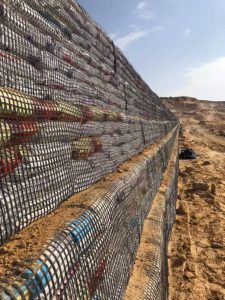
- Retaining Walls: Maintain structural integrity against lateral earth pressure for decades.
- Landfill Liners: Resist deformation under heavy waste loads.
- Railway Embankments: Withstand cyclic loading from trains without losing stiffness.
Key Takeaway
Polyester uniaxial geogrids combine high-tenacity PET, optimized manufacturing, and unidirectional design to achieve exceptional creep resistance. This ensures long-term stability in critical civil engineering projects, where even minor deformation could compromise safety. By contrast, materials like polypropylene or poorly engineered grids may succumb to creep, leading to costly failures.
Why This Matters for Retaining Walls and Slopes
Retaining Walls
Retaining walls hold back soil to create level ground (like in your backyard or along highways). If the geogrid inside the wall slowly stretches:
- The wall could bulge or crack.
- Soil might erode, leading to costly repairs.
Polyester geogrids stay strong over time, keeping the wall straight and stable.
Slope Protection
On hillsides or road embankments, gravity and rain constantly try to pull soil downhill. Geogrids act like an invisible net that holds the soil in place. If the geogrid creeps:
- The slope could gradually slump or slide.
- Roads or buildings nearby might be damaged.
With polyester geogrids, the net stays tight, preventing slow-motion disasters.
Real-World Superpowers
- Longevity: They last 50–100 years without losing strength.
- Weatherproof: Resistant to UV rays, chemicals, and moisture.
- Lightweight: Easy to install, reducing labor and costs.
The Bottom Line
Creep resistance might sound technical, but it’s simple: polyester uniaxial geogrids don’t quit. They’re built to handle heavy loads, day after day, year after year, without stretching or sagging. This makes them the go-to choice for engineers who need reliable, long-lasting solutions for retaining walls, slopes, and other critical earth structures.
Next time you see a steep hillside or a tall retaining wall, remember—there’s probably a hidden geogrid hero inside, keeping everything in place!
