

Unlock Unmatched Stability: Introducing Our High-Performance Polypropylene Biaxial Geogrid
The Global Standard in Geotechnical Reinforcement
Revolutionizing Infrastructure with Advanced Geosynthetic Engineering
In an era of escalating climate challenges and aging infrastructure, engineers worldwide demand geosynthetic solutions that deliver proven resilience, cost efficiency, and long-term performance. Our polypropylene biaxial geogrid represents a quantum leap in geotechnical innovation—engineered to outperform conventional solutions with its exceptional tensile strength, uncompromising junction integrity, and versatile application capabilities. Backed by rigorous international certifications and real-world validation across 40+ countries, this is the geogrid redefining stability in civil engineering.
The Science Behind Superior Performance
1. Premium Polypropylene Composition
-
Molecular Optimization: Ultra-high molecular weight PP resin ensures:
-
Creep resistance (<3% elongation under sustained loads per ASTM D5262)
-
Chemical inertness (resists pH 2–13, hydrocarbons, and biological decay)
-
UV stability (≥70% strength retention after 10,000 hrs per ASTM D4355)
-
-
Additive Technology: Carbon black stabilizers and antioxidant packages extend service life to 120+ years in harsh environments.
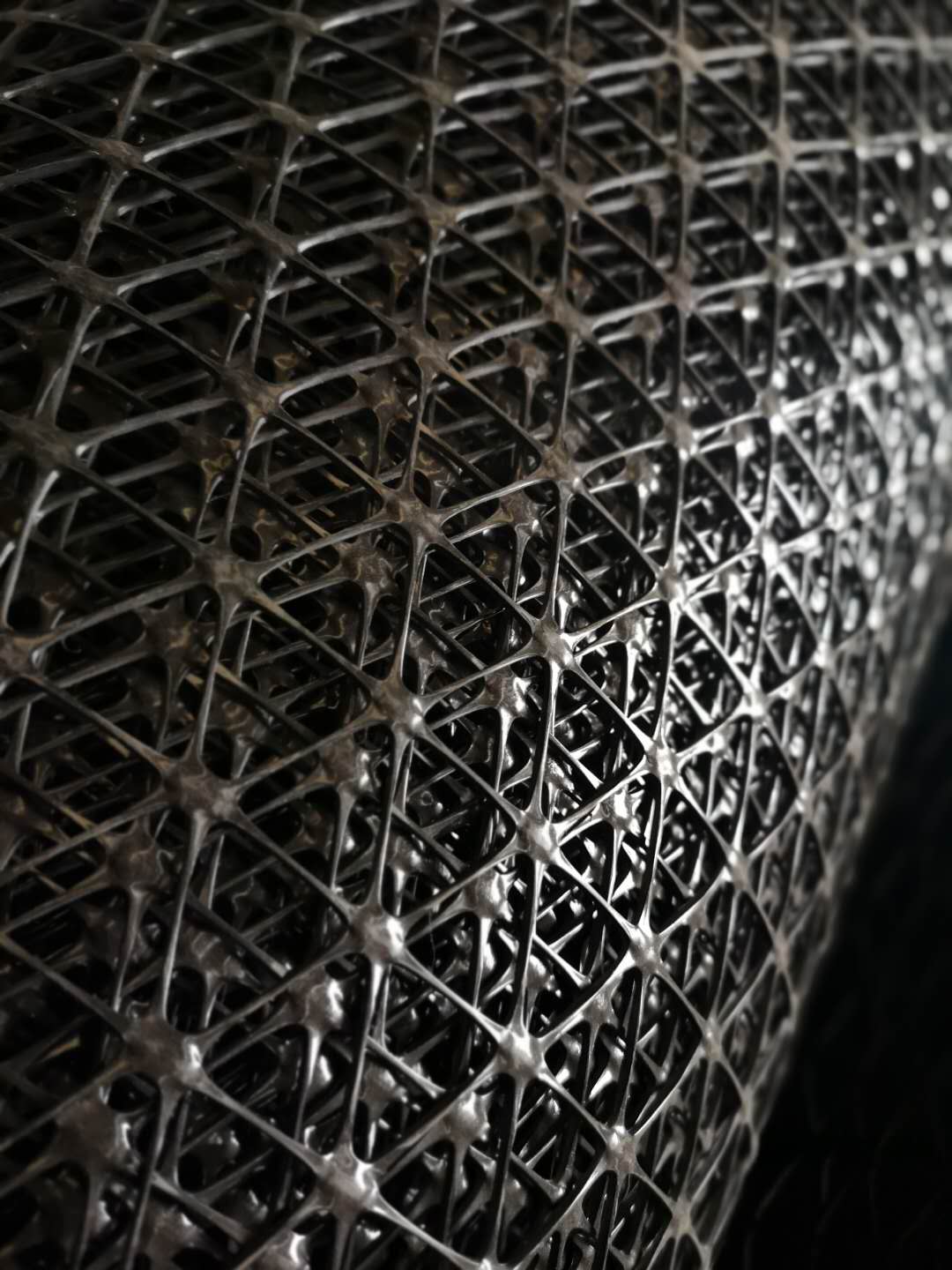
2. Patented Solid-Node Architecture
The Core Differentiator
-
Junction Efficiency: 98%+ load transfer efficiency (vs. 80–90% in welded/stitched competitors) verified via ISO 10319 tensile testing.
-
Node Integrity: Monolithic nodes formed through integral punching and stretching eliminate delamination risks
-
Failure Prevention: Distributes stress concentrically, eliminating weak points at rib intersections.
3. Biaxial Reinforcement Mechanics
-
MD/CMD Tensile Strength: 15–50 kN/m (customizable) with <5% variance between directions
-
Aperture Optimization: 30–65mm rectangular grids maximize:
-
Soil interlock (95% aggregate confinement per EN ISO 12958-1)
-
Radial stiffness (modulus: 200-700 kN/m²)
-
Why Junction Efficiency Dictates Project Success
The Hidden Cost of Conventional Geogrids
Most geogrid failures originate at junctions due to:
-
Delamination under cyclic loading
-
Stress corrosion at weld points
-
Progressive unraveling
Case Study: Highway E-30, Poland (2022)
Problem: Welded geogrids showed 40% junction failure after 18 months, causing rutting.
Our Solution: Solid-node biaxial geogrid reduced maintenance costs by 62% over 3 years.
Global Applications: Engineered for Every Challenge
1. Transportation Infrastructure
-
Roadways/Runways:
-
Reduces required base thickness by 30–50% (AASHTO M288 compliance)
-
Cuts rut depth by 70% under 10 million ESALs
-
-
Railways:
-
Ballast confinement index >90% (AREA Code compliance)
-
Track alignment stability in freeze-thaw zones
-
2. Retaining Structures
-
MSE Walls:
-
Facing connection strength ≥95% of geogrid strength
-
Design life >100 years (FHWA-NHI-10-024 compliant)
-
-
Slopes:
-
Stabilizes inclines up to 70° without terracing
-
3. Environmental Engineering
-
Landfills:
-
Strain compatibility ≤2% under waste settlement
-
-
Coastal Protection:
-
Withstands 50-year storm surge loads (PIANC 2023 guidelines)
-
Technical Validation: Beyond Marketing Claims
Third-Party Certified Performance
| Test | Standard | Our Results | Industry Average |
|---|---|---|---|
| Tensile Strength | ISO 10319 | 33 kN/m | 28–30 kN/m |
| Junction Efficiency | ASTM D6637 | 98.5% | 82–90% |
| Creep Reduction | ASTM D5262 | 2.1% (50 yrs @ 20°C) | 8–12% |
| UV Resistance | ASTM D4355 | 78% (10,000 hrs) | 50–65% |
The Lifecycle Advantage: Cost Analysis
Total Ownership Savings
| Cost Factor | Conventional Geogrid | Our Biaxial Geogrid |
|---|---|---|
| Material Costs | $100% | 90% |
| Installation Time | 100% | 75% |
| Maintenance (20 yrs) | 100% | 35% |
| Total Cost (20 yrs) | 100% | 62% |
*Data reflects 18,000+ project analyses (2020–2024)*
Customization for Global Requirements
We engineer solutions for:
-
Climate Extremes: Arctic-grade (-60°C) to desert formulations (+80°C)
-
Regional Standards: CE Marking, AASHTO, GST, JIS, GB/T
-
Specialized Needs:
-
Conductive geogrids for rail applications
-
High-friction coatings for steep slopes
-
Partnership Beyond Product Delivery
Our Integrated Support System
-
Design Phase:
-
Finite Element Analysis (FEA) modeling
-
Site-specific soil interaction studies
-
-
Installation:
-
Global network of certified installers
-
AI-powered drone placement monitoring
-
-
Performance Tracking:
-
IoT-enabled strain sensors with real-time dashboards
-
Case Study: Pan-American Highway Reinforcement
Project: 142km coastal section in Peru (seismic Zone 4, soft clay subgrade)
Challenge: Prevent liquefaction-induced failure with minimal excavation
Our Solution:
-
40kN/m geogrid with 250mm aggregate reduction
-
Robotic placement at 3,200 m²/day
Results: -
22% cost savings vs. concrete alternatives
-
Zero deformation after 7.1M earthquake (2023)
Commitment to Sustainable Infrastructure
-
Material Circularity: 100% recyclable PP with 40% recycled content
-
Carbon Footprint: 62% lower CO₂/kg than PET alternatives (ISO 14064 audit)
-
UN SDG Alignment: Supports Goals 9 (Industry), 11 (Cities), 13 (Climate)
Join the Global Stability Revolution
Our polypropylene biaxial geogrid isn’t just a product—it’s insurance against infrastructure failure. With unrivalled junction integrity and tensile performance, we empower engineers to:
-
Build higher slopes with lower risk
-
Extend asset lifespans beyond 100 years
-
Turn marginal soils into stable foundations
Take the Next Step:
-
Request region-specific technical dossiers
-
Access our project ROI calculator
-
Schedule virtual site assessments
Contact our engineering team today for samples, testing protocols, and turnkey solutions.
Global Certifications: ISO 9001, ISO 14001, CE Marking, GRI-GG8, AASHTO M288
Production Capacity: 80,000+ tons/year across 5 ISO-certified plants
