

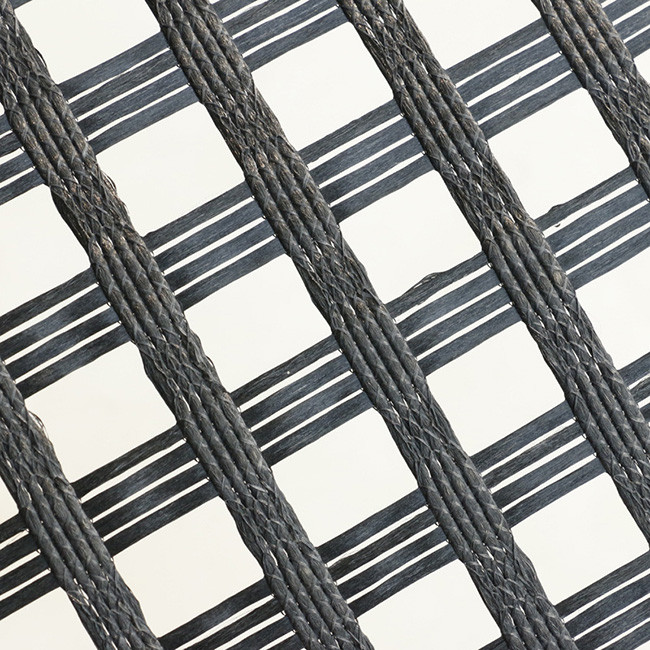
Fiberglass Geogrid Reinforcement: Extending the Lifespan of Asphalt Pavements
1 Introduction
Asphalt pavement durability remains a critical concern for transportation infrastructure worldwide, with engineers and road authorities continuously seeking innovative solutions to extend service life while minimizing maintenance costs and environmental impacts. The persistent challenges of cracking, rutting, and structural deterioration under increasing traffic loads and environmental stresses have prompted the development of various reinforcement technologies. Among these, fiberglass geogrid reinforcement has emerged as a particularly effective solution for significantly enhancing pavement performance and longevity. This article comprehensively examines how incorporating fiberglass geogrids into asphalt pavement structures compares with traditional unreinforced approaches, drawing upon laboratory research, case studies, and environmental impact assessments to quantify the substantial benefits this technology offers to modern road infrastructure.
2 The Conventional Pavement: Inherent Limitations and Shortened Lifespan
Traditional asphalt pavements without reinforcement operate as monolithic structures that directly transmit traffic loads and environmental stresses to underlying layers. This design approach suffers from several inherent weaknesses that inevitably lead to premature failure:
-
Reflective cracking: Existing cracks or joints in underlying layers inevitably propagate upward through new asphalt overlays due to concentrated stress from traffic loading and thermal movement. This phenomenon represents the most common and debilitating failure mechanism for unreinforced pavements.
-
Fatigue cracking: Repeated traffic loads over weak subgrades cause the asphalt surface to flex beyond its capacity, leading to interconnected cracks that resemble alligator skin, significantly compromising structural integrity.
-
Rutting: The permanent deformation of asphalt layers under heavy, channelized traffic creates ruts that pose safety risks and water drainage problems, particularly in high-temperature conditions.
For conventional asphalt overlays without reinforcement, the typical service life before requiring major rehabilitation is often only 5 to 8 years, with the first signs of reflective cracking frequently appearing within just 1-2 years of installation. This premature deterioration initiates a costly cycle of patching and sealing that addresses symptoms rather than root causes, ultimately resulting in higher lifetime costs and user disruptions.
3 How Fiberglass Geogrid Reinforcement Works
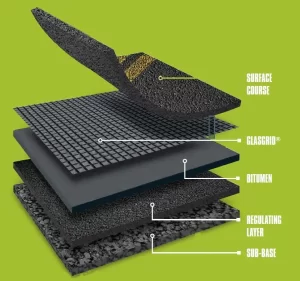
Fiberglass geogrids transform pavement performance through several key mechanical mechanisms that address the fundamental weaknesses of traditional asphalt:
-
The Membrane Effect: The high-tensile-strength geogrid absorbs tensile stresses that would otherwise cause cracking. It effectively bridges over cracks and voids in existing pavements, distributing loads over a wider area and significantly reducing stress concentration at crack tips .
-
Improved Interlock and Confinement: The geogrid’s open grid structure allows asphalt to penetrate through, creating a mechanical interlock that restrains aggregate movement within the asphalt layer, thereby enhancing shear resistance and reducing rutting .
-
Reduction of Vertical Strain: By stiffening the entire pavement structure, geogrids reduce vertical deformation under load, directly combating the causes of fatigue cracking .
-
Superior Material Properties: Fiberglass geogrids possess exceptional high-temperature resistance (up to 1000°C), ensuring grid stability during hot asphalt installation, and offer high tensile strength with low elongation, creating an optimal reinforcement solution .
Table: Key Properties of Fiberglass Geogrids That Enhance Pavement Performance
| Property | Technical Characteristic | Benefit to Pavement |
|---|---|---|
| Tensile Strength | High strength in both longitudinal and transverse directions | Distributes traffic loads, reduces stress concentrations |
| Elongation | Low elongation under load | Minimizes deformation, maintains structural integrity |
| Temperature Resistance | Stable up to 1000°C | Withstands hot mix asphalt installation without degradation |
| Interlock Capability | Open grid structure | Creates mechanical bond with asphalt aggregates |
4 Quantitative Evidence: Laboratory Research and Case Studies
4.1 Remarkable Fatigue Life Extension
Substantial research demonstrates the dramatic improvements possible with fiberglass geogrid reinforcement:
-
A comprehensive laboratory study published in the Transportation Research Record revealed that asphalt beams reinforced with glass fiber geogrids showed a 3 to 5 times longer fatigue life with 100-kN/m strength geogrids, and an extraordinary 5 to 9 times longer fatigue life with 200-kN/m strength geogrids compared to unreinforced beams .
-
The same study documented an on-site performance evaluation on the Taiwan Second Freeway, where rutting-depth measurements over 10 months confirmed “obvious and significant” improvement in the fatigue life of the pavement overlay reinforced with geogrids .
4.2 Reflective Crack Resistance and Real-World Applications
-
Research documented in the Journal of Transportation Engineering confirmed that fiberglass geogrids can reduce reflective cracking by up to 60% compared to unreinforced sections over a five-year evaluation period .
-
Case studies from Chinese highway systems have demonstrated that incorporating fiberglass geogrids in pavement rehabilitation projects effectively controls reflective cracking from underlying semi-rigid bases, a common failure mechanism in these environments.
-
Product performance data from industry leader Saint-Gobain indicates that their GlasGrid® pavement reinforcement system can reduce crack occurrence to one-third of conventional pavement performance while improving drainage capacity by 10%.
Table: Documented Performance Improvements with Fiberglass Geogrid Reinforcement
| Study Type | Performance Metric | Improvement Over Unreinforced Pavement |
|---|---|---|
| Laboratory Testing | Fatigue life | 3-9 times longer depending on geogrid strength |
| Highway Case Study | Reflective cracking | Up to 60% reduction over 5 years |
| Product Performance | Crack occurrence | Reduced to 1/3 of conventional pavement |
| Environmental Study | Maintenance impacts | 30% reduction over 40-year lifecycle |
5 Project Longevity and Sustainability Implications
The extended service life made possible by fiberglass geogrid reinforcement translates to substantial sustainability benefits:
-
A comprehensive life-cycle assessment study conducted on a stretch of the A2-Mediterraneo highway in Italy concluded that using glass fiber geogrid reinforcement could reduce environmental impacts by 30% over a forty-year service life, considering energy consumption, water use, and CO₂ emissions associated with maintenance operations .
-
By significantly delaying the need for major rehabilitation, geogrid-reinforced pavements reduce lifecycle costs by up to 30% compared to conventional approaches, considering both direct maintenance expenses and user delay costs .
-
The ability to use potentially thinner asphalt sections without compromising performance represents additional material savings and environmental benefits, further enhancing the sustainability profile of this reinforcement approach .
Research comparing traditional and geogrid-reinforced roads has demonstrated that the reinforcement approach can potentially double the time between major rehabilitations, from approximately 10 years for conventional surfaces to 20 years or more for reinforced sections, creating substantial economic and user convenience benefits .
6 Conclusion
The evidence from laboratory studies, real-world case examples, and environmental impact assessments consistently demonstrates that fiberglass geogrid reinforcement significantly extends asphalt pavement lifespan while reducing maintenance requirements and environmental impacts. Compared to conventional pavements that typically require major rehabilitation within 5-8 years, reinforced pavements can maintain structural integrity for 15-20 years or more, representing a 2-3 fold increase in service life between major interventions. The mechanisms of crack resistance, improved load distribution, and reduced deformation work synergistically to create more durable and cost-effective pavement systems. As transportation agencies worldwide face increasing pressure to optimize infrastructure investments while reducing environmental footprints, fiberglass geogrid reinforcement represents a proven, sustainable solution that aligns technical performance with economic and ecological responsibility. For engineers, project managers, and public works officials seeking to maximize infrastructure value, this technology offers a compelling approach to building the durable, long-lasting road networks that modern transportation systems require.
