


In the demanding world of civil engineering and construction, ensuring the long-term stability and performance of soil structures and pavements is paramount. Weak soils, heavy loads, and challenging environmental conditions can lead to costly failures like rutting, cracking, settlement, and slope instability. This is where advanced geosynthetic solutions, specifically Lianyi PP Biaxial Geogrids and PP Triaxial Geogrids, step in as essential tools for superior soil reinforcement and roadbase stabilisation.
Understanding Geogrids: The Engineered Backbone
Geogrids are polymeric (like Polypropylene – PP) grid-like structures with integral apertures. Their primary function is to interact mechanically with soil particles or aggregate, creating a composite material with significantly enhanced engineering properties. The key difference between biaxial and triaxial lies in their geometry and resulting performance:
-
Lianyi PP Biaxial Geogrid:

PP Extruded Geogrid 3030 -
Structure: Features a rectangular grid pattern with ribs running primarily in two perpendicular directions (machine and cross-machine directions), forming square or rectangular apertures.
-
Key Strength: Excels in applications requiring uniform load distribution across a wide area in two primary directions. It provides excellent tensile strength in both the longitudinal and transverse axes.
-
-
Lianyi PP Triaxial Geogrid:

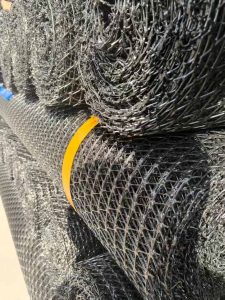
PP Triaxial Geogrid 160 -
Structure: Engineered with ribs radiating from connection points at approximately 60-degree angles, creating a stable triangular aperture pattern.
-
Key Strength: Offers multi-directional strength and superior in-plane stiffness due to its triangular geometry. This provides enhanced confinement and stabilisation, particularly under dynamic loads and in weaker soils.
-

Performing the Critical Functions: Reinforcement & Stabilisation
Both geogrid types perform vital, yet subtly different, functions:
-
Soil Reinforcement:
-
Mechanism: Geogrids are placed within soil layers (e.g., in embankments, steep slopes, retaining walls). Soil particles interlock within the geogrid apertures and bear against the geogrid ribs.
-
Result: This interaction creates a “coherent mass,” effectively transferring tensile forces within the soil. The geogrid acts like “rebar for soil,” allowing the construction of steeper, taller, and more stable slopes and walls than would be possible with soil alone. It significantly increases the soil’s shear strength and overall stability.
-
Application Focus: Reinforced soil slopes, mechanically stabilised earth (MSE) walls, embankments over soft ground, landfill liner systems.
-
-
Roadbase Stabilisation:
-
Mechanism: Geogrids are placed at the interface between the subgrade (native soil) and the overlying roadbase aggregate, or within the lower layers of the aggregate itself.
-
Result:
-
Lateral Restriction (Confinement): The geogrid interlocks with aggregate particles, preventing their lateral movement under traffic loads. This reduces shear deformation within the base course.
-
Tensioned Membrane Effect: Under load, the geogrid deforms slightly, developing beneficial tensile forces that help support the load and distribute it over a wider area of the underlying subgrade.
-
Separation: Prevents mixing of the aggregate roadbase with the softer subgrade soil below, maintaining the integrity and thickness of the structural layer.
-
-
Application Focus: Stabilising weak subgrades for roads, highways, parking lots, working platforms, railways, and airfields. Reduces required aggregate thickness, minimizes rutting, and extends pavement life.
-
Why Lianyi PP Biaxial & Triaxial Geogrids Stand Out
-
Superior Material (PP): Polypropylene offers excellent durability, resistance to biological degradation, and long-term chemical stability in typical soil environments. It provides reliable performance over the design life of the project.
-
Optimised Geometry:
-
Biaxial: Ideal for applications needing balanced strength in two primary directions where large-area stabilisation is key (e.g., large embankments, working platforms).
-
Triaxial: The triangular structure provides superior in-plane stiffness and multidirectional confinement, making it exceptionally effective for roadbase stabilisation, especially on very soft subgrades or under heavy, dynamic traffic loads. It often allows for greater aggregate savings compared to biaxial in stabilisation roles.
-
-
High Strength & Stiffness: Engineered ribs provide the necessary tensile strength and stiffness to effectively reinforce soil and confine aggregate.
-
Aperture Efficiency: The aperture size is designed to optimally interlock with a wide range of soil and aggregate particle sizes, maximizing the mechanical interaction.
-
Cost-Effectiveness: By enabling the use of locally available, lower-quality fills, reducing required aggregate thickness in pavements, allowing steeper slopes (reducing land take), and significantly extending service life, geogrids offer substantial project savings.
Applications in Action
-
Building Highways Over Soft Ground: A triaxial geogrid stabilises the roadbase, preventing aggregate punch-down into the soft clay subgrade and distributing truck loads effectively, eliminating costly deep soil replacement.
-
Constructing a Steep Retaining Wall: Layers of biaxial geogrid are placed within compacted backfill, reinforcing the soil and allowing a tall, stable wall to be built with minimal space requirements.
-
Creating a Stable Working Platform: Placing biaxial geogrid directly on a weak site allows construction equipment to operate safely without getting bogged down, using less imported fill.
-
Reinforcing a Landfill Slope: Biaxial geogrid reinforces the soil cover on steep landfill slopes, preventing erosion and slippage while accommodating settlement.
-
Extending Rural Road Life: Triaxial geogrid stabilises the gravel roadbase on a silty subgrade, reducing rutting and maintenance frequency significantly.
Conclusion: The Foundation for Success
Lianyi PP Biaxial and Triaxial Geogrids are not just materials; they are engineered solutions that fundamentally improve the performance of soil and aggregate. By providing exceptional reinforcement for soil structures and unparalleled stabilisation for roadbases, they deliver tangible benefits: increased safety, enhanced longevity, reduced construction costs, and minimized environmental impact.
Choosing the right geogrid – whether it’s the broad-area strength of biaxial or the multidirectional confinement of triaxial – depends on the specific project requirements. Understanding their standout roles in soil reinforcement and roadbase stabilisation empowers engineers and contractors to build more resilient, efficient, and cost-effective infrastructure.
Ready to reinforce your next project? Explore how Lianyi PP Biaxial and Triaxial Geogrids can provide the stability and strength your foundation demands.
