
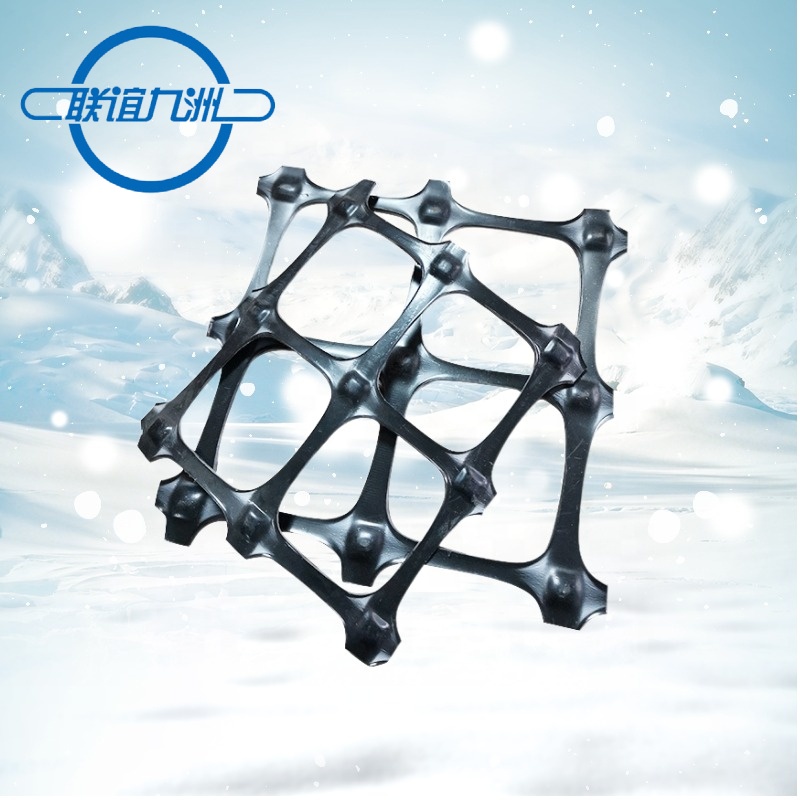


When designing soil-boosting, pavement, or slope-supporting projects, one of the first decisions that engineers or contractors must make is the type of geosynthetic material that will be used — and often the question arises: should we employ a biaxial or uniaxial geogrid? The distinction is not simply semantic, but structural, functional, and economic. Understanding the comparative behavior of PP biaxial geogrid and uniaxial geogrids regarding load distribution, soil interaction, installation, and the best use scenarios is essential to designing effective, safe, and cost-effective projects.
In this article, we first discuss what geogrids are and how they function, then discuss the structural and performance differences between biaxial and uniaxial types, the practical implications of different civil engineering applications, and how to choose a type based on the project’s requirements.
What is a Geogrid — Fundamental Concept
A geogrid is a synthetic material that is used to strengthen soil or other layers by providing tensile strength and allowing a greater distribution of loads than soil alone.
Geogrids are typically composed of polymers like polypropylene (PP), polyester (PET), polyethylene, etc.
The manufacturing process typically involves punching a sheet and stretching it to create a regular pattern of ribs (tensile components) and openings ( vias).
Once built, the grid will interact with the soil or other particles surrounding it. Through the openings, the soil or other particles will attempt to conform to the grid. Under stress, the tensile components will resist deformation and will increase the composite strength of the soil/geosynthetic layer.
Depending on the orientation of the grid and its manufacturing, geogrids are typically classified as uniaxial, biaxial, or triaxial. Each type is appropriate for different purposes and conditions.
In practice, PP biaxial geogrid continues to be one of the most popular geosynthetics for soil stabilization and sub-base reinforcement, this is especially in roadways, rail beds, embankments, and base layers beneath pavements.
Structural and Mechanical Differences: Biaxial vs Uniaxial Geogrid
- Definition: What “Biaxial” and “Uniaxial” mean.
Uniaxial geogrid — intended to increase the tensile strength of the material in one particular direction (the direction of travel or rotation). The ribs and openings are situated so that the grid can withstand the primary force axis.
Biaxial geogrid — designed to have a balanced tensile strength in two perpendicular directions: both longitudinal (man) and transverse (cross). This is accomplished by drawing the polymer sheet in a biaxial direction, which orients the molecular chains and stripes in both directions. This produces a grid structure with either square or rectangular openings.
In other words, uniaxial is defined as having a “strong” orientation along a single axis, while biaxial is defined as having a “strong” orientation along two different axes. This primary difference has the result of different performance characteristics and optimal applications.
- The distribution of loads and the interaction between soil and aggregate are both important aspects of soil science.
Because of its dual-oriented strength, the PP biaxial geogrid averts the distribution of applied loads in both directions (longitudinal and transverse). This is particularly beneficial when dealing with loads that have multiple vectors, such as under traffic, variable path loads, or complex subgrade deformation scenarios.
Uniaxial geogrid is superior to this in that it excels at where pressure and stress are primarily unidirectional, for example, the lateral pressure behind a retaining wall, or the slope of a mountain that is stabilized by a string of rocks.
Therefore:
Biaxial: It’s more effective at maintaining the overall subgrade, the foundation of the pavement, the load-bearing base, and embankments under traffic or dynamic pressure.
Uniaxial: more effective in the enhancement of soil structures that are subject to directional pressure, such as retaining walls, sloping soil, and embankments that need to be reinforced by lateral means.
- Open Space and Volumetric Design
The configuration of the apertures and ribs is varied: biaxial grids typically have square or rectangular openings, which provide a uniform degree of stiffness in both directions.
Uniaxial grids often have longer rib alignments that match the strength axis; the transverse ribs and cross-direction strength are both minimal or null. The grid is designed to support loads along one axis instead of isotropically.
This structural design is responsible for the way the aggregate is confined to the grid, the way the soil is sheared into the ground, and the way the composite soil/geogrid layer responds to stress or cyclical motion.
- Other considerations, such as the material and manufacturing process (particularly for PP Biaxial Geogrid)
PP biaxial geogrids are typically composed of polypropylene sheets that are punched and pulled; this process orients the polymer’s molecular chains, increases the tensile strength, and produces solid, integral connections.
Because of this, PP biaxial geogrids have a tendency to have a superior resistance to puncture, abrasion, and the capacity to withstand installation stress (e.g., compaction, heavyweight aggregate placement) techniques. triaxial) Or less powerful geogrid varieties.
Uniaxial geogrids can utilize the same polymers as other types of geogrids (polypropylene, polyester, etc.), but their design focuses on the tensile strength of one direction; their cross-direction struts and joints are less powerful by design, which means they aren’t intended for multiple directional loading.

Typical Applications: Where Each Geogrid Type Shines
The structural properties cause distinct, often supplementary, application domains for biaxial and uniaxial geogrids. As a blog about the industry that concerns engineers, contractors, or decision makers, it’s crucial to understand the geogrid type in order to utilize it correctly.
- Use Cases of PP Bi-axial Geogrid
The biaxial geogrid is beneficial for stabilizing the roadbed and improving the base course of the pavement. This is because of its capacity to distribute stress in both directions, which results in an ideal condition for reducing traffic-related rutting and improving the base course of the pavement.
Soil stabilization and aggregate base support: For embankments, base layers over soft soil, or landfill base enhancement, where different loads may come in different directions, or the settlement may be uneven.
Load-bearing platforms, parking spaces, air fields, rail sub-ballast layers, or any scenario that involves repeated or varying loads, traffic, or multiple directions of stress: Biaxial geogrid will increase the capacity for bearing, reduce the depth of aggregate, and extend the life of the platform.
Subgrade reinforcement that is useful for soft ground, land that has been reclaimed, or projects that improve the soil’s structure and distribution of loads is beneficial.
Because of the lack of directional precision during installation, the process is typically simpler and more malleable, an advantage in large-scale pavement or fill projects.
- Use Cases of Uniaxial Geogrid
Maintaining walls and additional soil walls: Uniaxial geogrid promotes targeted tension in order to resist the earth’s pressure, maintain backfill, and retain soil mass – this is ideal for areas that have a lot of lateral pressure.
Steep slopes and embankments: When soil at the base of the slope is slideable or has a high potential for failure in one direction (downslope), a uniaxial geogrid will help to maintain the soil by resisting the force of the slope in the direction of greatest danger.
Emphasis is placed on the design of the embankment, the bridge’s abutment, and the bank’s support. Structural reinforcement is primarily in one direction (horizontal or vertical), and the distribution of loads across different directions is less significant.
Utilities that prioritize the tensile strength of their materials over the distribution of loads in multiple directions, where the cost of effectiveness, specific load support, or directional stability is more important than broad soil stabilization.
In this instance, the use of a uniaxial geogrid that is optimized for strength in one direction is more effective and less expensive than the use of a multidirectional product.
Pros and Cons: Trade-offs Between Biaxial and Uniaxial Geogrids
No single type of geogrid is considered the best in all cases. The choice is often dependent on the project’s demands, soil type, the duration of the project, the cost, and the installation conditions. Understanding these trade-offs is essential to making accurate, informed decisions.
- The benefits of PP-Biaxial Geogrid
Balanced tensile strength in both directions — this is beneficial for multi-directional loading, traffic, dynamic pressure, and complex soil behavior.
Enhanced soil-aggregates’ interlock via rectangular/square geometry — improves confinement, decreases lateral displacement, increases capacity for bearing, and increases stiffness.
More simpler to install without requiring a strict orientation – because the strength of the grid is balanced, installers don’t have to align the grid in a particular direction, which decreases the risk of misplacement and costs.
Versatility in a wide variety of applications, including road sub-bases and landfill bases, soft soil stabilization, aggregate layer reinforcement, and more.
For variants that have a PP: tough material that can withstand puncture and abrasion, this is beneficial under heavy amounts of aggregate or compaction.
- Uniaxial Geogrid’s Advantages
High tensile strength that is primarily oriented in one direction — effective and budget-friendly when augmented with another axis (e.g., lateral earth pressure, slope stability).
Often, lower costs associated with material procurement and manufacturing are observed (since no need for bidirectional design), which leads to savings in cost when the project requirements are simple.
Adept at directional loads — walls, bastions, and sloping terrain — where the need for multiple directional reinforcements is not necessary.
The ease of installation when only one direction is important — it is easier to align and maximize the tensile capacity in relation to the expected direction of load.
- Disparities and substitutes
For the Biaxial Method:
If the project’s load is primarily composed of one-directional components (e.g., with the retention wall, the bidirectional capacity may be wasted unnecessarily — this may be more expensive than necessary.
In some instances, biaxial may not have the necessary tensile strength in the critical axis in comparison to a uniaxial design that is specifically designed for that direction.
For Uniaxial Direction:
Ineffective when loads or stresses are distributed in multiple directions: limited cross-direction strength, the risk of soil deformation or shift under lateral loads that are not aligned with the reinforcement axis.
Not ideal for use on the pavement or subgrade for stabilization under traffic or multiple directions of stress — it may lead to early failure, rolling, or the displacement of the aggregate.
Precautions must be taken during the installation process – misalignment can greatly diminish the effectiveness.
As a result, using the incorrect type of geogrid for a particular purpose can lead to subpar performance, instability, or structural failure over the long term.
How “PP Biaxial Geogrid vs Uniaxial Geogrid” Is Reflected in Engineering Practice & Project Decisions
From a project’s planning or design perspective, choosing between biaxial and uniaxial geogrid should follow a systematic evaluation of the following aspects:
- The evaluation of load conditions and stress vectors
If traffic loads are multidirectional, consider using a biaxial geogrid to improve the overall soil/aggregates stability.
If the majority of the loads are unidirectional — earth pressure from the lateral side (walls), slope forces due to shearing, and the side of the embankment that is loaded with soil, a uniaxial geogrid may be appropriate and more cost-effective.
- Soil type, subgrade conditions, aggregate type, drainage, and settlement risk
In soft soil, land that was reclaimed, or areas that were unevenly distributed, the biaxial geogrid promotes stress distribution and limits the aggregate or soil’s volume.
For projects that require backfill to support retaining walls or to strengthen the slope, uniaxial geogrid is typically more effective.
- Method of Construction, Handling, and Installation Stress
PP biaxial geogrid – sturdy ribs and joints (obtained through punched manufacturing) – have a greater tendency to perform under construction pressure: compacted soil, heavy stone, or other materials are typically used to augment its strength. This decreases the probability of grid failure before the soil has fully interlocked.
Uniaxial geogrids must be positioned correctly during installation; misaligned installation will undermine the intended design. The ease of uniaxial design is only beneficial if the quality of the installation (alignment, anchoring) is maintained.
- The cost of the project should be balanced with the performance it can provide
Biaxial geogrids, especially types of PP, are typically more expensive than uniaxial geogrids per square meter or ton, but their versatility and multiple directional reinforcement typically result in savings downstream (less aggregate, thinner base, reduced maintenance).
For projects with simple deadlines and a single direction of stress, uniaxial reinforcement may provide sufficient reinforcement at a lower cost, while optimizing the budget.
- Project Life Span, Maintenance, and Durability Requirements
For long-term projects that involve repeated loads, weather changes, and settlement, biaxial geogrid has a tendency to provide a more stable, long-lasting performance.
For structures that are simpler or temporary, or which require primarily tensile reinforcement in one direction, uniaxial geogrid is likely to be adequate. However, the long-term durability may be less consistent if the load conditions change.
Why PP Biaxial Geogrid Is Often Preferred for Soil Stabilization & Pavement Applications
As civil-engineering practice and geosynthetic technology have evolved, PP biaxial geogrid has become one of the most widely used solutions for subgrade stabilization, flexible pavement reinforcement, base layer support, and soil stabilization over soft or variable soils. The reasons:
Balanced bidirectional reinforcement aligns well with the complex, multidirectional stresses under road, traffic, and load-bearing structures.
Good construction tolerances: because orientation matters less, installers enjoy flexibility, reduced risk of misalignment, and faster deployment — valuable in large-scale projects or where labor/time costs matter.
Material robustness: the punched-and-drawn PP ribs provide reliable puncture and abrasion resistance during aggregate placement and compaction, improving survivability during installation — a known vulnerability for geosynthetics.
Cost-performance balance: although more complex than uniaxial, the multifunctionality of biaxial geogrid often reduces required fill depth, aggregate volume, and long-term maintenance — yielding overall cost efficiency in many stabilization projects.
Thus, for many foundational and subgrade reinforcement tasks, PP biaxial geogrid represents a “sweet spot” balancing performance, durability, and cost.
Common Misconceptions and Why “Biaxial = Always Better” Is Not Always True
Because of its broad directional strength, some may consider a biaxial geogrid to be a “one size fits all” solution. However, this mindset can cause inefficiencies, over-specification, or subpar results in certain situations.
Common misconceptions:
A biaxial geogrid is typically more powerful than a uniaxial; this is not necessarily true. Uniaxial is designed to have a high stretchiness that is optimized for tensile strength in a critical direction; in a slope or wall that has a force vector that is unidirectional, uniaxial may be more effective than a balanced biaxial.
“Using biaxial everywhere” reduces logistics complexity. However, using uniaxial instead of biaxial can lead to extra costs, wasted material, and design overburden.
“Installing biaxial” is simple and doesn’t require consideration of direction. While more tolerant than uniaxial, the design still needs to consider the load paths, behavior of soil, and configuration of layers; using biaxial doesn’t eliminate the need for proper design or compaction.
“One type of geogrid will fit all of the soil’s conditions” – The type of soil, its moisture content, the aggregate type, the load that is dynamic, ground water, and the expected stress patterns all have an effect on which type of geogrid is appropriate; both biaxial and uniaxial have contexts in which they excel.
The correct choice of technology is always dependent on a project-specific evaluation that includes geotechnical concerns, load patterns, cost concerns, installation conditions, and long-term performance goals.
Decision Framework — How to Choose Between Biaxial and Uniaxial Geogrid
To help engineers, contractors, or procurement specialists make informed decisions, here is a suggested decision framework when selecting between PP biaxial geogrid and uniaxial geogrid:
| Consideration | When Biaxial Is Favored | When Uniaxial Is Favored |
| Load pattern/stress directions | Multidirectional loads (traffic, dynamic loads, varying load paths) | Predominantly unidirectional load (lateral earth pressure, slope stability) |
| Soil / subgrade conditions | Soft soils, variable subgrade, need broad-area stabilization, aggregate confinement. | Backfill behind walls, embankments, and slope reinforcement where directional tensile strength matters |
| Aggregate/pavement / base reinforcement | Pavements, roadbeds, parking lots, rail sub-bases — needing load distribution and aggregate confinement | Structures needing directional reinforcement only (e.g., retaining walls, steep slopes) |
| Installation complexity and logistics | Projects where ease and speed matter; less sensitivity to orientation | Projects where correct orientation is manageable and critical for performance |
| Cost vs performance balance | When long-term stability, reduced maintenance, and aggregate savings justify a higher upfront cost | When cost-sensitive and structural requirements are simple |
| Long-term durability and maintenance | Projects with repeated loading, variable stress, where soil/geogrid interaction must remain stable | Projects with static or predictable loads and simpler soil conditions |
Using this framework helps ensure the geogrid choice aligns with structural and economic objectives, rather than defaulting to one type.
Conclusion — Use the Right Tool for the Right Job
In geotechnical engineering, structural design, or carpentry, success is dependent on the proper utilization of a tool. PP biaxial geogrids and uniaxial geogrids are not substitutes for one another: they are specialized instruments that each have their own advantages in different soil situations.
If your project involves multiple directions of travel, an aggregate-based subgrade, a pavement base, a soft soil that is stabilized, or dynamic conditions, a biaxial geogrid is probably the most effective in terms of stability, distribution of loads, installation concerns, and long-term performance.
If, however, your project involves walls that are retained, slopes, embankments, or additional structural components where the tensile strength of the material acts in a specific direction, a uniaxial geogrid may be a more beneficial, cost-effective structural component. These components should be installed with the proper orientation and design in mind.
For those involved in engineering, design, procurement, and contracting, the takeaway is simple: don’t base your choice on habit or convenience; instead, choose based on the demands of structural engineering, soil behavior, load conditions, and the long-term viability of the project. A proper choice of geogrid will maximize safety, cost, durability, and performance.
