


Today, modern geotechnical engineering and civil infrastructure employ biaxial geogrids to augment soil, support subgrades, and increase the load-bearing capacity of structures. Despite the general term “geogrid,” biaxial geogrids are a specific type of synthetic material that is intended to provide tensile strength in two perpendicular directions (typically longitudinal and transverse). This dual-headed strength attribute makes them ideal for projects that involve multiple-headed soil stressors, such as road foundations, embankments, railways, and reinforced earth walls.
Understanding the different types of biaxial geogrids — their composition, manufacturing processes, shape, coatings, and performance characteristics — is crucial to the selection of the appropriate product for your project and achieving the greatest possible performance.
In this comprehensive article, we will:
Explain what biaxial geogrids are and how they work
Define how types of biaxial geogrids are categorized
Explore material options and manufacturing differences
Review application-based classifications
Guide specification and selection
Let’s dive in.
What Are Biaxial Geogrids and Why They Matter
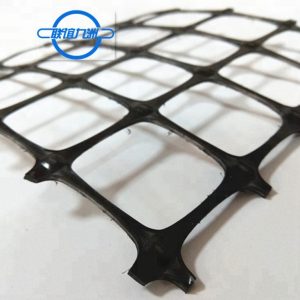
At the core, a biaxial geogrid is a geosynthetic material that possesses a grid-like structure designed to augment soil by spreading loads over a larger area. The primary difference between biaxial and uniaxial geogrids is that biaxial geogrids are intended to have stress in two perpendicular directions: one direction is the machine direction, the other is the cross-machine direction. This contrasts with uniaxial geogrids, which are primarily built for directional strength and are typically employed in applications like retaining walls or bridge supports.
The open grid design (apertures) allows the soil to interlock with the geogrid, which creates a combined mass that has increased strength and stability. This interlocking mechanism promotes:
- Improved load distribution
- Reduced lateral spreading of soil
- Increased bearing capacity
- Reduced settlement
- Enhanced durability over time
Because infrastructure projects now require stronger and more durable reinforcement solutions, biaxial geogrids are now commonly used in the design of roads, pavements, rail beds, and embankments.
How Biaxial Geogrids Are Categorized?
Biaxial geogrids are categorized on multiple dimensions. There is not only one “Type”, but each category also has important attributes of performance. The primary categories that are considered are:
By the Composition of the matter
Through the technique of manufacturing
By the shape and geometry of the Aperture
By Immobilization or Induction of a Reaction
By Designing the Appication-specifically
Each category has an effect on the mechanical behavior of the geogrid, the installation of the geogrid, and its long-term performance.
Types by Material Composition
The choice of material is fundamental because it affects the tensile strength, resistance to creep, chemical stability, and cost. The most common types of biaxial geogrids are:
-
High-density polyethylene (HDPE) Bi-axial Gels
HDPE biaxial geogrids are popular because of:
Good stretchiness and tensile strength
Excellent chemical resilience
Low price
Resistance to environmental deterioration
HDPE grids have a successful record in the performance of compressive cycling and are ideal for roads, parking areas, and soil enhancement where exposure to moisture and chemical interaction is possible. However, HDPE has a middle-range thermal conductivity compared to other options.
-
Polypropylene (PP) Bipolar Geogrids
Another common material that exhibits:
Higher initial stretchiness compared to other HDPE sheets.
Good toughness to withstand constant pressure
Low population, which facilitates easier handling.
Good chemical and microbial resilience in soil habitats.
PP biaxial geogrids are typically used to support rail tracks, Highway Number 3, and have a moderate capacity to support loads.
-
Polyester (PET) Bipolar Geogrids
Polyester geogrids are appreciated for:
High tensile strength and low consistency
Constant performance in high-volume operations
Good ultraviolet (UV) resistance when enhanced properly
PET biaxial geogrids are frequently chosen for areas that have a heavy load, such as multi-lane highways, port pavements, and other areas with high traffic volume.
-
Other variants of polymer and composite fibers
While HDPE, PP, and PET are the most popular materials, specialized geogrid products may combine polymer blends or extra-wide fibers (e.g., aramid fibers in specialized commercial applications). The prerogative is always to strike a balance between strength, consistency, and expense.
Types by Manufacturing Technique
Manufacturing impacts the strength, uniformity, and performance of a biaxial geogrid. Geogrids are typically produced using one of these methods:
-
Extruded Biaxial Geogrids
Produced by first extruding sheets of polymer, and then stretching them in both longitudinal and transverse directions.
This procedure aligns the polymer chains in both vectors, resulting in a high tensile strength in both vectors.
Biaxial geogrids that are extruded have a uniform geometry of aperture and a predictable mechanical characteristic.
Usages: Subgrade stabilization, base enhancement, retaining structures.
-
Bonded and Welded Biaxial Geogrids
Created by attaching polymeric straps or rods to the joint’s surface.
Joins are mechanically or thermally combined, which creates a grid-like structure.
These grids can have a variety of shapes and sizes, and are effective for certain projects.
Usages: Drainage enhancement, light to medium traffic volume stability.
Note: Quality control is of paramount importance in bonded profiles — imperfections in the welding process can adversely affect the tensile strength over time.
-
Knitted or Woven Biaxial Geogrids
Less common in heavy-duty geogrids, but significant in specialized geosynthetics.
Fibers are organized into grid-like patterns.
Often paired with coatings or supplements to enhance effectiveness.
Use: Controlling erosion, protecting against erosion, and holding in place for a period of time.
Types by Aperture Shape and Geometry
The configuration of the opening — the number of openings in the grid — has a significant impact on the way the soil interacts with the geogrid and the distribution of stress.
-
Square opening biaxial geogrids
Openings that are approximately the same size and height.
Provide equal support in both directions.
Provide effective mechanical locking with both fine and coarse soil types.
Best for: Roadbase enhancement, general soil improvement.
-
Rectangular Aperture Bi-axial Geogrids
Outskirts that are lengthened in one direction, but still augmented in both dimensions.
Help match the reinforcing characteristics of directional patterns with the stress profiles in certain roadway designs.
Best for: Applications that have a directional traffic pattern or that are isotropic in their behavior on soil.
-
Alternative or supplementary patterns for the Aperture or Ribbon
Elaborate designs maximize the thickness of the rib and the shape of its aperture in order to enhance the retention of soil and the contact area.
Some have slightly curved ribs or variable spacing to improve tough soils with higher shear resistance.
Best for: Drainage-boosted enhancement, multiple composite layers.
Types by Coating or Surface Treatment
Surface characteristics affect installation handling and long-term durability. Common surface treatments include:
-
Uncoated (Bare Polymer) Biaxial Geogrids
No additional protection.
Adept at general soil improvement where erosion and soil composition are inconsequential.
-
Coated or Laminated Biaxial Geogrids
Coatings are composed of polymeric material or protective sheets that are:
Increase resistance to erosion
Increase the embedment’s friction.
Avoid aggressive soil chemicals.
Laminated sheets are frequently employed in high-volume areas, chemical compounds, or violent environments (e.g., coastal soil).
-
Textured or Flocked Surfaces
Some high-friction grids employ a textured surface or even micro-sized fibers in the ribs to enhance the interaction with the soil.
This increases the pullout strength in fine or sandy soil.
These enhancements, on the surface, are particularly beneficial in earth-based walls and slope stabilization.
Application-Based Types of Biaxial Geogrids
In practice, engineers choose biaxial geogrids that are based on the performance of materials, not just the method of manufacturing. Several different subtypes of design emerge when requirements for design are considered:
-
Pavement Support Geogrids
Designed to be used con:
Reduce the amount of time spent roaming around
Increase the distribution of loads
Increase the life of fatigue
These grids have a typical strength of medium-low and are sized appropriately to match the aggregate size.
-
Subgrade Stalker Grids
Employed in conjunction with fill dirt, embankments, and railroad beds. These are:
High tensile strength
Good creep capacity
Capacity to withstand heavier-than-average loads
Here, materials like PET that have a long lifespan and are strong are common.
-
Maintaining the Wall and Supporting the Soil System
Despite the common usage of uniaxial grids for walls (due to their directional nature), biaxial grids can also be employed where the faces of the grid and the backfill have a multidirectional nature. This is typically used in hybrid reinforcement systems. In these instances:
The tensile strength of both directions is increased.
The long-term stability is essential
-
Slope stabilization and enhanced embankment
On inclines, the lateral and vertical forces have an interaction:
More grids with higher friction.
Textured surfaces, decorated ribbons
These are selected to withstand soil erosion and surface wear.
-
Industrial and Lightweight Support
Smaller scales, such as landscaping, green spaces, and pedestrian pathways, utilize lighter biaxial geogrids that have a balanced strength and ease of handling.

Comparing Biaxial Geogrids with Other Geosynthetics
To comprehend the biaxial geogrids more comprehensively, it’s beneficial to contrast them with:
Uniaxial Geogrids: powerful in one direction (commonly employed in buildings that have a lateral pressure of earth).
Triaxial Geogrids: Engineered to have the greatest possible strength in three different directions (rare, more specialized).
Geotextiles: Fabrics that serve as a filter, Separator, or Drain, but have a low tensile strength compared to geogrids.
Geocell Systems: 3D cellular structures that provide containment, but serve a different purpose.
Biaxial geogrids have a balanced combination of multiple directional tensile supports and are cost-effective for use on flat surfaces.
Performance Attributes and How They Relate to Types
Different design choices affect key performance metrics:
| Attribute | Influenced By |
| Tensile Strength | Material + manufacturing (extruded vs bonded) |
| Creep Resistance | Material polymer + long-term load behavior |
| Soil Interaction | Aperture size/shape + surface treatment |
| Durability | Polymer chemical resistance + coating |
| Ease of Installation | Grid flexibility + material handling |
Understanding these relationships helps engineers specify the best biaxial geogrid for a given scenario.
Practical Considerations for Selecting Biaxial Geogrids
When selecting a type, consider:
Soil type and the characteristics of grain — the opening sizes of the grains should correspond to the soil in order to promote effective association.
The magnitude and direction of loads — large loads benefit from stiffer, stronger materials like PET.
Environmental factors — including chemical exposures, humidity, and temperature changes.
Method of construction – efficiency and compatibility with machinery.
Performance requirements that are long-term, such as creep behavior, resistance to degradation over the design life.
Design codes, standards (such as ASTM, ISO), and local rules often require a minimum of performance based on the specifications of the project.
Installation and Handling Notes
While classifying is important, proper installation is of paramount importance:
Maintain the correct posture and prevent the formation of geogrids.
Ensure the correct orientation (biaxial grids must correspond with the expected stress patterns)
Preserve from harm during backfilling and compaction
Follow the manufacturer’s recommendations regarding soil contact and cover depth.
Installation errors can compete with beneficial materials.
Case Applications Highlighting Different Types
-
Highway Base Support
A highway project that required a high degree of fatigue resistance employed a PET biaxial lattice with a textured surface, which enhanced the stiffness of the lattice and distribution of load under repeated vehicle traffic.
-
Track Subgrade Support
The necessity of providing a high degree of lateral support to the tracks led to the development of larger ballasts. An HDPE biaxial geogrid that possessed large openings in its design provided effective soil contact and a competitive price.
-
Urban Support for Emphasis
For a stone’s throw of infrastructure, a coated, high-slippage biaxial geogrid was employed to enhance the interaction with the fine silty soil and resist the moisture-induced creep.
These examples demonstrate the specific types of plants that are appropriate for various types of performance.
Innovations and Future Trends in Biaxial Geogrids
Industry trends include:
More resilient polymers—enhancing the long-term viability of structures under stress
Excessive coatings – for adverse environments
Immobilized grids that sense – these are ideal for structural health monitoring.
Applicable apertures – utilizing computational methods to correspond with soil science.
These innovations augment the versatility and effectiveness of biaxial geogrid-based applications.
Conclusion — Selecting the Right Type for Your Project
The term biaxial geogrids includes a family of enhanced polymeric grids designed to have both tensile strength in two different directions. They have a wide variety of options:
The composition of the material (HDPE, PP, PET)
Production method (extruded, bonded, woven)
Aperture design (square, rectangular, altered)
The treatment of the surface and coating it on
Application-specific design guidelines
Selecting the appropriate type of adhesive is dependent on understanding the interactions between these properties and the specific geotechnical or structural requirements of your project.
For those involved in design, including project owners, a methodical approach to specifying biaxial geogrids leads to increased performance, decreased risk of construction, and enhanced long-term infrastructure sustainability.
