


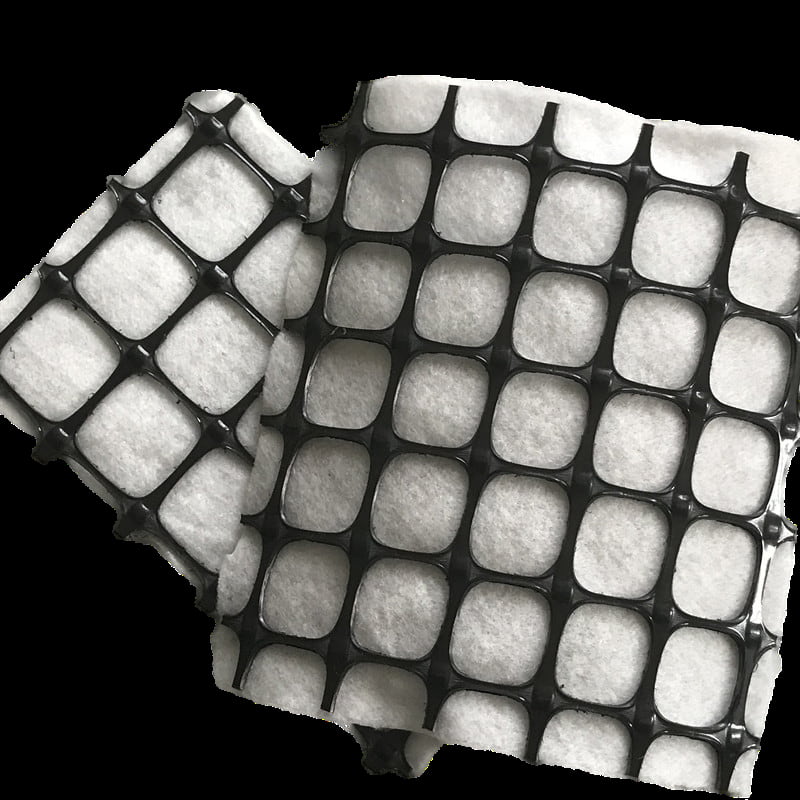
A polypropylene (PP) welded geocomposite geogrid is a geosynthetic composite that combines a geogrid with a geotextile layer. This provides soil reinforcement, separation, and filtration in a single product. The geogrid structure interlocks with the surrounding aggregate, confining it and limiting its lateral movement under loading. Meanwhile, the attached geotextile helps prevent fine soil particles from migrating into the aggregate layer. This description is based on guidance from the Federal Highway Administration’s Geotechnical Engineering department, a research review titled ‘Geosynthetics for Filtration and Stabilisation’, and relevant product specifications and testing standards.
What Is a PP Welded Geocomposite Geogrid?
A PP welded geocomposite geogrid is an engineered reinforcement material used in geotechnical and civil engineering projects. It typically comprises a polypropylene geogrid structure combined with a permeable geotextile, usually a nonwoven fabric. These two components are integrated during the manufacturing process to provide both reinforcement and soil separation functions, eliminating the need for separately placed materials.
The polypropylene geogrid is the primary load-bearing component. It has an open grid structure formed by longitudinal and transverse ribs that are connected at junctions. In welded designs, these ribs or polymer strips are joined at the intersections to create stable apertures. When granular fill is placed over the grid, the aggregate particles engage with the openings and ribs to create mechanical interlock and friction, which help to resist lateral displacement.
The geotextile layer performs a different but complementary role. Its porous structure allows water to pass through while restricting the movement of soil particles, provided that its opening size and permeability are compatible with those of the surrounding soil. This helps to maintain separation between the fine-grained subgrade and the granular base materials, thereby reducing the risk of contamination and loss of performance of the aggregate layer.
It is important to recognise that not all PP geocomposite geogrids are manufactured in the same way. Some products use welded polypropylene (PP) flat-bar grids with geotextiles integrated into the grid structure, while others use punched and stretched PP sheets with a geotextile heat-bonded to one side. While these are related product configurations, they should not be treated as identical. Buyers and engineers should therefore confirm the grid construction, junction design, geotextile material, and bonding method in the product specification.

Main Components and Their Functions
The performance of a PP Welded Geocomposite Geogrid depends on how its components work together. Selecting a product based only on its nominal tensile strength can overlook important factors such as junction integrity, aperture dimensions, geotextile filtration properties, and the interaction between the product and the site soil.
- Polypropylene Geogrid
Polypropylene is a thermoplastic polymer that is commonly used in geosynthetic reinforcement products. It can be processed into ribs or strips with defined geometry and mechanical properties. In a welded geogrid, the longitudinal and transverse elements form a regular aperture pattern, and the junctions are designed to transfer forces in both directions.
The open structure of the grid allows aggregate particles to penetrate the apertures and become mechanically restrained. Under traffic or structural loading, the aggregate tends to move laterally. The grid limits this movement by mobilising interlock and interface resistance to help create a more stable, reinforced aggregate layer. The effectiveness of this mechanism depends on the aperture size, aggregate grading, grid stiffness and installation quality, rather than simply the polymer type.
- Nonwoven Geotextile
The geotextile is typically a permeable nonwoven fabric attached to or integrated with the geogrid. Its principal functions are separation and filtration. At the interface between fine subgrade soil and granular fill, the fabric helps prevent the two materials from mixing while allowing water to pass through.
The fabric must be selected to suit the soil’s particle-size distribution, permeability, and hydraulic conditions. A fabric that is too open may allow excessive soil migration, while one that is too restrictive may impede water flow or become vulnerable to clogging. The appropriate balance is a design consideration rather than a universal property of all nonwoven geotextiles.
- Welded Junctions and Composite Integration
The junctions connect the grid ribs, helping the structure to retain its geometry when subjected to tensile forces and installation stresses. Their integrity is particularly important in biaxial products, where load transfer is required in both the machine direction (MD) and the cross-machine direction (CD).
Composite integration is also important. The geotextile must remain sufficiently attached to the grid throughout the handling, placement, spreading of aggregate, and compaction processes. A weak or inconsistent bond can result in the layers separating and reduce the practical advantages of a combined product. Therefore, when comparing products, junction strength and geotextile-to-grid integration should be considered alongside tensile strength.
How Does a PP Welded Geocomposite Geogrid Work?
A PP Welded Geocomposite Geogrid works through several interacting mechanisms. The grid reinforces the aggregate layer by limiting lateral movement, while the geotextile maintains separation and provides filtration at the soil interface. These functions contribute to a more stable pavement or foundation system, particularly where the natural subgrade has limited bearing capacity.
- Aggregate Interlock and Lateral Restraint
When granular aggregate is placed over the geogrid, the particles enter and engage with its apertures. When subjected to wheel loads or other applied forces, the aggregate tends to spread sideways. The ribs and junctions of the geogrid resist this movement by creating interlock and friction at the interface between the aggregate and the grid.
This restraint can improve the stiffness and load distribution of the reinforced aggregate layer. Rather than allowing particles to move independently, the grid helps the material behave as a more stable composite layer. Research on geogrid-reinforced pavement bases identifies aggregate interlock as the main reinforcement mechanism.
- Soil Separation
In road construction over soft or fine-grained subgrades, aggregate can gradually become mixed with the underlying soil due to construction traffic, repeated loading, and local deformation. This contamination changes the aggregate’s grading and can reduce its drainage and load-bearing performance.
The geotextile component acts as a separating layer between the subgrade and the granular base. By limiting the migration of soil particles into the aggregate, it helps preserve the intended structure of the pavement foundation. This function is particularly useful where the subgrade contains fine particles or is susceptible to disturbance during construction.
- Filtration and Water Passage
The movement of water within a pavement or foundation can affect the strength and long-term stability of the soil. Geotextiles allow water to pass through while retaining soil particles within the limits of their filtration design. This reduces the risk of fine particles being carried into adjacent granular layers by seepage.
However, a geocomposite geogrid should not be considered a complete drainage system in itself. While its geotextile may provide filtration and some water transmission across the interface, it does not necessarily provide the in-plane drainage capacity of a dedicated drainage geocomposite. Where substantial water collection or lateral discharge is required, separate drainage layers, pipes, or outlets may be needed.
- Combined Performance Under Loading
The main advantage of the composite is that reinforcement, separation, and filtration are brought together in one installation layer. The geogrid helps restrain aggregate movement, while the geotextile reduces intermixing at the subgrade interface. Together, these mechanisms can help improve construction-platform stability and pavement foundation performance.
The degree of improvement depends on the complete soil-geosynthetic-aggregate system. Subgrade strength, groundwater conditions, aggregate grading, traffic loading, product stiffness, installation quality, and design thickness all influence the outcome. A composite product should therefore be selected through engineering assessment rather than assumed to deliver the same benefit in every ground condition.

Key Functions and Engineering Benefits
PP Welded Geocomposite Geogrids are used because they combine several geosynthetic functions in a single product. Their practical benefits depend on project conditions, but the following functions are commonly considered during design and specification.
| Function | How It Works | Engineering Benefit |
| Soil reinforcement | Grid ribs and apertures interact with aggregate to resist lateral movement | Improves stability and stiffness of granular layers |
| Separation | Geotextile limits mixing between subgrade soil and aggregate | Helps preserve aggregate grading and layer integrity |
| Filtration | Geotextile allows water passage while retaining soil particles | Helps control soil migration under seepage conditions |
| Construction support | Reinforced aggregate layer distributes construction loads more effectively | Can improve access and working-platform stability on weak ground |
| Integrated installation | Grid and geotextile are supplied as one composite | Reduces the need to position separate reinforcement and separation layers |
One potential project benefit is reduced aggregate loss into weak subgrade soils. In suitable conditions, this may allow engineers to optimize the thickness of the granular layer or reduce the amount of unsuitable soil excavation. However, neither outcome is guaranteed. Any reduction in material quantities must be supported by project-specific design calculations, construction requirements, and applicable specifications.
Typical Applications of PP Welded Geocomposite Geogrid
The product is most relevant where a project needs both reinforcement and separation at the same interface. Its use is common in transportation infrastructure and ground improvement, although the exact product grade and design arrangement vary according to the loading and soil conditions.
- Road and Highway Construction
In road construction, the PP welded geocomposite geogrid is typically used at the interface between a weak subgrade and the granular subbase or base course. The geogrid helps to confine the aggregate beneath the repeated impact of vehicle traffic, while the geotextile prevents fine particles from the subgrade from migrating into the pavement structure.
This arrangement is useful for soft, wet, or fine-grained subgrades, as construction traffic can cause rutting or aggregate contamination in these conditions. However, engineers should assess subgrade strength, drainage conditions, traffic loading and aggregate compatibility before deciding whether a composite is appropriate.
- Railway Infrastructure
Railway foundations require stable support for ballast and underlying granular layers. Where weak formation soils or material migration are concerns, a geocomposite may be used as part of a ground-improvement design. The reinforcement component can help stabilize the granular layer, while the geotextile provides separation and filtration at the formation interface.
Railway projects have specific requirements for deformation control, cyclic loading, ballast behavior, and long-term maintenance. Product selection should therefore follow the railway authority’s specifications and project-specific geotechnical design.
- Airport Pavements and Heavy-Duty Platforms
Airport pavements, industrial yards, logistics areas and heavy-duty working platforms may experience substantial repeated or concentrated loads. Installing a reinforced aggregate layer can help to distribute stresses and limit lateral movement, particularly where the underlying soil is weak.
Geocomposites may be used in taxiways, access roads, aircraft parking areas, container yards, and temporary construction platforms. Before specifying a product, the designer must evaluate load magnitude, traffic frequency, subgrade variability, and the required service life.
- Embankments and Foundation Reinforcement
For embankments and foundation platforms, geogrid reinforcement can contribute tensile resistance and help improve the stability of granular foundation layers. The geotextile component may provide separation and filtration where the embankment fill contacts fine-grained or moisture-sensitive soil.
A PP Welded Geocomposite Geogrid is not a substitute for a complete slope-stability or foundation design. Where global stability, deep-seated failure, settlement, or bearing capacity governs, the design must account for the full soil profile and loading conditions.
| Application | Typical Placement | Main Design Considerations |
| Road and highway | Between subgrade and granular subbase/base | Subgrade strength, traffic, aggregate interlock, filtration |
| Railway | Formation or subgrade interface beneath granular layers | Cyclic loading, ballast compatibility, deformation limits |
| Airport pavement | Beneath granular pavement foundation layers | Aircraft loading, repeated stress, foundation stiffness |
| Industrial yard | Under aggregate working platform or pavement base | Heavy vehicle loads, subgrade variability, construction access |
| Embankment foundation | At the interface between soft soil and granular fill | Stability, settlement, tensile resistance, drainage conditions |
How to Select the Right PP Welded Geocomposite Geogrid?
Choosing a suitable PP Welded Geocomposite Geogrid requires more than comparing nominal tensile strength values. A product with a higher ultimate strength is not necessarily the best option if its stiffness at working strain, aperture geometry, geotextile properties, or junction performance do not match the project requirements.
The following parameters should be reviewed before procurement:
- Tensile strength in both directions: Check machine-direction and cross-machine-direction values. Biaxial reinforcement products should provide appropriate properties in both directions where the design requires them.
- Tensile stiffness at specified strain: Strength at 2% or 5% strain can be more informative for service behavior than ultimate strength alone. Compare values tested using equivalent methods and conditions.
- Aperture size and stability: The openings should be compatible with the aggregate grading so that particles can engage effectively with the grid. Aperture stability also matters during placement and compaction.
- Junction strength: Welded intersections must transfer load between ribs and resist damage during installation and service.
- Geotextile filtration properties: Review characteristic opening size, permeability, mass per unit area, and other relevant properties against the site soil and hydraulic conditions.
- Composite bond and durability: Confirm that the geotextile remains securely integrated with the grid and that the product has suitable resistance to installation damage, environmental exposure, and long-term service conditions.
EN ISO 10319:2024 specifies the wide-width tensile test for geosynthetics, including geogrids and geocomposites, for tensile properties. ASTM D6637/D6637M, on the other hand, addresses the tensile properties of geogrids using single- or multi-rib methods. However, these methods are not interchangeable without considering the specimen configuration and reported property, so technical comparisons must identify the test method used.
A useful procurement review should also request a current technical data sheet, quality-control documentation, product identification information, roll dimensions, installation guidance, and test reports from an appropriately qualified laboratory. If the project requires junction strength, installation damage or interface shear tests, these requirements should be stated separately rather than being inferred from a tensile strength certificate.

Installation Considerations and Quality Control
Even a technically suitable geocomposite can underperform if it is damaged, incorrectly oriented, or installed on an inadequately prepared surface. Installation should follow the manufacturer’s instructions and the project specification, with particular attention to subgrade preparation, roll placement, overlaps, aggregate placement, and compaction.
A typical installation sequence includes:
- Prepare the subgrade: Remove sharp objects, debris, and unsuitable materials. Address standing water, soft spots, and major surface irregularities in accordance with the project design.
- Unroll and position the composite: Place the geocomposite in the specified orientation, avoiding wrinkles, folds, and unnecessary tension. Confirm which side of the product should face the subgrade if the manufacturer specifies an orientation.
- Provide the required overlaps or connections: Overlap dimensions and joining details should follow the design drawings and product installation guidance. Do not assume a universal overlap width for all projects.
- Place aggregate carefully: Avoid direct turning, braking, or aggressive trafficking on exposed geosynthetics. Use the specified minimum cover before allowing construction equipment to travel over the layer.
- Spread and compact the fill: Place aggregate in the required sequence and compact it to the project specification without damaging the grid or geotextile.
- Inspect the completed layer: Check for exposed, torn, displaced, or folded material and repair or replace damaged areas according to the approved method.
Installation quality should be documented through inspection records, material traceability, and confirmation that the delivered product matches the approved submittal. Where installation damage is a design concern, relevant test methods and project-specific acceptance criteria should be included in the specification.
Common Mistakes When Specifying PP Welded Geocomposite Geogrid
A common error in specifications is to treat all geogrid composites as equivalent based on their similar appearance or nominal tensile strength. In practice, however, different types of geogrid composites can exhibit different mechanical behaviour and manufacturing characteristics. For example, welded polypropylene (PP) flat-bar grids, punched-and-stretched PP grids, and woven geogrids are all polymer structures that can behave differently. Their product data should be compared based on the actual construction and test methods used, rather than just the product name.
Another common error is assuming that the attached geotextile automatically provides sufficient drainage. While filtration and drainage are related, they are distinct functions: a filter controls particle movement while allowing water through, whereas a drainage layer must also convey water at the required flow rate to a suitable outlet. Projects involving significant groundwater or seepage may require a dedicated drainage solution.
Ultimate tensile strength alone should not determine product selection. Tensile stiffness at working strain, junction performance, aperture compatibility, geotextile filtration characteristics, resistance to installation damage, and long-term durability all affect performance. A technically sound specification considers the geocomposite as part of the complete soil-aggregate system.
Frequently Asked Questions About PP Welded Geocomposite Geogrid
- What is PP welded geocomposite geogrid used for?
It is used for soil reinforcement, separation, and filtration in applications such as roads, railways, airport pavements, and foundation platforms. It is particularly useful where granular layers are placed over weak or fine-grained subgrades.
- What is the difference between a PP geogrid and a PP geocomposite geogrid?
A PP geogrid primarily reinforces aggregate interlock and tensile resistance. A PP geocomposite geogrid combines the grid with a geotextile layer to add separation and filtration functions.
- How does a welded geogrid improve soil stability?
Its grid apertures engage with surrounding aggregate particles and restrict their lateral movement under loading. This interaction can increase the stiffness and stability of the reinforced granular layer.
- Is PP welded geocomposite geogrid suitable for road construction?
Yes, it is commonly considered for road subgrade stabilization and base or subbase reinforcement, especially where weak soils and aggregate contamination are concerns. The final selection depends on subgrade conditions, traffic loading, aggregate grading, and engineering design.
- What is the difference between PP and PET geogrid?
PP geogrids are made from polypropylene, while PET geogrids use polyester. Their tensile behavior, stiffness, creep characteristics, chemical resistance, and manufacturing structures can differ, so the appropriate material depends on the design conditions and product specifications.
- How do you choose the right PP welded geocomposite geogrid?
Compare tensile strength and stiffness in both directions, aperture size, junction strength, geotextile filtration properties, and installation-damage resistance. Always check the technical data sheet and confirm that the product meets the project’s design and testing requirements.
Conclusion
The PP Welded Geocomposite Geogrid combines the reinforcement capabilities of a polypropylene grid with the separation and filtration functions of a geotextile. Its performance is based on the interaction between the grid’s apertures and the aggregate particles, as well as the geotextile’s ability to restrict soil migration while allowing water to pass through. This makes it a practical option for road foundations, railway formations, airport pavements, industrial platforms, and other geotechnical applications where weak subgrades or material intermixing are a concern.
Successful use depends on selecting the right product structure and engineering properties for the site conditions. As part of the design, tensile stiffness, junction strength, aperture compatibility, geotextile filtration characteristics, installation quality, and long-term durability should all be assessed. Rather than selecting a geocomposite based solely on its nominal tensile strength, engineers and buyers should evaluate the complete product specification and its suitability for the intended soil-aggregate system.
