


Asphalt Reinforcement with Lianyi Fiberglass Geogrid: The Engineered Path to Stronger, Leaner, Longer-Lasting Pavements
By Lianyi Technical Engineering Team
1. The Future of Pavement Design Has Arrived
The demands on our roads have never been greater. Traffic volumes rise relentlessly. Axle loads grow heavier. Extreme weather swings from summer heatwaves to winter deep-freezes. In this punishing environment, the old ways of simply pouring thicker layers of asphalt are no longer acceptable—they are costly, resource-hungry, and ultimately unsustainable.
Modern pavement engineering has therefore shifted decisively towards mechanistic-empirical design and the long-life pavement philosophy. We no longer build a road and hope; we mathematically model the stresses, the strains, and the cracking mechanisms, and we engineer the pavement layers to defeat them at their origin. At the heart of this revolution lies a single, brilliant concept: high-performance asphalt reinforcement.
Lianyi has pioneered the development and production of fiberglass-based geogrids that transform an ordinary asphalt pavement into a robust, crack-resistant, and economically optimized structural composite. This article explains the science, the economics, and the unique advantages of Lianyi fiberglass geogrids, with a special spotlight on our advanced knitted nonwoven composite geogrid. Whether you are an infrastructure agency, a design engineer, or a forward-thinking contractor, you will discover why fiberglass reinforcement is the definitive solution for reflective cracking, fatigue life extension, and sustainable road construction.
2. Why Asphalt Needs Reinforcement: A Quick Engineering Primer
To understand the value of a Lianyi geogrid, we must first understand the enemies of an asphalt pavement. Despite its impressive compressive strength, asphalt concrete is naturally weak in tension. Three primary forces tear a pavement apart:
-
Traffic-induced bending: A moving wheel makes the bound layers flex. The underside of the asphalt beam experiences high tensile strain. Over thousands of repetitions, micro-cracks form and grow upward until the surface fails—this is bottom-up fatigue cracking.
-
Thermal contraction: In cold weather, the pavement shrinks. Restraint from the layer below creates immense tensile stresses that cause full-depth transverse thermal cracks.
-
Reflective cracking: When a new asphalt overlay is placed on an old, cracked surface (concrete joints, block paving, or a deteriorated asphalt layer), every movement—vertical shear and horizontal opening—concentrates stress directly in the new overlay above the crack. The old crack literally “reflects” through to the surface, often within just one or two years.
Traditional solutions—massive increases in asphalt thickness—only partially reduce the tensile strain. A far more intelligent approach is to place a thin, ultra-high tensile strength, low-elongation reinforcement exactly where the tensile stress is highest. The reinforcement intercepts crack propagation, bridges cracks, and redistributes stress over a much wider area. This is precisely what a Lianyi fiberglass geogrid does.
3. The Material Science of Lianyi Fiberglass Geogrids: High Strength at Minimum Elongation
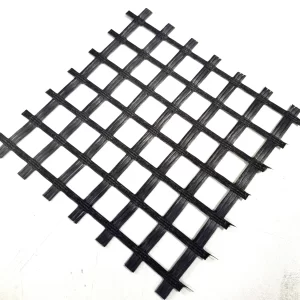
What makes fiberglass the superior material for asphalt reinforcement? The answer lies in its unique mechanical signature: extremely high tensile strength combined with extremely low elongation.
Lianyi geogrids are manufactured from continuous filament E-glass (or alkali-resistant AR-glass) yarns, coated with a proprietary polymer-modified bitumen or polymeric coating for compatibility and protection. The fundamental properties of the glass filaments are:
-
Ultimate tensile strength: typically in the range of 1,500–2,000 MPa.
-
Modulus of elasticity: approximately 70 GPa (10 million psi).
-
Elongation at break: only 2.5–3.5 %.
In grid form, these translate into design tensile strengths commonly specified as 50 kN/m, 100 kN/m, 120 kN/m, up to 200 kN/m in both longitudinal and transverse directions. When your clients asked for the tensile muscle of fiberglass in concrete terms—understanding that a 425 kg/cm² compressive strength concrete benefits enormously from such tensile reinforcement—you can confidently state that the same ultra-stiff fibers can provide tensile capacity equivalent to heavy steel mesh, but at a fraction of the weight and without any corrosion risk.
The killer advantage for asphalt, however, is the modulus combined with low elongation. Asphalt cracks start to form at strains well below 1%. A reinforcement material must engage immediately, before the crack opens perceptibly. Polyester (PET) geogrids, a common alternative, typically have a secant stiffness at 2% strain of only around 5–15 GPa and an elongation at break of 10–12%. They stretch significantly under load—meaning the crack can widen before the grid picks up the force. Fiberglass, by contrast, is nearly Hookean to failure: it develops huge restraining force with minimal deformation. It catches the micro-crack at its inception and physically stops it from opening. This is why fiberglass geogrids consistently achieve a reflective cracking mitigation factor of 3x to 5x in full-scale overlay tests.
And unlike polymer-based grids, fiberglass exhibits zero creep. Under a sustained load—the permanent dead load of an asphalt overlay, the prolonged push of heavy stationary traffic—glass simply does not deform with time. Your structural design assumptions remain valid for 30, 40, even 50 years.
4. The Lianyi Knitted Nonwoven Composite Geogrid: Two Functions in One Ingenious Product
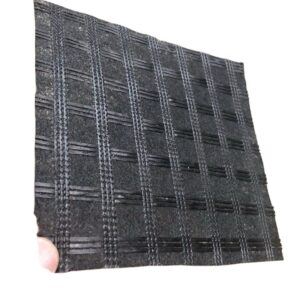
While a standalone fiberglass geogrid is a superb crack barrier, we asked ourselves: can we integrate additional, life-saving functionality directly into the reinforcement? The result is our signature product: Lianyi fiberglass geogrid knitted with a nonwoven fabric backing.
Product Structure
-
The fiberglass grid provides the tensile backbone. Yarns are knitted—not merely glued—at the junctions, creating a structurally robust, stable mesh with high node strength.
-
A lightweight, needle-punched nonwoven polypropylene or polyester fabric is mechanically bonded to the grid during the knitting process. This is not an afterthought; it is an integral part of the composite.
How It Works in the Pavement
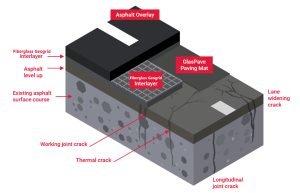
During installation, the composite is laid onto a hot, polymer-modified tack coat (typically an emulsion or hot bitumen). The nonwoven fabric acts like a sponge: it instantly absorbs the bitumen, swelling to form a continuous, flexible, fully waterproof stress-absorbing membrane interlayer (SAMI). The fiberglass grid remains perfectly positioned within this membrane, fully bonded to both the existing surface below and the new overlay above.
Key Differences and Advantages vs. Separate Systems
vs. Standalone Fiberglass Geogrid with a Simple Tack Coat:
A simple tack coat provides bond but no waterproofing and only minimal stress absorption. A standalone grid relies on the asphalt itself to encapsulate it, which can lead to localized debonding if the grid is not perfectly saturated. The knitted nonwoven composite guarantees a thick, uniform SAMI that decouples vertical movements (shear) and seals the old surface 100% against water ingress, while the glass grid handles tensile crack-bridging.
vs. Separate SAMI + Grid (Two-Layer Installation):
The traditional method is to first spray a heavy SAMI layer, then roll a grid into it. This requires two passes, greater material quantity, and risks the grid floating or wrinkling. Our one-step composite installs in a single pass. The nonwoven fabric acts as a spacer and absorption medium, ensuring the correct bitumen uptake and holding the grid completely flat. No wrinkles. No slip. No debonding. Labour time and installation risk are dramatically reduced.
vs. Polyester (PET) Geogrids with or without Nonwoven:
Polyester grids, even when composite, still suffer from the inherent high elongation and creep of polyester. Under high summer temperatures, the modulus of polyester drops significantly. A Lianyi glass-based composite maintains its stiffness at any pavement temperature, making it superior for both thermal and traffic-induced reflective cracking.
vs. Steel Mesh Reinforcement:
Steel mesh is heavy, hard to handle, and requires thick cover layers to prevent corrosion and to achieve adequate bond. It is a thermal bridge and can itself corrode and expand, causing new cracking. Lianyi fiberglass composites are chemically inert, will never rust, weigh a fraction (a 100 m² roll of steel mesh can weigh nearly a ton; our composite roll weighs roughly 20–30 kg), and can be placed directly under a thin overlay without any cover depth penalty.
5. The Comprehensive Advantages of Lianyi Fiberglass Geogrids
When you specify a Lianyi product, you unlock a suite of engineering and economic benefits:
5.1 Superior Reflective Cracking Resistance
Laboratory overlay tests (modes I, II, and mixed-mode) and decades of field data confirm that a properly installed Lianyi glass composite interlayer extends the time before reflective cracks appear by a factor of three to five. Finite element modeling shows the grid reduces the stress intensity factor at the crack tip by up to 70%.
5.2 High Tensile Strength at Low Elongation
Already detailed, but worth repeating: with ultimate strengths up to 200 kN/m and an elongation at break under 3%, you are embedding a true tensile element that works immediately, stiffens the overlay, and drastically reduces the critical tensile strain at the bottom of the bound layers.
5.3 Excellent Fatigue Life Extension
Because the grid absorbs tensile stress, the asphalt’s own fatigue endurance limit is effectively raised. This enables the perpetual pavement concept: a structurally reinforced base that never fatigues, with only periodic surface renewal required. Design thickness can often be reduced by 20–30%, delivering enormous savings in raw material.
5.4 Waterproofing and Pavement Preservation
The knitted nonwoven version creates a seamless, fully bonded waterproofing membrane. Water is the single greatest destroyer of pavement foundations. By keeping the unbound granular layers and subgrade dry, the Lianyi interlayer preserves the structural modulus of the entire pavement system, preventing the premature softening and failure that costs road agencies billions.
5.5 Cost Effectiveness
Cost effectiveness is not about the square-meter price of a grid. It is about the whole life cost. Consider:
-
25% asphalt thickness reduction on new builds.
-
Elimination of one or two major rehabilitation cycles over the design life.
-
Reduced traffic management costs, shorter possession times, and minimal user delays (which dominate life cycle cost calculations).
-
In most projects, the reinforcement pays for itself several times over within the first extended maintenance interval.
5.6 Environmentally Friendly Construction
Lianyi geogrids are a powerful tool for sustainability. The raw material savings—less aggregate mined, less bitumen refined—directly reduce the pavement’s carbon footprint. Enabling the use of cold recycled asphalt layers as a base, with grid reinforcement providing the structural capacity, further closes the materials loop in a true circular economy. Moreover, our products are fully compatible with reuse and eventual recycling of the pavement. A longer-lasting road means fewer reconstructions, less congestion, and lower total emissions over the asset’s lifetime. This is green engineering that makes financial sense.
5.7 Fast, Simple Installation
Lightweight rolls (typically 100 m x 1.5–5.2 m) can be handled manually or with a simple bar. The knitted composite unrolls flat and absorbs the tack coat like a carpet, enabling immediate overlay paving. No specialized equipment, no heavy lifting, no safety hazards from wire mesh.
6. Comparison with Other Reinforcement Materials: At a Glance
| Property / Material | Lianyi Glass Geogrid (with nonwoven) | Polyester (PET) Geogrid | Steel Mesh | Nonwoven Fabric Only |
|---|---|---|---|---|
| Tensile modulus | ~70 GPa (very high) | 5–15 GPa (moderate) | ~210 GPa (high) | Very low |
| Elongation at break | 2.5–3.5% | 10–12% | ~0.2% yield (plastic) | >40% |
| Creep resistance | Excellent (zero) | Poor to moderate | Good | Poor |
| Corrosion risk | None | None | High (unless stainless) | None |
| Waterproofing ability | Excellent (with nonwoven) | Only if composite | None | Excellent (SAMI function) |
| Installation weight | Very light | Light | Very heavy | Light |
| Crack bridging (stiffness) | Immediate, full | Delayed, partial | Immediate but brittle | No effective bridging |
| Cost per life-year | Very low | Moderate | Moderate to high | Low structural value |
The table makes the case clear: only a fiberglass-based composite delivers the full package—instant crack bridging, waterproofing, zero corrosion, light weight, and outstanding durability.
7. From Theory to Jobsite: Installation and Quality
A great product deserves a proper installation. The Lianyi system’s success rests on a few straightforward, non-negotiable practices:
-
Surface Preparation: The existing surface must be clean, dry, and free of debris. Potholes and wide cracks should be filled.
-
Tack Coat Application: A polymer-modified bitumen emulsion or hot bitumen is sprayed at a rate specifically calibrated to the nonwoven’s absorption capacity—typically 0.8–1.2 kg/m² residual bitumen. We provide detailed guidelines for every product grade.
-
Grid Laying: The composite roll is unrolled directly into the hot tack coat, nonwoven side down. Bubbles and wrinkles are eliminated with a simple broom or squeegee. End laps and side laps (usually 10–15 cm) ensure continuity.
-
Paving: The asphalt overlay is placed immediately after, at standard paver speeds. The fully bonded composite does not lift or delaminate. Vibratory rolling achieves full compaction without damage to the grid.
With these simple steps—fully consistent with standard contractor practice—the reinforcement system becomes an integral, high-performance interlayer that works from day one.
8. Conclusion: The Intelligent Choice for Modern Asphalt Infrastructure
Our conversation began with a deep exploration of how asphalt reinforcement, aligned with modern mechanistic-empirical design and perpetual pavement theory, is transforming road construction. We saw that the days of rule-of-thumb thicknesses are over, replaced by engineered layers that precisely manage tensile stress and crack propagation. You then asked a very specific, practical question about tensile strength—the raw number that gives a concrete pavement its resistance to failure. That number, for our fiberglass geogrids, is a design-strength typically specified up to 200 kN/m, with glass fiber tensile stress exceeding 1,500 MPa, providing enormous crack-bridging power at minimal elongation.
Now, we have brought all of that together for your Lianyi website. The Lianyi fiberglass geogrid range—especially our knitted nonwoven composite—is the embodiment of everything modern asphalt reinforcement should be. It delivers:
-
Unmatched reflective cracking control through ultra-high modulus, low-elongation glass fibers.
-
Active waterproofing through an integrated, bitumen-absorbing stress-absorbing membrane interlayer.
-
Exceptional economy, slashing material use and maintenance interventions, delivering the lowest whole-life cost of any interlayer technology.
-
Environmental responsibility, cutting CO₂ emissions, conserving natural resources, and supporting closed-loop road rehabilitation.
-
Installation simplicity, reducing time, equipment, and risk on site.
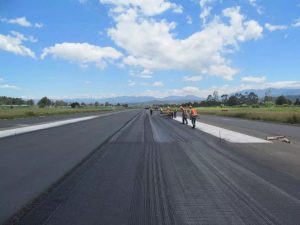
Whether you are reinforcing a heavily loaded highway, an airport taxiway, an urban intersection, or a rural road’s overlay, Lianyi fiberglass geogrids transform a simple asphalt overlay into a resilient, long-life composite structure. We invite you to contact our engineering team for project-specific design support, finite element modeling input, and certified product data sheets. Together, we can build the roads of tomorrow—stronger, leaner, and greener.
