

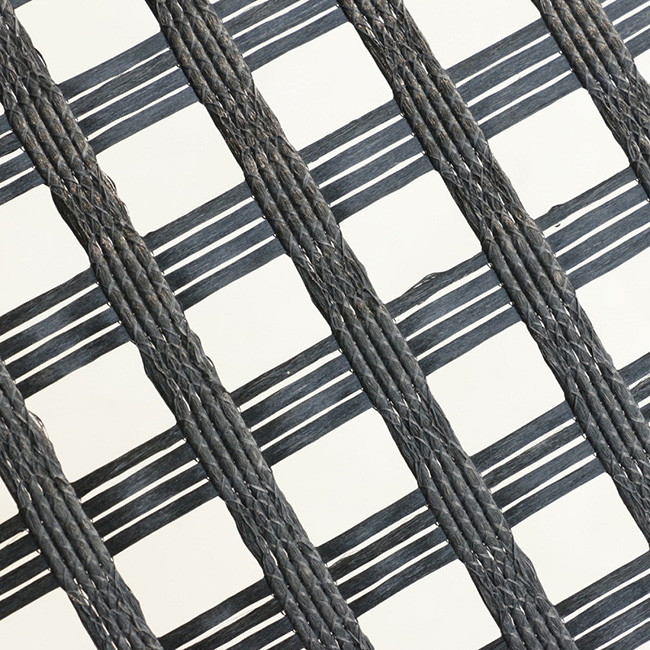


Triaxial geogrid is often the better choice for reinforcing the aggregate base of roads, pavements, and working platforms where loads act from multiple directions, as its triangular aperture geometry provides greater multidirectional aggregate interlock. However, for applications where reinforcement is primarily required along two principal directions, biaxial geogrid remains an effective and often more economical option.
Research published in the ‘Journal of Materials in Civil Engineering’ and the ‘International Journal of Transportation Science and Technology’ suggests that, under certain test conditions, triaxial geogrids can provide stronger confinement and reduce permanent deformation. Ultimately, the choice depends on tensile properties, aperture size, aggregate gradation, subgrade strength, and project design.
What Are Biaxial and Triaxial Geogrids?
Biaxial and triaxial geogrids are geosynthetic reinforcement products that improve the mechanical performance of soil and aggregate layers. They are typically made from polymers such as polypropylene (PP) or high-density polyethylene (HDPE) and have an open grid structure that enables the surrounding soil or aggregate particles to interact with the grid ribs. Their primary reinforcement mechanisms include aggregate interlocking, lateral confinement, load distribution, and enhanced resistance to deformation.
The main difference between them lies in their aperture geometry and how their ribs distribute resistance across the plane of the grid. Biaxial geogrids generally have square or rectangular apertures and are designed to provide tensile strength in two principal directions: the machine direction (MD) and the cross-machine direction (CMD). A triaxial geogrid typically has triangular apertures arranged to provide a more uniform in-plane response across multiple directions. The term ‘triaxial’ describes the grid’s geometry and directional reinforcement behaviour. It does not mean that the product is a three-dimensional geocell, nor that it necessarily has three times the strength of a biaxial product.

Biaxial Geogrid: Structure and Working Characteristics
Biaxial geogrids have regularly spaced ribs that form square or rectangular openings. Their tensile properties are usually tested separately in the machine and cross-machine directions, making them ideal for projects requiring reinforcement along two main axes. When placed within an aggregate base, the grid ribs restrict the lateral movement of particles when subjected to traffic or other applied loads. Aggregate particles that enter and engage with the apertures create a form of mechanical interlocking that helps the reinforced layer maintain its structure.
This mechanism is particularly useful in road construction, subgrade stabilisation, access roads and foundation platforms. Biaxial geogrids are also available in a wide range of tensile strengths, aperture dimensions and polymer formulations, enabling engineers to select products according to expected loads and soil conditions. Their established use and broad availability make them a practical option for conventional reinforcement projects.

Triaxial Geogrid: Structure and Working Characteristics
Triaxial geogrids typically feature triangular apertures formed by interconnected ribs. This geometry is intended to distribute resistance more evenly across different in-plane directions, rather than relying mainly on two principal tensile directions. When compacted aggregate is placed around the grid, particles can engage with the triangular openings and ribs, helping create a mechanically stabilized composite layer.
The multidirectional arrangement can be beneficial where traffic loads, wheel paths, or construction stresses are not consistently aligned with the grid’s two principal directions. In suitable aggregate and subgrade conditions, this interaction may improve confinement and reduce permanent deformation. However, triangular geometry alone does not guarantee superior performance. The grid’s tensile stiffness, junction strength, aperture dimensions, installation quality, and compatibility with the aggregate are all important.
Biaxial vs. Triaxial Geogrid: Key Differences
The most useful way to compare these products is to examine their reinforcement mechanisms and performance under the actual conditions of a project. Neither aperture geometry nor a single tensile-strength value provides enough information to determine which geogrid is better.
| Comparison Factor | Biaxial Geogrid | Triaxial Geogrid |
| Typical aperture shape | Square or rectangular | Triangular |
| Main reinforcement directions | Two principal directions | More uniform in-plane response across multiple directions |
| Aggregate interlock | Effective when aperture size matches aggregate | Can provide multidirectional particle interaction |
| Lateral confinement | Strong reinforcement along two principal axes | Designed to provide more uniform confinement in different directions |
| Typical applications | Road bases, subgrade stabilization, working platforms | Pavement bases, aggregate stabilization, working platforms |
| Tensile properties | Usually specified in MD and CMD | Must be evaluated using product-specific test data and relevant directions |
| Design considerations | Directional strength, aperture size, stiffness, and installation orientation | Aperture geometry, stiffness, junction properties, aggregate compatibility |
| Purchasing considerations | Often widely available in established product ranges | Compare performance data and project-specific value, not geometry alone |
Aperture Geometry and Aggregate Interlock
The geometry of the apertures determines how the aggregate particles interact with the geogrid. For effective reinforcement, the size of the apertures must be compatible with the size distribution of the aggregate particles. If the apertures are too small, larger particles may not engage effectively with the grid. Conversely, if the apertures are too large, the aggregate may move through them without developing sufficient mechanical interlock.
Biaxial grids use square or rectangular openings to engage with the particles and restrain their lateral movement in two main directions. Triaxial grids use triangular openings to create a more multidirectional arrangement of ribs. This provides a more consistent interaction when aggregate movement occurs at different angles. However, the effectiveness of either structure depends on the aggregate gradation, particle shape, grid stiffness, and compaction conditions.
Tensile Strength and Stiffness
Tensile strength indicates the maximum tensile load a geogrid can sustain under a specified test method, while tensile stiffness describes its resistance to deformation at a given strain. These are related but distinct properties. A product with high ultimate tensile strength may not necessarily provide the best reinforcement if its stiffness at the working strain is unsuitable for the project.
Engineers should compare tensile strength at specified strain levels, tensile stiffness, junction strength, and long-term design properties where relevant. Test values should be obtained using comparable methods and units. For example, comparing a biaxial product’s strength in one direction with a triaxial product’s reported value under a different test basis can produce a misleading conclusion.
Load Distribution and Deformation Control
Both types of geogrid can help to distribute loads through a reinforced aggregate layer and reduce lateral particle displacement. Triaxial geometry may be advantageous when the direction of loading varies, or when a more uniform in-plane response is desired. Biaxial geogrids are effective where the principal loading and reinforcement directions are well understood.
The extent of improvement depends on the entire pavement or foundation system, including subgrade stiffness, aggregate thickness, drainage, traffic volume, and the location of the geogrid within the layer. Therefore, geogrid reinforcement should be considered as part of a composite structural design rather than as an isolated material upgrade.
Which Geogrid Performs Better in Engineering Applications?
While research generally supports the potential advantages of triaxial geogrids in certain aggregate-base reinforcement conditions, the results should not be interpreted as proof of their universal superiority.
In a 2012 study, Abu-Farsakh, Souci, Voyiadjis and Chen used repeated-load triaxial tests to evaluate geogrid-reinforced granular base materials. The study found that the performance of the materials was affected by the geometry of the geogrids and their tensile modulus, and that a triangular-aperture triaxial product with the highest tensile modulus performed consistently better than the other products tested. The study also reported that geogrid reinforcement reduced permanent deformation under cyclic loading; however, improvements in resilient deformation or resilient modulus were not evident in the tested specimens. It is important to note that these results reflect the specific products and test conditions examined, rather than every biaxial and triaxial geogrid on the market.
A separate paper, ‘An Assessment of the Geometry Effect of Geosynthetics for Base Course Reinforcements’, compared typical geosynthetic geometries and concluded that triangular-aperture triaxial geogrids could provide a better confinement effect than rectangular-aperture biaxial geogrids when considering the polymer material and typical product geometries. It also highlighted that conventional uniaxial tensile modulus may be an inadequate standalone indicator of reinforcement effectiveness.
More recent research published in the Journal of Pipeline? No—the relevant study is in the Journal of Performance of Constructed Facilities—examined critical factors affecting geogrid reinforcement using a loaded wheel tester. It reported that triaxial geogrids performed better than biaxial geogrids with similar tensile strength in the tested aggregate-base conditions. However, tensile strength had a more significant effect on reinforcement than aperture geometry, reinforcing the importance of comparing complete product properties rather than relying on grid shape alone.
- Road and Pavement Construction
In the construction of flexible pavements, both biaxial and triaxial geogrids can be used to stabilise aggregate base layers and improve resistance to rutting. Triaxial products are worth considering when traffic loading is multidirectional, stronger lateral confinement of the aggregate base is required, or the project is designed to minimise deformation over a weak subgrade. Biaxial products remain suitable where their directional properties and aperture geometry meet the design requirements.
- Soft Subgrade Stabilization
Soft or weak subgrades can deform under construction equipment and repeated traffic loads. A geogrid placed at the appropriate interface can help restrain aggregate movement and improve the stability of the working platform. Triaxial geogrids may offer an advantage in some conditions because of their multidirectional geometry, but the actual benefit depends on subgrade strength, aggregate quality, reinforcement position, and construction method.
- Working Platforms and Access Roads
Temporary construction roads and working platforms often have to withstand changing vehicle paths, turning forces, and concentrated equipment loads. A triaxial geogrid can be an effective solution where multidirectional aggregate confinement is important. A biaxial geogrid can also be effective if the loading pattern, product properties, and installation layout are considered appropriately. The choice should be supported by design calculations or project-specific testing, particularly where heavy equipment is operating over weak ground.
When Should You Choose Biaxial or Triaxial Geogrid?
The correct choice should start with the engineering requirement, not with a preference for a particular product shape. The following factors help narrow down the options.
Choose a biaxial geogrid when:
- The project requires reinforcement primarily along two principal directions.
- The selected product’s machine-direction and cross-machine-direction properties satisfy the design requirements.
- Its aperture size is compatible with the aggregate gradation and particle shape.
- The project uses an established design method or specification based on biaxial geogrid properties.
- It offers a suitable balance of performance, availability, and installed cost.
Choose a triaxial geogrid when:
- More uniform in-plane reinforcement is desirable because loading directions vary.
- Aggregate interlock and multidirectional confinement are important design considerations.
- Project-specific evidence indicates better rutting or deformation performance with the selected triaxial product.
- The grid’s tensile stiffness, junction properties, and aperture dimensions are suitable for the aggregate.
- Its performance benefit justifies the material and installation cost.
| Project Condition | Geogrid Option to Evaluate First | Important Design Checks |
| Conventional road base reinforcement | Biaxial or triaxial | Traffic loading, aggregate gradation, tensile stiffness |
| Pavement with multidirectional traffic | Triaxial | In-plane response, rutting resistance, aperture compatibility |
| Weak subgrade stabilization | Both types | Subgrade CBR, aggregate thickness, reinforcement location |
| Heavy-duty working platform | Both types | Equipment loads, construction traffic, junction strength |
| Project with defined directional reinforcement | Biaxial | MD/CMD tensile properties and installation orientation |
| Project prioritizing multidirectional aggregate confinement | Triaxial | Aggregate interlock and product-specific performance tests |
Key Factors to Check Before Purchasing Geogrid
Selecting a geogrid based only on whether it is biaxial or triaxial can lead to poor design decisions. Buyers, contractors, and engineers should review the following technical factors before approving a product.
- Tensile Properties and Junction Strength
Request technical data showing the tensile strength and stiffness of the product under clearly defined test conditions. For biaxial products, review the results for both MD and CMD. For triaxial products, request the relevant directional performance data and test method from the manufacturer. Junction strength is also important, as the connections between ribs must be able to transfer forces without failing prematurely.
- Aperture Size and Aggregate Compatibility
The grid opening should be evaluated against the aggregate’s particle-size distribution. A suitable aperture allows particles to penetrate and engage with the grid structure, supporting mechanical interlock. Aggregate gradation, angularity, maximum particle size, and compaction method should all be considered together.
- Polymer Material and Durability
Although polypropylene and HDPE are common geogrid materials, the suitability of a polymer depends on the installation and service environment. Factors to consider include chemical exposure, temperature, installation damage, creep, and long-term durability. When designing for a long service life, engineers should use appropriate long-term design strengths rather than relying solely on short-term ultimate tensile strength.
- Installation and Quality Control
Even a technically suitable geogrid can underperform if it is poorly installed. The subgrade should be prepared according to the project specification, the grid should be laid without excessive wrinkles or damage, and aggregate should be placed and compacted using an appropriate construction sequence. Overlapping, anchorage, cover thickness, and equipment movement should follow the manufacturer’s installation instructions and the engineer’s approved design.
Common Mistakes When Comparing Biaxial and Triaxial Geogrids
A common misconception is that triaxial geogrids are automatically stronger simply because they have a three-directional geometry. While grid geometry affects how loads and aggregate interactions develop, it does not eliminate the need to check tensile strength, stiffness, junction performance, and durability. For a particular application, a well-designed biaxial geogrid may be more appropriate than a lower-performance triaxial product.
Another mistake is to compare tensile strength values without checking the test methods, strain levels, and measurement directions used. Buyers should also avoid selecting a grid without considering aggregate gradation or subgrade conditions. A product that performs well in one laboratory configuration may not deliver the same benefits in different soil, aggregate, moisture, or traffic environments.
Finally, geogrids should not be treated as a substitute for proper pavement or foundation design. While it can improve the performance of a granular layer, it cannot independently correct issues such as inadequate drainage, unsuitable fill, insufficient layer thickness, or poor compaction. A sound design considers the entire soil–aggregate–geogrid system.
How to Evaluate Geogrid Performance Through Testing?
In cases where the project is technically demanding or where there is a significant cost difference between products, laboratory or field evaluation can help to determine which option offers better value. Useful methods include tensile testing, junction-strength testing, pull-out testing and repeated-load or wheel-tracking tests on representative aggregate systems. The test programme should reflect the actual material combination and loading conditions as closely as possible.
For pavement applications, performance indicators may include permanent deformation, rut depth, resilient response and the number of load repetitions required to reach a defined deformation level. These measurements provide a more meaningful comparison than product labels alone. Research reviews also emphasise that the performance of geogrid reinforcement is influenced by stiffness, geometry, installation depth, aggregate thickness and subgrade strength.
Engineers should distinguish between index properties used for product characterisation and design properties used for long-term structural calculations. Where possible, request technical datasheets, test reports from accredited laboratories, installation guidance and project references for comparable conditions. Transparent comparisons should use equivalent test methods and clearly state the assumptions behind any claimed improvement.
Frequently Asked Questions About Biaxial and Triaxial Geogrids
- Which is stronger, biaxial or triaxial geogrid?
Neither type is inherently stronger in every case. Tensile strength, stiffness, junction strength, and test direction must be compared using equivalent test methods.
- What is the main difference between biaxial and triaxial geogrid?
Biaxial geogrids typically have square or rectangular apertures and reinforce two principal directions. Triaxial geogrids generally have triangular apertures designed to provide a more uniform in-plane response.
- Is triaxial geogrid better for road construction?
Triaxial geogrid can be advantageous for aggregate base reinforcement where multidirectional confinement and rutting resistance are important. Biaxial geogrid can also perform effectively when its properties match the pavement design.
- Can biaxial geogrid be used for soft soil stabilization?
Yes. Biaxial geogrid is widely used to reinforce aggregate layers over weak subgrades by restricting lateral aggregate movement. Its effectiveness depends on subgrade conditions, aggregate compatibility, and installation.
- Does triaxial geogrid reduce road rutting?
It can help reduce permanent deformation by improving aggregate confinement and load distribution. The actual rutting reduction depends on the product properties, aggregate, subgrade, pavement structure, and traffic conditions.
- How do I choose the right geogrid for a project?
Start with the subgrade strength, design loads, aggregate gradation, required reinforcement properties, and installation conditions. Then compare biaxial and triaxial products using equivalent test data and, where necessary, project-specific testing.
Conclusion
So, which is better: biaxial or triaxial geogrid? For aggregate base reinforcement, where multidirectional confinement and improved aggregate interaction are key priorities, the triaxial geogrid is often the stronger option. Its triangular aperture geometry has been shown to offer advantages in several laboratory studies, particularly in certain pavement and granular-base conditions. However, for projects where reinforcement along two principal directions is sufficient, and the design requirements are met by its mechanical properties, biaxial geogrid remains a reliable and practical solution.
The most effective selection is based on engineering performance rather than product terminology. Project teams can identify the geogrid that delivers the best technical and economic outcome by comparing tensile stiffness, tensile strength, aperture geometry, junction strength, aggregate compatibility, subgrade conditions, and long-term durability.
