

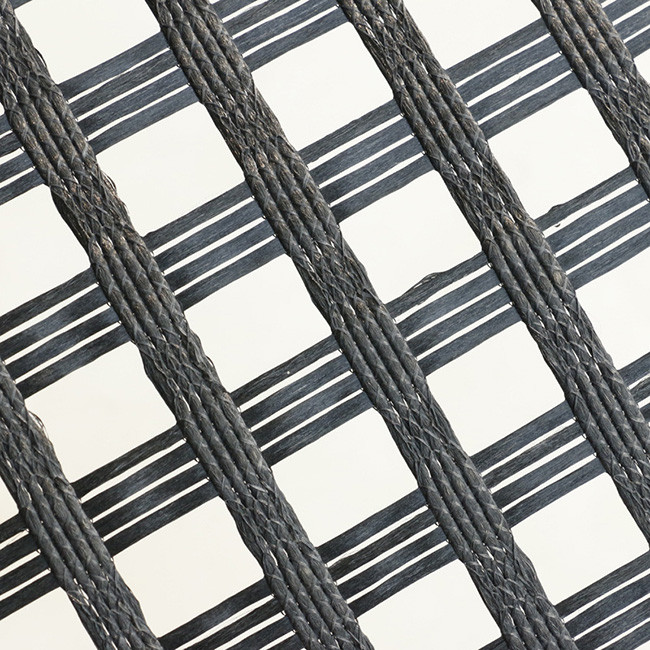

빠른 답변: 둘 다 지오그리드 그리고 지오텍스타일 (지오페브릭스)는 토목 및 지반공학에 사용되는 고분자 기반의 지오투합재료입니다. 그러나 이들 간에는 근본적으로 다른 주요 기능이 있습니다. 지오그리드는 개방형 격자 구조로, 인장 저항성과 상호 맞물림을 통해 흙과 골재를 기계적으로 보강하도록 설계되었습니다. 반면 지오텍스타일은 연속적인 투수성 직물 시트로, 주로 여과, 분리, 배수 및 표면 침식 방지에 사용됩니다.
Koerner(지오투합재료를 이용한 설계, 6판, Xlibris, 2012)와 Holtz, Christopher 및 Berg(지오투합공학, BiTech Publishers, 2008)에 따르면, 이 두 제품 유형 중 선택은 지반공학에서 요구되는 주된 기능—보강 또는 여과/분리—뿐만 아니라 각 프로젝트의 특정 하중, 배수 및 흙과의 상호작용 조건에 따라 결정됩니다. 두 기능을 결합한 복합 ‘지오투합’ 시스템은 복잡한 응용 분야에서 점점 더 일반화되고 있습니다.
소개
지오투합재료 산업은 1970년대 널리 보급된 이후 토목, 지반공학 및 환경공학의 관행을 변화시킨 다양한 고분자 기반 건설 자재를 포함합니다. 종종 명시되고 혼동되기 쉬운 두 가지 제품군은 지오그리드와 지오페브릭스입니다. 공급업체의 사양서에서 이들은 비슷해 보이지만, 재료 구조, 공학적 메커니즘 및 적용 분야에서는 매우 차이가 있습니다. 둘 다 폴리프로필렌, 폴리에틸렌 또는 폴리에스터와 같은 열가소성 고분자로 제조되며, 둘 다 롤 형태로 공급되고 설치되어 흙층 사이 또는 흙과 골재 채움 사이의 경계면에 위치합니다. 그러나 이들 간의 구조적 차이는 단단하고 개방된 격자망 대비 연속적이고 투수성 직물 시트라는 점에서 서로 다른 공학적 거동을 초래하며, 이는 각각의 프로젝트 사양에서의 역할을 결정짓습니다.
이 구분을 이해하는 것은 단순한 학문적 활동이 아닙니다. 지오텍스타일이 필요한 곳에 지오그리드를 명시하거나 그 반대로 하면, 구조물의 조기 파손, 차등 침하 또는 이러한 재료가 보호하기 위해 설치된 표면의 가속화된 침식을 초래할 수 있습니다. 인프라 엔지니어, 조경 계약자, 도로 건설자 및 옹벽 설계자 모두에게 지오그리드와 지오텍스타일 간의 차이에 대한 명확하고 기술적으로 뒷받침된 이해는 현명한 재료 선택을 위한 필수 요소입니다.
지오그리드란 무엇인가? 재료, 구조 및 메커니즘
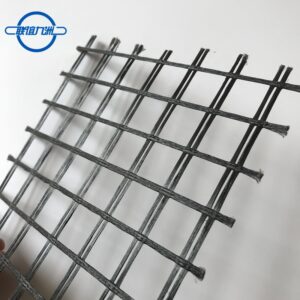
지오그리드는 개방형 구멍과 격자 모양의 구조를 특징으로 하는 지오투합제품으로, 서로 연결된 종방향 및 횡방향 리브들이 규칙적으로 배열되어 직사각형, 정사각형 또는 삼각형의 개구부(구멍)를 형성하며, 폭은 보통 10~100mm입니다. 이 개방 구조 덕분에 지오그리드는 기계적 맞물림과 인장 하중 전달을 통해 흙과 골재를 보강하는 주요 공학적 기능을 수행합니다. 골재나 압축된 채움재가 지오그리드 위나 주변에 놓이면 골재 입자가 구멍에 침투하여 그리드 리브 주위에 고정됩니다. 이로 인해 흙과 지오그리드의 복합 구조는 보강되지 않은 흙이나 골재보다 훨씬 높은 전단 저항성과 지지력을 갖게 됩니다.
지오그리드는 세 가지 주요 방법으로 제조됩니다. 가장 일반적인 유형인 펀칭 및 드로잉 지오그리드는 고분자 시트에 규칙적인 구멍 패턴을 뚫고, 뚫린 시트를 일축 또는 이축으로 늘려 고분자 분자 사슬을 리브 축과 정렬시킵니다. 이를 통해 지오그리드의 인장 강도와 최종 강도가 증가합니다. 직조 지오그리드는 고강력 폴리에스터나 폴리프로필렌 원사를 격자 형태로 직조한 후 접합부를 코팅하거나 봉합하여 구조를 안정화합니다. 용접 또는 접착 지오그리드는 압출된 고분자 막대를 교차점에서 연결해 조립합니다. 상용 지오그리드의 인장 강도는 주 하중 방향에서 약 20 kN/m에서 200 kN/m 이상까지 다양합니다. ASTM D6637 및 ISO 10319 시험법으로 정의된 접합부 효율성은 그리드 노드에서 유지되는 리브 강도의 비율을 나타내는 중요한 성능 파라미터입니다.
지오페브릭(지오텍스타일)이란 무엇인가? 구성 및 기능
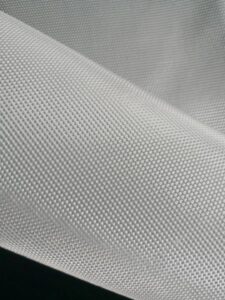
지오텍스타일은 ASTM D4439 및 ISO 10318-1의 정의에 따라 정식으로 지오페브릭이라 불리며, 개방형 구멍이 없는 합성 고분자 섬유나 필라멘트로 만들어진 투수성의 연속적이고 2차원적인 직물 구조입니다. 지오텍스타일은 직물의 연속성으로 정의되며, 물은 통과시키면서 흙 입자는 유지하는 투수성 장벽으로 작용합니다. 이러한 성능 특성은 두 가지 주요 파라미터로 정량화됩니다: 겉보기에 나타나는 개구부 크기(AOS), 즉 직물이 유지할 수 있는 가장 큰 흙 입자를 정의하며, ASTM D4751에 따라 측정됩니다; 그리고 투과율, 즉 단위 수두 차이당 직물을 통과하는 물의 체적 유량을 정의하며, ASTM D4491에 따라 측정됩니다.
지오텍스타일은 두 가지 주요 형태로 제조됩니다. 직조 지오텍스타일은 표준 직조기에서 모노필라멘트 또는 멀티필라멘트 실을 서로 직각으로 교차시켜 생산됩니다. 이들의 규칙적이고 밀집된 직조는 높은 인장 강도와 비교적 균일한 기공 크기를 제공하며, 지속적인 하중 아래에서 분리 및 보강 작업에 적합합니다. 부직포 지오텍스타일은 무작위로 배열된 짧은 스테이플 섬유나 연속 필라멘트를 니들 펀칭, 열접착 또는 화학적 접착을 통해 결합해 생산됩니다. 이들의 무작위 섬유 배열은 복잡한 기공 구조를 형성해 우수한 입자 유지 성능과 높은 평면 내 배수 능력을 제공하며, 여과, 배수 및 침식 방지 응용 분야에서 주된 선택이 됩니다. 부직포 지오텍스타일의 단위 중량은 보통 100 g/m²에서 1,000 g/m²까지이며, 높은 단위 중량은 더 높은 여과 내구성과 내구성을 제공합니다.
지오그리드 vs. 지오페브릭 — 핵심 비교
| 구조 | 개방형 구멍 격자(10–100mm 구멍) | 연속적이고 투수성 직물 시트 |
| 주요 기능 | 흙/골재 보강 | 여과, 분리, 배수 |
| 재료 | PP, HDPE, PET(압출 또는 직조) | PP 또는 PET 섬유(직조 또는 부직포) |
| 인장 강도 | 20–200+ kN/m | 10–100+ kN/m(직조); 5–40 kN/m(부직포) |
| 흙 입자 유지 | 없음 — 입자가 구멍을 자유롭게 통과 | 예 — AOS 규격에 따라 흙을 유지 |
| 물 흐름 | 개방 구멍을 통해 제한 없이 흐름 | 제어된 투수성(투과율) |
| 주요 ASTM 표준 | D6637, D7737, ISO 10319 | D4759, D4751, D4491, D4533 |
| 일반적인 애플리케이션 | 도로 기초 보강, 옹벽, 제방 | 배수 랩, 침식 방지 담요, 분리층 |
| 설치 위치 | 골재층 사이 또는 기초 접합부 | 흙과 골재 사이; 배수관 주변 |
| 하중 전달 메커니즘 | 골재의 구멍 내 맞물림 | 주된 하중 지지 메커니즘이 아님 |
주요 기능적 차이: 각 재료가 가장 잘 발휘하는 경우
지오그리드와 지오텍스타일 간의 가장 중요한 차이는 고분자 화학이나 제조 원천에 있지 않으며, 각 재료가 지반에서 활용하는 특정 지반공학적 메커니즘에 있습니다. 이러한 메커니즘에 대한 명확한 이해가 올바른 재료 선택의 기초입니다.
Geogrids are ideal for reinforcement applications where the aim is to increase the tensile strength and stiffness of granular or cohesive soil systems that are weak in tension by nature. Soils and granular aggregates are strong in compression but weak in tension; they cannot resist the lateral spreading forces that develop beneath loaded pavements, within tall retaining walls or under the fill of steep embankments. When installed at the base of a granular road base course, a geogrid interacts with the aggregate above and below through aggregate interlock in its apertures. This effectively converts the geogrid’s tensile strength into a lateral confinement force that resists the aggregate spreading outwards under wheel load. As documented in AASHTO M288-17 and confirmed by decades of monitored performance data, the result is a measurable reduction in required aggregate base thickness — typically 20–40% for equivalent structural performance — and an extension to pavement service life.
Geo fabrics excel in filtration and separation applications where the engineering objective is to prevent two materials — typically a fine-grained subgrade soil and a coarser aggregate base — from mixing under dynamic or static loading while allowing free water movement across the fabric plane. Without a separation layer, the fines from a weak subgrade soil pump upward into the voids of an aggregate base under repeated traffic loading, contaminating and weakening the aggregate while simultaneously destabilizing the subgrade — a failure mechanism that destroys road bases rapidly on soft ground. A nonwoven geotextile with correctly specified AOS installs between subgrade and base course to block this fines migration while maintaining drainage continuity, extending pavement life without adding structural thickness. The same filtration principle governs the use of geotextile filter wraps around perforated drainage pipe, geotextile erosion control mats on cut slopes, and geotextile underlays in coastal revetment structures.
Geotextiles also provide a secondary reinforcement contribution in some woven fabric applications — particularly in very weak subgrade stabilization, where the fabric’s tensile strength helps distribute surface loads over a larger subgrade area — but this reinforcement is geographically diffuse and mechanistically different from the concentrated aggregate-interlock reinforcement mechanism of a geogrid. In applications where reinforcement is the dominant performance requirement, a geogrid will consistently outperform a geotextile of equivalent cost.
Application Matrix — Selecting Between Geogrid and Geo Fabric
| Unpaved road over soft subgrade | ✅ Primary choice | ✅ Separation layer | ✅ Geogrid + nonwoven GTX |
| Paved road base reinforcement | ✅ Primary choice | — | — |
| 기계적으로 안정화된 흙(MSE) 옹벽 | ✅ Required | — | — |
| Steep slope embankment reinforcement | ✅ Required | — | — |
| Drainage pipe filter wrap | — | ✅ Primary choice | — |
| Cut slope erosion control. | — | ✅ Primary choice | — |
| Separation between subgrade and base course | ✅ (for reinforcement) | ✅ (for separation only) | ✅ When both needed |
| Landfill liner drainage composite | — | ✅ (as filter/protection layer) | ✅ With geonet drainage |
| Coastal revetment / rip-rap underlayer | — | ✅ Filter fabric | — |
| Green roof drainage layer | — | ✅ Filter/separation | — |
| Railway subballast stabilization | ✅ Primary choice | ✅ Separation layer | ✅ Common in practice |
Can Geogrid and Geo Fabric Be Used Together?
In a significant proportion of real-world geotechnical applications — particularly on soft or variable subgrade soils — the engineering problem simultaneously demands both reinforcement and filtration/separation performance, and neither geogrid nor geo fabric alone is sufficient to address both requirements. The recognized engineering solution is the use of both materials together, either as separately specified and separately installed layers or as a pre-manufactured geocomposite in which a geogrid and a nonwoven geotextile are factory-bonded into a single product.
In unpaved road construction over soft subgrade, for example, a nonwoven geotextile is typically installed directly on the subgrade to prevent fines contamination of the base course, and a biaxial geogrid is placed immediately above the geotextile within or at the base of the aggregate fill to provide tensile reinforcement and lateral confinement of the aggregate. The two layers are complementary: the geotextile performs filtration and separation that the open-aperture geogrid cannot provide, while the geogrid provides reinforcement stiffness that the geotextile cannot match. When specified and installed correctly as a dual-layer system, this combination can reduce required aggregate fill thickness by 30–50% compared to unreinforced construction on equivalent subgrade, a saving that typically more than offsets the combined cost of both geosynthetic layers. Geocomposite products that bond a geogrid to a nonwoven geotextile simplify installation in this scenario by eliminating relative displacement between the two layers during aggregate placement and compaction.
Material Selection Guide: Engineering Decision Framework
Selecting correctly between geogrid, geo fabric, or a combination of both begins with a clear identification of the dominant geotechnical function required — a step that is prior to any consideration of product grades, weights, or tensile specifications. The following decision logic applies:
Use a geogrid when the primary engineering need is to increase the load-bearing capacity or tensile strength of a granular soil or aggregate system, to stabilize a retaining wall mass, to reinforce a steep slope or embankment, or to reduce differential settlement under applied surface loading. The subgrade California Bearing Ratio (CBR) value and the applied design load are the primary input parameters for geogrid selection, with product specification driven by required tensile modulus at 2% strain (not ultimate tensile strength alone) per ASTM D6637 or ISO 10319.
Use a geo fabric when the primary engineering need is to separate two soil layers of differing particle sizes, to filter water movement at a soil-aggregate interface while retaining soil particles, to provide in-plane drainage of water from within a soil mass, or to protect a slope, embankment face, or revetment from surface erosion. AOS selection is determined by the D₈₅ particle size of the adjacent soil per AASHTO M288-17 filter design criteria, and permittivity must equal or exceed the design hydraulic gradient requirements.
Use both — or a geocomposite — when the application involves both a weak subgrade requiring reinforcement and a soil condition requiring separation or filtration, as is typically the case in unpaved roads over silty or clayey subgrade, railway trackbed rehabilitation, and certain coastal protection scenarios.
자주 묻는 질문
Q1: What is the main difference between geogrid and geotextile (geo fabric)?
The main difference is function and structure. A geogrid is an open-aperture polymer grid that reinforces soil and aggregate through mechanical interlock, while a geotextile (geo fabric) is a continuous permeable fabric sheet that performs filtration, separation, and drainage. Neither product effectively performs the primary function of the other, which is why they are frequently used together in demanding applications.
Q2: Can I use geo fabric instead of geogrid for road reinforcement?
Geo fabric alone is not an adequate substitute for geogrid in structural road base reinforcement applications. While woven geotextiles provide some tensile contribution on very soft subgrades, they lack the aperture geometry needed to interlock with aggregate particles and generate the lateral confinement mechanism that is the geogrid’s primary performance advantage. For road base reinforcement where tensile stiffness and aggregate confinement are the design objectives, a biaxial or triaxial geogrid is the correct specification.
Q3: Which is stronger — geogrid or geo fabric?
It depends on what is being measured. In tensile strength, high-end geogrids (100–200+ kN/m) exceed most woven geotextiles for structural applications. However, geotextile puncture resistance, tear strength, and in-plane drainage capacity (transmissivity) are not properties that geogrids possess at all, making direct strength comparisons less meaningful than function-specific performance comparison. The correct question is not “which is stronger?” but “which performs the required geotechnical function better?”
Q4: What is geogrid used for?
Geogrid is used primarily for soil reinforcement in applications including: mechanically stabilized earth (MSE) retaining wall construction; unpaved and paved road base stabilization over weak subgrade; steep slope and embankment reinforcement; railway subballast stabilization; and load-distribution beneath foundations and hardstanding areas on soft ground. Biaxial geogrids are used where reinforcement is needed in both plan directions (roads, hardstands); uniaxial geogrids are preferred for MSE walls and slopes where the primary load direction is defined.
Q5: What type of geo fabric is best for drainage applications?
Nonwoven needle-punched geotextiles are generally preferred for drainage applications because their random fibre structure provides high in-plane drainage capacity (transmissivity) and effective particle retention across a range of soil types. For drainage pipe filter wrapping, a nonwoven geotextile with AOS matched to the D₈₅ of the surrounding soil per AASHTO M288-17 criteria is the industry standard specification. Woven geotextiles are better suited to separation applications where high tensile strength under sustained load is important.
Q6: How do I choose between geogrid and geo fabric for my project?
Identify the dominant geotechnical function your project requires. If you need to increase the structural capacity of a granular layer, resist lateral forces in a retaining structure, or reinforce an embankment slope — specify a geogrid. If you need to prevent subgrade fines from contaminating an aggregate layer, filter water at a soil interface, control surface erosion, or wrap a drainage pipe — specify a geotextile. If your project requires both functions simultaneously (common in road construction on soft ground), specify both products in complementary layers or select a factory-bonded geocomposite that combines geogrid and nonwoven geotextile in a single product.
결론
경쟁하는 대신, 지오그리드와 지오페브릭은 서로 보완적인 지오투합 기술로서, 각각이 상대방이 재현할 수 없는 독특한 토양-재료 상호작용 메커니즘을 활용하도록 설계되었습니다. 지오그리드는 개방형 구조와 주변 골재 입자 간의 기계적 맞물림에서 그 공학적 가치를 얻습니다. 이로 인해 인장 구속력이 발생하며, 약한 입상 재료를 구조적 성능을 갖춘 보강 시스템으로 변환합니다.
반면, 지오페브릭은 직조된 연속성에서 공학적 가치를 얻습니다. 이는 물은 통과시키면서도 토양 입자의 이동은 막아주어, 필터링 및 분리 기능을 수행하는데, 이는 지오그리드의 개방형 구조와 근본적으로 상충됩니다. 이 두 제품군 중에서 올바른 소재를 선택하려면 해당 응용분야에서 요구되는 주요 지반공학적 기능을 명확히 진단한 후, 제품 수준에서의 사용 중 성능을 좌우하는 성능 파라미터—예를 들어 인장 모듈러스, AOS 및 투과율—를 명확히 규정해야 합니다. 보강과 필터링 모두가 필요한 복합적인 응용분야에서는 적절히 설계된 이중층 또는 지오파일 합성체 시스템에 두 소재를 결합함으로써 각각의 소재만으로는 달성할 수 없는 성능 결과를 얻을 수 있습니다.
참고문헌:
Koerner, R.M. 지오투합재를 이용한 설계, 6판. Xlibris Corporation, 2012.
Holtz, R.D., Christopher, B.R. & Berg, R.R. 지오투합공학. BiTech Publishers, 2008.
ASTM D4439. 지오투합재 표준 용어집. ASTM International. (현재 판)
ASTM D6637. 지오그리드의 인장 특성 결정을 위한 표준 시험 방법. ASTM International.
AASHTO M288-17. 고속도로 적용을 위한 지오텍스타일 표준 규격. 미국 주립 고속도로 및 교통 관리 협회, 2017.
ISO 10318-1:2015. 지오투합재 — 제1부: 용어 및 정의. 국제표준화기구.
