


Resumo do artigo: Geogrelhas e geotêxteis are primarily made from synthetic polymers, particularly polypropylene (PP), polyester (PET), and polyethylene (PE). However, their structures and formulations differ according to their intended engineering function. The Federal Highway Administration’s Geotechnical Engineering Circular No. 7 and the peer-reviewed publication Polymer Geogrids explain that geogrids are open-grid reinforcement products designed to interact with soil or aggregate, while geotextiles are permeable textile materials commonly used for separation, filtration, drainage, and reinforcement. A Review of Material, Design and Structure Relationships explains that geogrids are open-grid reinforcement products designed to interact with soil or aggregate. In contrast, geotextiles are permeable textile materials commonly used for separation, filtration, drainage, and reinforcement.
What Are Geogrid and Geotextile Materials?
Geogrids and geotextiles are two key types of geosynthetic materials used in civil engineering projects, including road construction, retaining structures, earthworks, drainage systems, and erosion control. Both are manufactured materials that are installed in contact with soil, aggregate, or other construction materials; however, they perform different functions due to their different physical structures. A geogrid consists of interconnected ribs that form regular openings, which allow the surrounding soil or aggregate particles to interlock with the grid. By comparison, a geotextile is a permeable fabric made from fibres, filaments, or yarns, and its pore characteristics can be selected to meet filtration, separation, and drainage requirements.
The most common raw materials are polypropylene, polyester, and polyethylene. These polymers are selected for their tensile properties, chemical resistance, durability, processability, and cost. However, the polymer alone does not determine product performance. Molecular structure, fibre or rib geometry, manufacturing method, coatings, stabilisers, and installation conditions all influence how a geosynthetic behaves over its intended service life. Consequently, two products made from the same base polymer may exhibit significantly different tensile strength, stiffness, permeability, creep resistance, and resistance to environmental exposure.
What Materials Are Geogrids Made Of?
Geogrids are generally manufactured from high-performance polymeric materials that are formed into an open grid. The main polymers used are high-density polyethylene (HDPE), polypropylene (PP), and polyester (PET). HDPE and PP are commonly used in extruded geogrids, whereas polyester is widely used in flexible geogrids made from high-tenacity yarns. The most suitable material is chosen based on the required tensile strength, stiffness, long-term loading behaviour, chemical exposure, and direction of reinforcement.
- High-Density Polyethylene (HDPE)
HDPE is a popular material for geogrids used in soil reinforcement, retaining walls and on steep slopes, as well as for other applications requiring durable tensile elements. It can be processed into a continuous sheet that is punched with a regular pattern and stretched to form an integrated grid structure. This drawing process aligns the polymer molecules, developing the mechanical properties necessary for reinforcement. HDPE also offers good resistance to many chemicals commonly found in soil, making it ideal for use in challenging geotechnical environments.
One important consideration is long-term deformation under sustained load. A geogrid used in a retaining wall or reinforced embankment, for example, must retain sufficient strength throughout its design life rather than merely achieving a high short-term tensile strength in a laboratory test. Consequently, engineers assess creep behaviour, installation damage, chemical compatibility and environmental durability when specifying HDPE geogrids. The appropriate grade and grid geometry must be selected according to the design requirements and verified long-term performance data from the manufacturer.
- Polipropileno (PP)
Another major material used to manufacture geogrids is polypropylene, particularly for products designed for road-base stabilisation and reinforcement beneath pavements. It can be extruded and stretched into a rigid grid with openings that enable aggregate particles to engage with the ribs. When placed in the correct layer, this interaction can restrict lateral movement, improve load distribution and help maintain the stability of the reinforced layer.
PP is attractive due to its relatively low density, practical processing characteristics and resistance to many acids and alkalis. However, its performance can be affected by ultraviolet exposure, temperature, sustained stress and installation conditions. A geogrid left exposed at a construction site for longer than the permitted exposure period may deteriorate depending on its formulation and stabilisation package. For this reason, the material specification should include the required installation and exposure limits, as well as the relevant tensile and durability properties for the intended application.
- Poliéster (PET)
Polyester geogrids are typically made from high-tenacity PET yarns woven or knitted into a grid configuration. The yarns provide tensile strength, and the junction design and protective coating help the product to maintain its structure during handling, installation and use. Polyester geogrids are often selected for applications where high tensile strength and controlled long-term deformation are important, such as reinforced soil structures, retaining walls, and embankments, due to their superior performance compared with many polyolefin-based products.
However, PET is sensitive to its chemical environment, particularly under certain combinations of high alkalinity, temperature, and moisture. Therefore, its suitability should be assessed against the actual backfill and exposure conditions, rather than being assumed from tensile strength alone. Many polyester geogrids use a protective coating, such as a polymeric or bituminous formulation, to protect the yarns from abrasion and construction damage. The type and integrity of the coating matter because damaged or incompatible coatings can affect the durability of the reinforcement system.
What Materials Are Geotextiles Made Of?
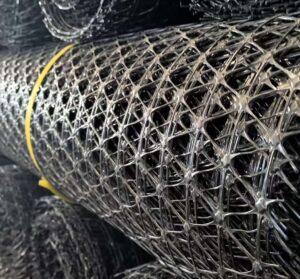
Geotextiles are permeable textile products made from polymer fibres, filaments or yarns. The most common materials are polypropylene and polyester, while polyethylene, polyamide (nylon) and natural fibres are used in selected applications. Unlike geogrids, which are primarily designed to reinforce their open structure, geotextiles are engineered to manage the interaction between soil and water, and to reinforce soil in some designs. Their performance depends on the polymer composition and how the fibres are formed into a fabric.
The peer-reviewed article ‘Geotextile composition, application and ecotoxicology: a review’, published in the Journal of Hazardous Materials, notes that synthetic geotextiles commonly consist of polymers from the polyolefin and polyester families, along with additives that improve stability and performance. This distinction is important for procurement purposes, as specifying only ‘polypropylene geotextile’ or ‘polyester geotextile’ does not guarantee that a product will meet the hydraulic, mechanical, or durability requirements of a project.
- Polypropylene Geotextiles
Polypropylene is widely used in both woven and non-woven geotextiles due to its combination of low density, cost-effective manufacturing, and resistance to the chemicals commonly found in soil. It is commonly used in road construction, as a separation layer, for drainage applications, in erosion-control systems and in general civil engineering works. Depending on the product, polypropylene (PP) can be formed into continuous filaments, staple fibres, or slit-film tapes, each of which produces a different fabric structure and set of performance characteristics.
Polypropylene is particularly useful in applications where a geotextile needs to separate dissimilar materials while allowing water to pass through. For instance, a separator installed between a subgrade and a granular road base can help prevent fine soil particles from migrating into the aggregate layer. However, the selected product must still provide adequate tensile strength, puncture resistance, and filtration compatibility for the site conditions. UV exposure during storage or installation should also be controlled according to the product specifications since prolonged sunlight can reduce the performance of insufficiently stabilised polypropylene.
- Polyester Geotextiles
Polyester geotextiles are typically produced from PET fibres or filaments, and are employed in applications where their mechanical properties align with the design requirements. They are available in woven and non-woven forms, including products intended for reinforcement, filtration, separation and protection. Woven polyester fabrics offer high tensile strength at relatively low elongation, making them ideal for applications requiring controlled deformation. Nonwoven PET products can provide a porous structure that is well-suited to filtration, drainage and protection functions.
When selecting materials, attention must be paid to the chemical and environmental conditions surrounding the installed fabric. Polyester can be vulnerable to hydrolysis in the presence of certain combinations of moisture, temperature, and pH, so its long-term suitability should be verified in aggressive or highly alkaline environments. Designers should also compare the product’s tensile properties, elongation, apparent opening size, and water permeability with the project’s requirements. A strong fabric does not automatically make an effective filter: it must retain relevant soil particles without becoming excessively clogged or restricting the necessary water flow.
- Other Materials: Polyethylene, Polyamide, and Natural Fibers
Polyethylene is used in certain geotextile and geosynthetic products due to its chemical resistance and processing characteristics. Polyamide, commonly known as nylon, is less prevalent than polypropylene (PP) and polyethylene terephthalate (PET) in general geotextile production, but it may be used where specific mechanical or material properties are required. The performance of these alternatives should be assessed on their own merits rather than being treated as interchangeable with the more common polymers.
Natural fibres such as coir, jute and sisal are also used in certain erosion control and temporary stabilisation products. They can be useful where the establishment of vegetation and the provision of short-term surface protection are priorities, particularly on slopes exposed to rainfall and surface runoff. However, as they are biodegradable and their strength changes as they weather, natural fibres are not a direct substitute for durable synthetic geotextiles in applications requiring long-term structural performance. Their suitability therefore depends on the expected service period, moisture conditions, biological activity and the rate at which vegetation or another permanent protection system becomes established.

How Are Geogrids and Geotextiles Manufactured?
The manufacturing process transforms a base polymer into a structure with specific mechanical or hydraulic properties. For geogrids, the process is selected to create strong ribs and stable junctions; for geotextiles, it is selected to create a fabric with the required tensile properties, pore structure, and permeability. The production route therefore influences performance as much as the name of the raw material.
Common geogrid manufacturing methods include:
- Extrusion and stretching: A polymer sheet is extruded, punched with a regular pattern, and stretched in one or more directions. This process is commonly used for integrated HDPE and PP grids, with the orientation and aperture geometry influencing tensile behavior.
- Weaving or knitting high-tenacity yarns: PET or other suitable polymer yarns are formed into a grid structure. Protective coatings may be added to improve resistance to installation damage and help maintain dimensional stability.
- Welding or bonding grid elements: Some products are manufactured by joining separately formed polymer ribs or strips. Junction strength and consistency are critical because the connections must transfer load between the grid elements.
Common geotextile manufacturing methods include:
- Woven production: Yarns or tapes are interlaced in a regular pattern to form a fabric. Woven products are often selected where tensile strength and controlled elongation are important.
- Needle-punched nonwoven production: Fibers are mechanically entangled to form a porous fabric. These materials are frequently used for filtration, drainage, separation, and protection.
- Thermally bonded nonwoven production: Synthetic fibers or filaments are bonded using heat. The resulting structure depends on fiber type, bonding conditions, thickness, and the intended hydraulic and mechanical properties.
These methods produce products with different strengths, pore sizes, elongation characteristics, and resistance to construction damage. A buyer should therefore request the relevant product datasheet and test results, rather than relying on a description such as “woven geotextile” or “extruded geogrid” alone.
Key Differences in Composition, Structure, and Function
Although geogrids and geotextiles often use the same polymer families, they are not interchangeable. A geogrid’s open apertures are designed to engage with soil or aggregate and transfer tensile forces through its ribs and junctions. A geotextile’s fabric structure is designed to control the movement of soil particles and water, and it can also provide reinforcement where its tensile properties and installation arrangement are appropriate.
| Característica | Geogrelha | Geotêxtil |
| Typical base materials | HDPE, PP, PET | Mainly PP and PET; also PE, polyamide, and selected natural fibers |
| Estrutura física | Open grid of interconnected ribs | Woven, knitted, or nonwoven permeable fabric |
| Common manufacturing methods | Extrusão e estiramento; tecelagem ou tricotagem de fios; adesão ou soldagem | Tecelagem; punção com agulha; adesão térmica |
| Função principal de engenharia | Reforço e estabilização de solos ou agregados | Separação, filtração, drenagem, proteção e, às vezes, reforço |
| Interação com o solo | As aberturas permitem o intertravamento dos agregados e a transferência de cargas de tração | A estrutura porosa do geotêxtil retém as partículas do solo ao mesmo tempo em que permite a passagem da água, quando adequadamente selecionado |
| Principais considerações de desempenho | Resistência à tração, resistência nas junções, rigidez, fluência, danos durante a instalação | Resistência à tração e à perfuração, tamanho aparente das aberturas, permeabilidade, resistência ao entupimento |
| Aplicações típicas | Estabilização da base de estradas, taludes reforçados, muros de contenção, aterros | Separação em estradas, camadas de drenagem, filtração, controle de erosão, proteção de membranas |
| Principal risco na especificação | Escolher uma malha que não forneça o reforço de longo prazo necessário | Escolher um geotêxtil cujo tamanho das porosidades ou permeabilidade seja incompatível com as condições do solo e do fluxo |
A tabela destaca por que a composição do material deve ser considerada juntamente com a estrutura e a função. Por exemplo, uma geogrelha de PET e um geotêxtil de PET podem compartilhar a mesma base polimérica, mas apresentar comportamentos de tração muito diferentes, pois um é projetado como uma grelha de suporte de carga e o outro como um tecido. Da mesma forma, um geotêxtil de PP com características de porosidade adequadas pode funcionar bem como separador, mas não substitui automaticamente uma geogrelha especificada para estabilizar uma camada de agregados. A seleção do produto deve seguir a função de engenharia, e não apenas o nome do polímero ou o preço de compra.
Como os aditivos e os revestimentos protetores afetam o desempenho?
O polímero base é apenas um dos componentes da composição de um geossintético. Os fabricantes podem incorporar aditivos como antioxidantes, estabilizadores UV, pigmentos e auxiliares de processamento para ajudar o produto a resistir às condições de fabricação, armazenamento, instalação e exposição de longo prazo. O tipo e a quantidade desses aditivos variam conforme o produto, e sua presença não garante necessariamente resistência ilimitada à luz solar, ao calor ou a ataques químicos.
Os revestimentos protetores são especialmente relevantes para determinadas geogrelhas feitas de fios de poliéster. PVC, látex, materiais betuminosos e outros revestimentos compatíveis podem ser utilizados para proteger os fios, melhorar a durabilidade durante o manuseio e ajudar a preservar a integridade da grelha durante a instalação. Os revestimentos também podem influenciar a interação do produto com o solo circundante e sua resistência à abrasão. No entanto, um revestimento não elimina a necessidade de avaliar o comportamento de longo prazo do polímero subjacente nem as propriedades de tração do produto testadas.
A durabilidade ambiental deve ser avaliada sob as condições reais do projeto. Fatores importantes incluem a exposição aos raios ultravioleta antes do enterramento, o pH do solo, a química das águas subterrâneas, a temperatura, a carga de tração contínua e a possibilidade de danos mecânicos durante a colocação e a compactação. Para projetos com longos períodos de vida útil, os engenheiros devem revisar dados de durabilidade e fatores de redução pertinentes, em vez de comparar produtos apenas com base na resistência à tração de curto prazo.
Como escolher a geogrelha ou o geotêxtil adequados?
O material correto depende do que o geossintético deve realizar na estrutura final. Selecionar um produto apenas pelo tipo de polímero pode resultar em reforço deficiente, filtração inadequada ou deterioração prematura. Antes de comprar, a equipe do projeto deve definir a função de projeto e verificar as propriedades testadas do produto em relação às condições do local.
Utilize esta lista prática:
- Defina a função de engenharia. Determine se o produto é necessário para reforço, separação, filtração, drenagem, proteção ou uma combinação de funções. Quando o reforço for a exigência principal, avalie se uma geogrelha é apropriada; quando a retenção do solo e o fluxo de água forem essenciais, considere um geotêxtil.
- Avalie as condições do solo e da água. Considere a distribuição do tamanho das partículas do solo, a permeabilidade, a química das águas subterrâneas, o pH e a possibilidade de entupimento. Para aplicações de filtração, o tamanho aparente das aberturas do geotêxtil e sua capacidade de fluxo de água devem ser compatíveis com o solo circundante.
- Verifique as propriedades mecânicas de longo prazo. Revise a resistência à tração, o alongamento, a resistência nas junções quando aplicável, a resistência à fluência e o desempenho frente a danos durante a instalação. Os valores de projeto devem refletir as cargas esperadas e a vida útil, em vez de depender exclusivamente da resistência máxima laboratorial.
- Verifique a compatibilidade ambiental. Avalie a exposição à luz solar antes do enterramento, a temperatura, as condições químicas e a umidade. Solicite informações específicas sobre a durabilidade do produto quando o ambiente puder afetar o desempenho do polímero.
- Confirme a conformidade e a documentação. Solicite folhas técnicas, relatórios de teste, instruções de instalação e a conformidade com a especificação do projeto aplicável ou com normas reconhecidas. Verifique se os métodos de teste e as unidades relatados são adequados às exigências de projeto.
Para um projeto rodoviário, por exemplo, uma geogrelha pode ser especificada para estabilizar a base de agregados, enquanto um geotêxtil pode ser usado para separar a base do solo fraco subjacente. Algumas concepções utilizam ambos os produtos, cada um desempenhando uma função distinta. A especificação final deve ser elaborada ou revisada por um engenheiro geotécnico ou civil qualificado, especialmente quando o geossintético faz parte de um muro de contenção, talude reforçado, aterro ou outra estrutura crítica à segurança.
Perguntas frequentes
- Qual é o material mais comum utilizado em geogrelhas?
As geogrelhas são comumente fabricadas em polipropileno, polietileno de alta densidade ou poliéster. O material mais adequado depende das propriedades de tração requeridas, do comportamento de carga de longo prazo, do projeto de fabricação e das condições do local.
- Os geotêxteis são feitos de plástico?
A maioria dos geotêxteis sintéticos é produzida a partir de materiais à base de polímeros, especialmente polipropileno e poliéster, que são formas de plástico. Também estão disponíveis geotêxteis de fibras naturais, feitos de materiais como fibra de coco ou juta, para aplicações temporárias ou de controle de erosão selecionadas.
- Qual é a diferença entre uma geogrelha e um geotêxtil?
Uma geogrelha possui uma estrutura de grade aberta, projetada principalmente para reforçar o solo ou os agregados por meio de interação mecânica e transferência de cargas de tração. Um geotêxtil é um tecido permeável, amplamente utilizado para separação, filtração, drenagem e proteção, embora alguns produtos também ofereçam reforço.
- O polipropileno ou o poliéster é melhor para geotêxteis?
Nenhum dos dois polímeros é universalmente superior; o polipropileno é amplamente utilizado para geotêxteis econômicos e resistentes a produtos químicos, enquanto o poliéster pode ser escolhido para requisitos mecânicos específicos. A decisão deve levar em conta a química do solo, a temperatura, a durabilidade de longo prazo, o desempenho de tração e a função pretendida do produto.
- Geogrelhas e geotêxteis podem ser usados juntos?
Sim, eles podem ser combinados quando o projeto exige tanto reforço quanto separação ou filtração. Por exemplo, uma geogrelha pode estabilizar a base granular de uma estrada, enquanto um geotêxtil ajuda a evitar que o fino solo subjacente migre para os agregados.
- Quanto tempo duram geogrelhas e geotêxteis no subsolo?
A vida útil depende do tipo de polímero, dos aditivos, dos revestimentos, da química do solo, da temperatura, da carga contínua, dos danos durante a instalação e dos requisitos de projeto. Para infraestruturas de longo prazo, utilize dados de durabilidade específicos ao produto e os fatores de projeto de engenharia aplicáveis, em vez de assumir uma vida útil fixa para cada geossintético.
Conclusão
Embora as geogrelhas e os geotêxteis sejam compostos principalmente por polipropileno, poliéster e polietileno, seu desempenho é determinado por mais do que apenas a seleção das matérias-primas. As geogrelhas utilizam uma estrutura aberta e resistente à carga para reforçar o solo e os agregados, enquanto os geotêxteis empregam tecidos tramados, tricotados ou não tecidos para separação do solo, filtração, drenagem e outras finalidades correlatas. Para obter resultados confiáveis, engenheiros e compradores devem considerar, de forma integrada, o polímero, o processo de fabricação, o projeto estrutural, os aditivos, a compatibilidade ambiental e os dados de desempenho comprovados. A escolha adequada é um produto que atenda às reais exigências de engenharia de um projeto ao longo de sua vida útil prevista.
